Auth & Permissions
Implementation status (shipped): Local auth (JWT + rotating refresh token), TOTP MFA, API tokens with scopes, five external identity provider types configured at runtime from the admin UI (LDAP, OIDC, SAML, RADIUS, TACACS+), failover to backup servers on LDAP / RADIUS / TACACS+, group-based RBAC enforced on every API router, and a set of builtin roles seeded at startup (see
PERMISSIONS.md). Deferred: SCIM provisioning.
Overview
SpatiumDDI’s auth stack has three layers:
- Authentication — verifying who you are. Local password login, plus
any mix of enabled external providers. All external providers funnel
through a unified
sync_external_user()that creates / updates the localUserand replaces their group membership from the provider’s group mappings. A login with no group mapping match is rejected. - Session — the login handler issues a short-lived JWT access token
(15 min default) and a longer-lived rotating refresh token stored as a
hashed row in
user_session. - Authorization — every API router uses a permission helper
(
require_permission/require_resource_permission/require_any_permission) to check that the caller’s groups carry a role with a matching permission entry. See PERMISSIONS.md for the grammar.
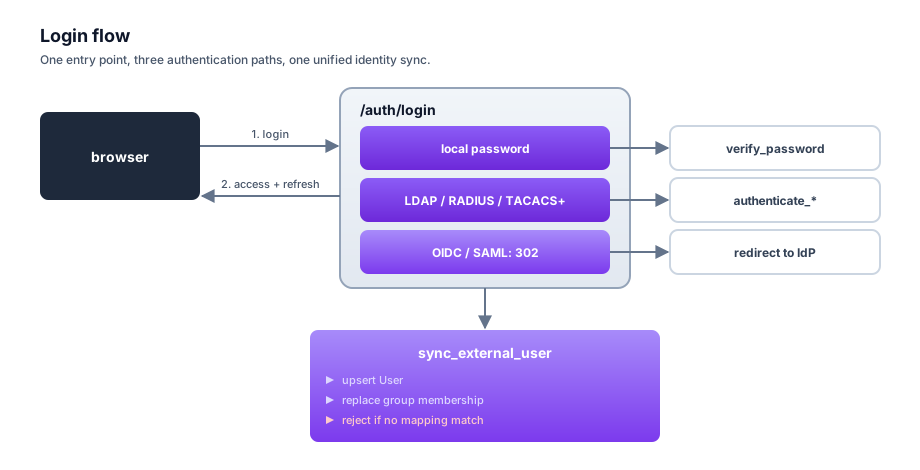
Local auth
POST /auth/loginaccepts JSON{username, password}. Returns{access_token, refresh_token, force_password_change}.- Passwords are
bcrypthashed. New users defaultforce_password_change=Trueso the UI redirects them to/change-passwordbefore they can do anything else. - Access token expires in 15 min. Refresh token expires in 7 days
(
refresh_token_expire_daysdefault) and rotates on every use. admin/adminis seeded on first start withforce_password_change=True. Reset the password from the CLI with the one-liner in the README.
TOTP MFA (issue #69)
Local-user 2FA stacks on top of the password flow. As of #408, TOTP enrolment is also open to external-identity users (LDAP / OIDC / SAML / RADIUS / TACACS+) — not for login (they still authenticate at their provider), but so an SSO superadmin can re-confirm sensitive reveals (appliance kubeconfig, pairing codes, agent bootstrap keys, SNMP community) with a TOTP code, since those reveals demand a credential the session alone doesn’t prove and an SSO account has no local password.
- Enrolment: Settings → Security → “Enable MFA” generates a fresh
TOTP secret stored Fernet-encrypted in the
User.totp_secret_encryptedcolumn (recovery codes inrecovery_codes_encrypted,totp_enabledflag flips true only after the first valid code). The backend emits theotpauth://provisioning URI viapyotp.TOTP(secret).provisioning_uri(...); the frontend renders the QR code client-side from that URI. The operator scans with Authenticator / Authy / 1Password / Bitwarden, enters a 6-digit code to confirm enrolment, and the next page shows 10 single-use backup codes (persisted hashed). Backup codes are only shown once. - Login flow: when MFA is enabled, the
POST /auth/loginresponse carries a short-lived pre-token instead of the full access token. The UI prompts for either a 6-digit TOTP code or a backup code and exchanges the pre-token viaPOST /auth/login/mfafor the real{access_token, refresh_token}pair. Backup codes are invalidated on use. - Disable: a user clears their own MFA via
POST /auth/mfa/disable(local users supply their password AND a current TOTP code; password-less external-auth users supply just the current TOTP code). The action lands in the audit log (action="mfa.disabled") and the user can re-enrol from scratch. - Re-confirming sensitive reveals (#408): the secret-reveal
endpoints (agent keys / SNMP community / appliance kubeconfig / pairing
codes) re-verify the operator right before handing back the cleartext,
via the shared
app.services.reauth.reverify_operatorhelper. A local user proves their password; a password-less external-auth user proves a current TOTP code (so they must enrol MFA first, hence the open enrolment above). TOTP is deliberately not accepted in lieu of a local user’s password — that would downgrade the password step-up, since MFA enrolment needs only a session and a hijacked session could otherwise self-enrol and reveal. Disable / regenerate-recovery-codes follow the same shape (password for local, TOTP-only for SSO).
External identity providers
All providers are configured at runtime from /admin/auth-providers. The
AuthProvider row carries:
| Column | Type | Notes |
|---|---|---|
id |
UUID | |
name |
str | Display name shown on the login page. |
type |
str | "ldap", "oidc", "saml", "radius", or "tacacs". |
is_enabled |
bool | Disabled providers are skipped at login. |
priority |
int | Lower = tried first (password-flow fallthrough). |
auto_create_users |
bool | Create missing users at first login. |
auto_update_users |
bool | Update email / display name on every login. |
config |
jsonb | Public config (see per-provider fields below). |
secrets_encrypted |
bytes | Fernet-encrypted secrets dict. |
Secrets at rest. Everything in secrets_encrypted is wrapped with
Fernet. The encryption key is derived from settings.credential_encryption_key
(explicit) or SHA-256(secret_key) (fallback), so a fresh deploy that only
sets SECRET_KEY still works. See backend/app/core/crypto.py.
Group mappings. Each provider owns a list of AuthGroupMapping rows
(external_group → internal_group_id). The unified sync in
backend/app/core/auth/user_sync.py resolves the user’s provider-reported
groups case-insensitively and rejects the login if no mapping matches.
LDAP
Driver: backend/app/core/auth/ldap.py (ldap3).
Flow per login:
- Bind as the service account (
config.bind_dn+secrets.bind_password). - Search under
config.user_base_dnusingconfig.user_filter(must contain the{username}placeholder). - Bind as the returned DN + the user’s password to verify credentials.
- Extract groups from the
memberOfattribute (orconfig.attr_member_of).
Key config fields:
| Field | Default | Notes |
|---|---|---|
host |
— | FQDN or IP of the primary directory. |
port |
636 (SSL) / 389 | |
backup_hosts |
[] |
List of "host" or "host:port" entries. Bracketed IPv6 ([::1]:389) allowed. |
use_ssl |
true |
ldaps:// on port 636. |
start_tls |
false |
Upgrade a plain connection after bind. |
bind_dn |
— | Service account DN. |
user_base_dn |
— | Search base for user lookups. |
user_filter |
(&(objectClass=user)(sAMAccountName={username})) |
Must contain {username}. |
attr_username / attr_email / attr_display_name |
sAMAccountName / mail / displayName |
|
attr_member_of |
memberOf |
|
tls_ca_cert_file |
— | Container path to a custom CA. |
OIDC
Driver: backend/app/core/auth/oidc.py (authlib).
Flow:
- Login page calls
GET /auth/{provider_id}/authorize— 302 redirects to the IdP’s authorization endpoint with a signed-JWT state+nonce cookie (oidc_flow). - IdP redirects back to
/auth/{provider_id}/callbackwith an authorization code. - Backend validates the state+nonce cookie, exchanges the code, validates
the ID token via
authlib.jose(discovery + JWKS cached), and redirects to/auth/callback#token=…&refresh=…on the frontend. - Frontend’s
LoginCallbackPageconsumes tokens from the URL hash and routes into the app.
Key config fields:
| Field | Notes |
|---|---|
discovery_url |
e.g. https://accounts.google.com/.well-known/openid-configuration |
client_id |
From the IdP. |
scopes |
Array. Defaults to ["openid", "profile", "email"]. |
claim_username / claim_email / claim_display_name / claim_groups |
Claim names to pull from the ID token. |
Secrets: client_secret.
SAML
Driver: backend/app/core/auth/saml.py (python3-saml).
Flow:
- Login page calls
GET /auth/{provider_id}/authorize— builds an HTTP-RedirectAuthnRequestand 302s to the IdP’s SSO URL. - IdP POSTs the
SAMLResponseback to/auth/{provider_id}/callback(ACS endpoint). - Backend consumes the assertion and redirects to
/auth/callback#token=…. GET /auth/{provider_id}/metadatareturns SP metadata XML so admins can register SpatiumDDI at the IdP.
Key config fields:
| Field | Notes |
|---|---|
idp_metadata_url |
Optional — backend can pull IdP details automatically. |
idp_entity_id / idp_sso_url / idp_slo_url |
Set these when you don’t provide a metadata URL. |
idp_x509_cert |
Base64 or PEM — used to verify the assertion. |
sp_entity_id |
Defaults to the app URL. |
attr_username / attr_email / attr_display_name / attr_groups |
SAML attribute names. |
Secrets: sp_private_key (PEM, optional — only needed for signed requests).
SAML needs HTTPS with any hosted IdP. Step 2 above is a cross-site
POST: the browser is on the IdP’s origin and submits the assertion to
SpatiumDDI. The short-lived saml_flow cookie set in step 1 — which
binds the assertion to the browser that started the flow — only rides
that POST when it is marked SameSite=None, and browsers honour
SameSite=None only when the cookie is also Secure. A Lax cookie is
withheld from every cross-site POST, which is what made all logins
against a hosted IdP fail with error=saml_state_missing
(#873). Note the
contrast with OIDC, whose flow cookie is legitimately SameSite=Lax:
the OIDC provider returns the browser with a cross-site GET
redirect, which Lax permits.
The cookie policy is therefore picked per deployment, from the external URL’s scheme:
| External URL | Flow cookie | Works with |
|---|---|---|
https://… |
SameSite=None; Secure |
any IdP |
http://… |
SameSite=Lax |
only an IdP sharing SpatiumDDI’s registrable domain (its POST is same-site) |
SameSite=None cannot be used over plain HTTP at all — the browser
drops such a cookie at set time — so HTTP keeps Lax rather than
losing the same-site case too. When that Lax cookie does not come back,
the ACS reports /login?error=saml_requires_https instead of
saml_state_missing, because on an HTTP deployment a missing cookie is
the signature of a cross-site IdP and the fix is TLS, not a retry.
The URL whose scheme decides all this is the admin-set External URL
(Settings → General, platform_settings.app_base_url) when configured,
otherwise the incoming request URL — the same value the SP metadata
advertises as the ACS, i.e. the origin the IdP actually posts to.
Behind a TLS-terminating proxy, set the External URL to the public
https:// address. Relying on X-Forwarded-Proto alone is not enough
with the shipped Docker Compose stack: the frontend container’s nginx
listens on :80 and hard-sets X-Forwarded-Proto $scheme, so it
overwrites the https an outer terminator sent (the TLS recipes in
DOCKER.md §5 Options A and B both put the
terminator in front of that container). The request then looks like
plain HTTP to the API, and the SP metadata would advertise an http://
ACS URL anyway. The forwarded header does carry the real scheme where
nginx itself terminates TLS: DOCKER.md Option C, and the Helm chart’s
TLS-enabled frontend.
RADIUS
Driver: backend/app/core/auth/radius.py (pyrad).
Flow: one UDP round-trip per login. The driver sends Access-Request with
User-Name + User-Password (pyrad encrypts). Access-Accept with group
info lifted from the reply attribute (Filter-Id by default) is a success;
Access-Reject is bad credentials; timeout / MAC mismatch raises
RADIUSServiceError so the caller can fall through to the next provider.
Key config fields:
| Field | Default | Notes |
|---|---|---|
server |
— | Primary RADIUS host. |
port |
1812 |
Auth port. |
backup_servers |
[] |
List of "host" or "host:port" entries. |
timeout |
5 |
Seconds per attempt. |
retries |
3 |
Per server, before failing over. |
nas_identifier |
"spatiumddi" |
Stamped into every Access-Request. |
attr_groups |
"Filter-Id" |
Attribute that carries group info. |
dictionary_path |
— | Optional extra RADIUS dictionary file path. |
Secrets: secret (shared secret — bytes).
TACACS+
Driver: backend/app/core/auth/tacacs.py (tacacs_plus).
Flow:
client.authenticate(username, password)over TCP;valid=Trueis a success.client.authorize(username)round-trip pulls AV pairs.priv-lvlnumeric values are surfaced aspriv-lvl:Nso admins can map e.g.priv-lvl:15→Adminsin the group-mapping UI.
Key config fields:
| Field | Default | Notes |
|---|---|---|
server |
— | Primary TACACS+ host. |
port |
49 |
|
backup_servers |
[] |
List of "host" or "host:port" entries. |
timeout |
5 |
Seconds. |
attr_groups |
"priv-lvl" |
AV pair used for group mapping. |
Secrets: secret.
Backup server failover (LDAP / RADIUS / TACACS+)
Each password provider accepts an optional list of backup hosts via
config.backup_hosts (LDAP) or config.backup_servers (RADIUS / TACACS+).
Entries are strings of the form "host" or "host:port"; bracketed IPv6
literals ([::1]:389) are supported. The admin UI exposes a “Backup hosts /
servers” textarea (one entry per line).
LDAP failover uses ldap3.ServerPool(pool_strategy=FIRST, active=True,
exhaust=True):
active=True— the pool checks reachability before issuing operations.exhaust=True— once a host fails it is removed for the lifetime of the pool, so subsequent binds in the same Connection don’t keep retrying a dead host.
RADIUS + TACACS+ failover iterates primary → backups manually:
- A definitive auth answer (Access-Accept / Access-Reject,
valid=True/valid=False) stops iteration. The first server that gives you an answer wins — failing over on a rejection is wrong. - Network / timeout / protocol errors (pyrad’s
MAC mismatchon a bad shared secret,socket.timeout,ConnectionError, etc.) fail over to the next target. - All backups share the primary’s shared secret,
nas_identifier,timeout, and dictionary.
Test-connection probe
Every provider type exposes a probe under backend/app/core/auth/ that
returns {ok, message, details} without raising — test_connection for
LDAP / RADIUS / TACACS+, probe_discovery for OIDC, and probe_metadata
for SAML. The admin UI’s “Test” button hits
POST /api/v1/auth-providers/{id}/test to run the
probe. For LDAP + OIDC + SAML the probe does a real service bind /
discovery fetch / metadata fetch; for RADIUS + TACACS+ it sends a stub
Access-Request — a Reject for the bogus credentials still proves the
server is reachable and the shared secret is correct (the MAC would not
validate otherwise).
Provider priority
When a password-grant login arrives at /auth/login:
- Local credentials are tried first. If the
Userexists and has a hashed password, that wins (or loses) on its own. - Otherwise the handler iterates every enabled provider whose type is in
PASSWORD_PROVIDER_TYPES = ("ldap", "radius", "tacacs")in(priority, name)order. Eachauthenticate_*()call runs in a worker thread (asyncio.to_thread) with a 20 s timeout. - The first definitive answer wins. Service errors (unreachable / misconfigured) are logged and fall through to the next provider.
- If nothing accepted, a single
401+ aloginaudit row are emitted.
OIDC and SAML are redirect flows — they are never tried at /auth/login.
The login page lists every enabled OIDC/SAML provider as a “Sign in with
…” button that kicks off the redirect flow directly.
Permission enforcement
See PERMISSIONS.md for the full grammar + built-in roles. In short:
- Every router has a
Depends(require_resource_permission(<type>))dependency that maps HTTP method → action (GET=read,POST/PUT/PATCH=write,DELETE=delete). - Handlers doing resource-scoped checks also call
user_has_permission(user, action, resource_type, resource_id)before mutating. Superadminshort-circuits every check without writing a denial audit row.Inactiveusers are refused regardless of permissions.
Audit
Every login attempt — success, failure, LDAP service error — writes an
AuditLog row with action="login", result="success"|"failure", the
auth source (local, ldap, oidc, saml, radius, tacacs), source
IP, user agent, and for failures a new_value.reason string. Failed
logins for unknown usernames still get a row (user_id=NULL,
user_display_name=<attempted name>) so brute-force attempts are visible
in the audit viewer.
API tokens
Long-lived bearer credentials for scripts, CI pipelines, and
automation. As of issue #74, tokens carry an explicit scopes set
that narrows the owning user’s permissions — a token can do at
most what its scope set allows AND what the owning user has
permission for. Tokens are indistinguishable from JWTs on the wire
(both use Authorization: Bearer …); the auth middleware peeks at
the prefix to pick the validation path.
Scopes (issue #74). APIToken.scopes is a JSONB list drawn from
a closed coarse-grained vocabulary (backend/app/services/api_token_scopes.py),
checked against TOKEN_SCOPE_VOCABULARY at create time so a typo is
rejected with 422 rather than silently locking the operator out:
read— restricts the token to safe-method requests (GET/HEAD/OPTIONS); any mutation401s.ipam:write— allows mutations under/api/v1/ipam/*,/vlans*,/vrfs*,/network-devices*.dns:write— allows mutations under/api/v1/dns/*,/dns-pools*.dhcp:write— allows mutations under/api/v1/dhcp/*.agent— allows only the agent push surface (/api/v1/dns/agents/*,/api/v1/dhcp/agents/*).
Multiple scopes compose by union (any single match passes). An empty scope set means no scope restriction at all (the token still inherits the owning user’s RBAC, which is the only gate) — equivalent to the pre-#74 behaviour. New tokens pick scopes via a chip selector in the create modal.
Scope enforcement runs before RBAC: a non-empty scope set narrows the
token, and the owning user’s RBAC still applies on top, so a read-scoped
token owned by an IPAM Editor can list subnets but cannot create one. A
per-token resource-instance binding (resource_grants, #374) can narrow
further to specific {action, resource_type, resource_id} grants, validated
at create time to be a subset of what the issuing user holds.
Wire format. Raw tokens start with sddi_ followed by 40 bytes of
url-safe base64 entropy (secrets.token_urlsafe(40)). Operators typically see only the first
10 characters (sddi_AbCdE) in the UI as an identifier — this is
the APIToken.prefix column, sufficient to pick a token out of a
list without leaking entropy to an observer.
At rest. Only the SHA-256 hash is stored (APIToken.token_hash).
The raw value is returned exactly once from POST /api/v1/api-tokens
and never again — losing it means creating a new token.
Device enrolment QR code (issue #906)
The only way to get a token onto a phone used to be typing or pasting it between devices. That is the worst step in the mobile sign-in flow, and worse than merely annoying: an operator who cannot paste cleanly emails the token to themselves or reads it aloud, and the credential ends up somewhere it should never have been.
The reveal-token modal therefore offers a QR code in two shapes:
| Shape | Payload |
|---|---|
| Token only | the bare token string — no format needed |
| Server + token | spatiumddi://enrol?host=…&port=…&scheme=…&token=…&fingerprint=… |
The enrolment URI is a contract with the mobile client
(spatiumddi-mobile),
which already parses both shapes. port is omitted when it is the
scheme default, and scheme only appears when it is http — being
explicit about the insecure case is the right way round, since a code
that silently downgrades is the failure worth preventing. IPv6 hosts
are bracketed so the client cannot reparse them as host:port. The
builder lives in frontend/src/lib/enrolment.ts.
The connection comes from the browser, not the server. Behind a
reverse proxy, split DNS or NAT the control plane does not know its own
externally-reachable address, and would guess wrong on exactly the
deployments this is most useful for. The UI starts from
window.location and lets the operator correct it — a laptop on a VPN
and a handset on wifi routinely disagree about how to reach one server.
Why the fingerprint is the interesting part. A self-hosted control plane usually presents a certificate from a private CA or the appliance’s own root, so the client has to ask the operator to confirm it rather than blanket-trusting an unknown certificate. Comparing 64 hex characters by eye on a phone is precisely the check people skim. Putting the fingerprint in a code the operator scans from inside an authenticated session makes that comparison machine-checked — the weakest step in the trust flow becomes the strongest, for one query parameter.
GET /api/v1/api-tokens/enrolment-context supplies it, gated on
authentication only (matching token creation — a TLS fingerprint is not
a secret; it is what the server hands every client that connects).
It answers only when SpatiumDDI actually owns the TLS termination,
i.e. there is an active ApplianceCertificate — the row deployed to
the TLS secret the frontend serves. On a Compose or plain-Kubernetes
install an external proxy terminates TLS with a certificate this
process has never seen, and the honest answer is null with a reason,
not a guess: a fingerprint that disagrees with the wire would make the
client report a mismatch on a correct setup, training operators to
click through the one warning this exists to make meaningful. The UI
also lets the operator untick certificate pinning for the case where
something in front of SpatiumDDI re-terminates TLS.
Exposure. The QR is hidden behind an explicit reveal, like the token text beside it, and is not rendered into the DOM until then. That is not decoration: a QR makes the credential camera-readable, so it is strictly easier to capture over a shoulder — or from a screen-share — than the masked string. The code carries no exposure the displayed token does not, but it is easier to capture at a distance.
Short-lived enrolment codes would be better still: if minting ever moves to a device-token grant, the QR could carry a single-use code and the token would never leave the server. The URI format above does not preclude that.
Validation path. app/api/deps.py:get_current_user checks for the
sddi_ prefix first; if present it hashes the bearer, looks the row
up by hash, enforces is_active and expires_at, then loads the
owning user and bumps last_used_at. JWTs take the original path. A
missing / wrong / revoked token returns the same generic 401 as an
invalid JWT to avoid confirming token existence to an attacker.
Lifecycle.
- Create via the Admin → API Tokens UI or
POST /api/v1/api-tokens(JSON:{name, description?, expires_in_days?}). The create response contains the rawtokenfield once — the UI forces a “copy now” dialog before it disappears. - List via
GET /api/v1/api-tokens(your tokens only; superadmins see everyone’s). - Revoke softly via
PATCH /api/v1/api-tokens/{id}with{is_active: false}— the row stays solast_used_atis still visible for incident forensics. - Delete hard via
DELETE /api/v1/api-tokens/{id}— same outward behaviour (401 on next use), audit row written on both paths.
TTL. The UI defaults to 90 days and flags “Never” in amber so
operators have to opt into long-lived bearers. The backend accepts
both expires_in_days (UX-friendly) and expires_at (ISO timestamp,
for automation). Expired tokens 401 with a distinct detail message
so clients can detect “refresh me” vs “reconfigure me”.
Open items
- SCIM provisioning — not planned for Phase 1.
- Per-provider signing key rotation — manual today; automate in a later wave.
- Global-scope / service-account tokens — the
APIToken.scopecolumn supportsglobal, but validation rejects them today pending a proper service-account user model. Token-onlyallowed_pathsand per-token permission overrides exist on the model but aren’t exposed on create yet.
Rules & constraints
Server-side validations that reject requests with a human-readable
error. Clients should surface the response detail to the operator
rather than swallowing the failure. Permission-related rejections
(403 forbidden) are covered separately in docs/PERMISSIONS.md.
Login & session
- Invalid credentials. Local password verification failure returns
401. Enforced atbackend/app/api/v1/auth/router.py. - Account disabled. Login is refused with
403whenuser.is_activeis false — regardless of auth source.backend/app/api/v1/auth/router.py. - Empty external ID from IdP. External login (LDAP / OIDC / SAML /
RADIUS / TACACS+) with no stable external identifier in the IdP
response is rejected — we won’t create a
Userrow we can’t correlate later.backend/app/core/auth/user_sync.py. - No group-mapping match. An external user whose IdP group claim
doesn’t match any
AuthGroupMappingrow for that provider is rejected with401, even if the IdP authenticated them. This is deliberately strict — there is no implicit “default group” fallback.backend/app/core/auth/user_sync.py. - Auto-create disabled. First external login for a new subject is
refused with
401ifprovider.auto_create_users=False. An administrator must create theUserrow manually.backend/app/core/auth/user_sync.py. - Username collision across auth sources. An external user whose
external_idis new but whose preferred username already belongs to a user on a differentauth_sourceis rejected to prevent silently hijacking an existing account.backend/app/core/auth/user_sync.py. - Refresh token invalid or expired. Refresh is rejected with
401when the token is not in the sessions table, has been revoked, or has passedexpires_at.backend/app/api/v1/auth/router.py. - User deactivated mid-session. A refresh request from a disabled
user returns
401even if the refresh token itself is still valid — deactivating a user revokes their session on the next refresh.backend/app/api/v1/auth/router.py.
Password management
-
One length authority, and it is the configured policy. The Pydantic-validator baseline rejects only an empty password (
422), so a legacy client still fails before reaching the handler; every length verdict comes from the configurable policy (length / character classes / history / age, issue #70), which runs server-side againstPlatformSettingsand returns400with a per-rule error list.backend/app/api/v1/auth/router.py,backend/app/services/password_policy.py.That baseline used to be 8 characters (#1004) — a second minimum, unconfigurable, contradicting the default policy’s 12 and making a relaxed 6-character policy unreachable through the API while the UI offered it. It also fired as a Pydantic
422, whosedetailis an error array rather than the{reason, errors}object the policy path returns, and the change-password screen parsed neither shape: a 7-character password was reported to the operator as “check your current password”. Any newfield_validatoron these request models emits that same array shape, so the frontend parses it (frontend/src/lib/password-policy.ts). - The browser evaluates the policy too, and gates on what it
evaluated.
GET /auth/password-policyis unauthenticated so the login and change-password forms can render the rule list before a token exists; the Change Password screen disables submit while any evaluated rule fails, sparing a round trip whose outcome it can already predict. The server stays authoritative — this never permits anything. Password history is excluded from the gate and rendered as a note, because the browser cannot check it; giving it the same green tick as the checkable rules made a failing password read as nearly complete.frontend/src/lib/password-policy.ts. - Current password required. Change-password endpoints verify
current_passwordbefore accepting the new value; a mismatch returns400rather than silently succeeding.backend/app/api/v1/auth/router.py.
Auth providers
- Duplicate provider name. Two
AuthProviderrows with the samenameare rejected with409, regardless of type.backend/app/api/v1/auth_providers/router.py. - Invalid provider type.
typemust be one of the values inPROVIDER_TYPES(ldap,oidc,saml,radius,tacacs).backend/app/api/v1/auth_providers/router.py. - Group mapping target must exist.
AuthGroupMappingrows rejectinternal_group_idvalues that don’t resolve to an existingGroup.backend/app/api/v1/auth_providers/router.py.