System Architecture
System topology, component relationships, and the HA design. Start here to understand how the control plane, the managed service containers, and the agents fit together before reading the per-feature or per-deployment specs.
Related:
deployment/TOPOLOGIES.md(six reference production layouts),deployment/DNS_AGENT.md(the agent container contract in full),deployment/DOCKER.md,deployment/APPLIANCE.md, andOBSERVABILITY.md. The repo-wide conventions and non-negotiables live in../CLAUDE.md.
1. The Big Picture
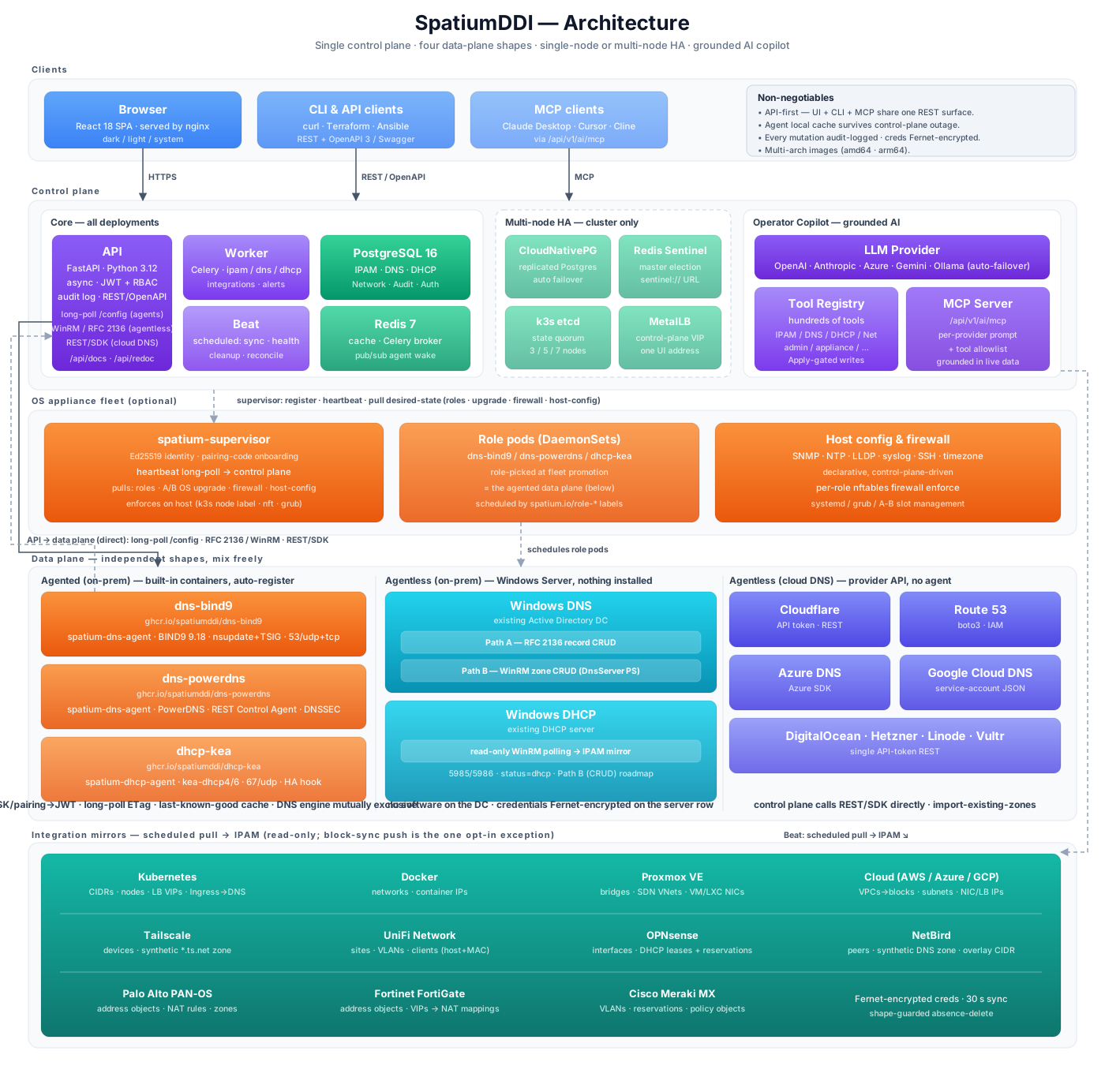
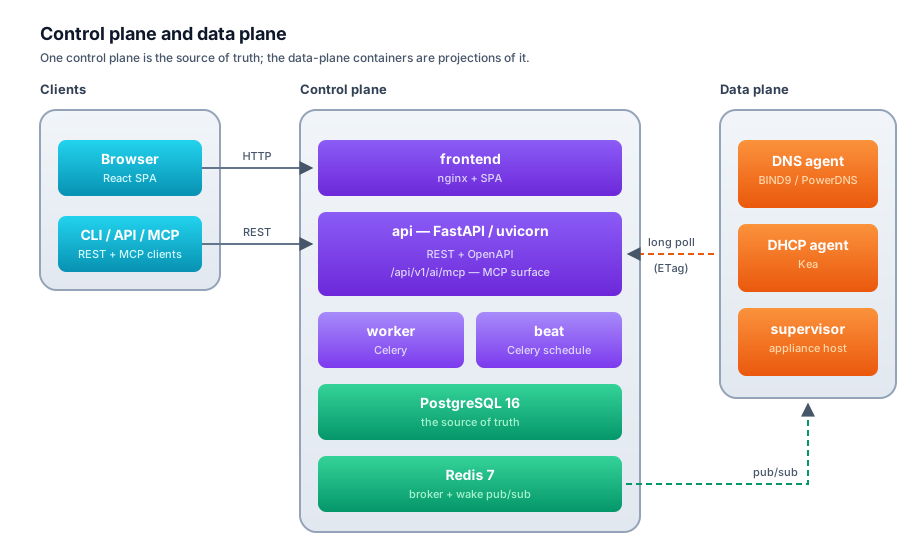
SpatiumDDI is an all-in-one DDI platform built around one control plane that is the single source of truth, plus a set of data-plane service containers (DNS and DHCP daemons) that the control plane deploys, configures, and runs.
Three properties define the design and are enforced everywhere
(see ../CLAUDE.md “Absolute Non-Negotiables”):
- API-first — every UI action is a REST call. The browser SPA, CLI
tooling, and the MCP surface for the Operator Copilot all share the
same
/api/v1surface; the API validates authorization independently of the UI. - Source-of-truth control plane — PostgreSQL holds the desired state; the service containers are projections of it. SpatiumDDI does not merely point at external DDI servers — it renders their config and runs them.
- Agents survive control-plane outage — every DNS/DHCP agent caches its last-known-good config on local disk and keeps serving if the control plane is unreachable.
2. Control Plane
The control plane is five long-lived processes plus two datastores. In
Docker Compose they are the frontend, api, worker, beat,
migrate, postgres, and redis services
(docker-compose.yml); in Kubernetes they map to the corresponding
manifests under ../k8s/base/ and the umbrella chart
../charts/spatiumddi/.
api — FastAPI + uvicorn
The HTTP brain. Async throughout (no synchronous DB or network calls in request handlers). It owns:
- The REST API at
/api/v1/*(route handlers underbackend/app/api/v1/), with OpenAPI docs at/api/docsand/api/redoc. - JWT auth + group-scoped RBAC (
{action, resource_type,
resource_id?}
— seePERMISSIONS.md). - The agent-facing long-poll endpoints (
GET /dns/agents/config,GET /dhcp/agents/config) and registration/heartbeat endpoints. - The MCP JSON-RPC endpoint for the Operator Copilot at
/api/v1/ai/mcp(backend/app/api/v1/ai/mcp.py), exposing hundreds offind_*/count_*read tools plus apply-gatedpropose_*writes.
Every mutation writes an append-only AuditLog row
(backend/app/models/audit.py) into the same transaction as the change
before the response is returned — routers build the row and add it to
the session next to the mutated entity (e.g. _audit(...) in
backend/app/api/v1/ipam/router.py), so an audit gap and a rolled-back
write are the same event.
worker — Celery
Background execution for everything that must not block a request:
IPAM↔DNS sync, DNS/DHCP health checks, lease sweeps, integration
reconcilers, alert evaluation, blocklist feed refresh, the Operator
Copilot digest, and more (backend/app/tasks/). All tasks are written
to be idempotent and safe to retry.
beat — Celery schedule
The scheduler that enqueues periodic tasks (the schedule lives in
backend/app/celery_app.py). Beat runs as a singleton — exactly
one replica, Recreate rollout strategy — because two beats would
double-enqueue. The deliberate decision not to add leader election is
documented inline in
../charts/spatiumddi/templates/beat.yaml:
beat only enqueues, every task is itself idempotent, and the broker
(Redis) is already HA, so a Redis-backed beat lock would add a
node-drain-blocking workload for no correctness gain.
frontend — nginx + React SPA
React 18 + TypeScript (Vite, shadcn-style primitives, Tailwind, React
Query) built to static assets and served by nginx, which also reverse-
proxies the API. The host-published port defaults to 8077
(HTTP_PORT); see deployment/DOCKER.md for
the full port reference and TLS setup.
migrate — one-shot Alembic job
alembic upgrade head runs as a short-lived job/container before the
api becomes ready (../k8s/base/migrate-job.yaml).
On a fresh multi-node install the api deliberately stays out of the
Service endpoint set until the schema matches the head its image
expects: /health/ready reads the bundled Alembic head once and
compares it against SELECT version_num FROM alembic_version
(backend/app/api/health.py), returning distinct detail strings for
“schema not initialised”, “alembic_version row missing”, and “schema
behind / image expects Y” so cold-boot vs connectivity failures are
never ambiguous.
PostgreSQL 16 — the source of truth
Holds IPAM (spaces / blocks / subnets / addresses), DNS (zones / records / views / groups), DHCP (servers / scopes / pools / leases), network modeling, auth/RBAC, the audit log, and platform settings. The service containers never hold authoritative state of their own; they render from what the control plane assembles.
Redis 7 — broker, cache, and wake bus
Three jobs: the Celery broker/result backend, a general cache / sessions store, and the agent-wake pub/sub bus (see §4). Treat both Postgres and Redis as internal-only — never expose them to the host or network.
The non-negotiable stack pins Redis 7; the shipped Compose file currently runs a newer
redis:*-alpinetag. Either way the app connects viasettings.redis_url(andsentinel://URLs in HA).
3. Data Plane — Managed Service Containers
The data plane is the DNS and DHCP daemons SpatiumDDI deploys and runs.
Each daemon ships with a thin agent sidecar that registers with the
control plane, pulls config, and applies it. Available service images
(see docker-compose.yml profiles and ghcr.io/spatiumddi/*):
| Image | Daemon | Driver |
|---|---|---|
dns-bind9 |
BIND9 | bind9 |
dns-powerdns |
PowerDNS (+ optional dns-dnsdist) |
powerdns |
dns-technitium |
Technitium DNS Server | technitium |
dhcp-kea |
Kea DHCPv4/DHCPv6 | kea |
The DNS agent lives in ../agent/dns/spatium_dns_agent/,
the DHCP agent in ../agent/dhcp/spatium_dhcp_agent/.
Both are multi-arch (linux/amd64 + linux/arm64).
Driver abstraction
Backend-specific logic never leaks into the service layer.
backend/app/drivers/{dns,dhcp}/base.py defines an ABC plus neutral
dataclasses (ConfigBundle, ZoneData, ServerOptions, scope/pool
shapes, etc.). Concrete drivers (bind9.py, powerdns.py,
technitium.py, kea.py)
render backend-specific config from those dataclasses; the services
layer only ever speaks to the ABC. There are also agentless
drivers — Windows DNS/DHCP over WinRM, cloud DNS (Cloudflare / Route 53
/ Azure DNS / Google Cloud DNS) over the provider SDK — which the api
drives directly with no agent on the far side. See
drivers/DNS_DRIVERS.md and
drivers/DHCP_DRIVERS.md.
The supervisor (OS appliance only)
On the OS appliance, a per-host spatium-supervisor
(../agent/supervisor/spatium_supervisor/)
owns all appliance-host concerns the service containers used to carry:
slot telemetry + slot-upgrade/reboot triggers, SNMP / chrony / firewall
/ timezone reload triggers, deployment-kind detection, and role
assignment. The DNS/DHCP service containers keep only their own
service-level concerns (register, config long-poll, lease events,
metrics). See the “Post-#170 architecture” section of
deployment/DNS_AGENT.md for the split.
4. Config Delivery — ConfigBundle + ETag Long-Poll + Redis Wake
This is the core control-plane → data-plane mechanism. Three layers stack on top of each other.
ConfigBundle + ETag
The control plane assembles a neutral ConfigBundle from DB state and
hashes its contents to a stable SHA-256 ETag
(backend/app/services/dns/config_bundle.py,
backend/app/services/dhcp/config_bundle.py;
ConfigBundle.compute_etag() in backend/app/drivers/{dns,dhcp}/base.py).
The hash deliberately excludes the etag field and the generated_at
timestamp, so two runs over identical state produce the same ETag.
When you add a field that affects rendered config, make sure it flows into the bundle so the ETag shifts — otherwise agents will never see the change. (The DHCP path additionally wraps its driver-dataclass etag with a fleet-upgrade marker so a Fleet command wakes the poll even when the rendered bundle is byte-identical —
backend/app/api/v1/dhcp/agents.py.)
ETag long-poll
The agent holds an HTTP long-poll open on /config, passing its
last-seen ETag as If-None-Match. The api handler rebuilds the bundle,
compares the new ETag against the agent’s, and:
- returns the new bundle immediately if the ETag changed (or there
are pending per-record ops), persisting the new
last_config_etag; - returns
304 Not Modifiedwhen the deadline elapses with no change.
See the loop in backend/app/api/v1/dns/agents.py
(agent_config_longpoll). The ETag compare is the sole source of
truth for whether the agent reloads.
Wire form of the ETag (#862). The internal value is a bare
sha256:<hex>— that is what the DB columns, the bundle body’s ownetagfield,structural_etagand the agents’ on-disk cache all hold. On the wire it is emitted as a weak, quoted entity-tag,W/"sha256:<hex>", viaformat_etaginbackend/app/core/http_etag.py. Two reasons, and both are load-bearing: an unquoted tag is malformed per RFC 9110 §8.8.3, and a strong tag is deleted outright by nginx’s gzip filter — which cannot honestly assert byte-identity for a body it just compressed. Both the appliance and compose nginx gzipapplication/json, so before this the header simply vanished for any client sendingAccept-Encoding: gzip. A weak tag is also the semantically correct one: gzipped and identity are different representations of the same payload, which is exactly whatW/means.Incoming
If-None-Matchis compared withetag_matches, which accepts the weak, strong-quoted and legacy-bare spellings plus*and comma-separated lists. That tolerance is what stops the whole fleet re-downloading a bundle on the first poll after an upgrade. Compare withetag_matches, never with==— a raw compare re-breaks the conditional poll for every client that normalises the header.
Redis wake (#358)
The long-poll no longer blind-polls the DB on a fixed tick. It waits on
a Redis pub/sub channel for that agent’s group/server
(backend/app/core/agent_wake.py); config-mutating handlers publish to
that channel after commit, collapsing change latency to well under
a second. The DNS-record path publishes through the enqueue_record_op
chokepoint via the request-scoped collect_wake collector that the
wake_publishing router dependency flushes after the handler’s commit;
DHCP/structural handlers call collect_wake directly; Celery workers
call publish_wake over settings.redis_url.
The wake is purely advisory and never the sole delivery path (non-negotiable #5):
publish_wakeis fire-and-forget — any Redis error is swallowed and logged, never propagated into the mutating request.- The subscription degrades to a plain sleep on any Redis error, so a
Redis-down deployment behaves byte-for-byte like the old fixed-tick
poll (
LONGPOLL_POLL_INTERVAL_FALLBACK = 2 s). - A genuinely missed publisher is still caught by the belt-and-braces
WAKE_TICK_SECONDS(12 s) safety tick — worst case is ≤12 s convergence, never staleness.
The same bus also wakes the supervisor heartbeat long-poll on a
per-appliance channel (appliance_channel(id)) when a desired-state
column (fleet upgrade / reboot / role assignment / host config)
changes, so commands start in ~0 s instead of waiting a heartbeat
interval (backend/app/api/v1/appliance/supervisor.py). The fleet-scale
broker escalation beyond Redis is deferred — see
OBSERVABILITY.md.
5. Agent Bootstrap, Reconnection, and Local Cache
Bootstrap
A standalone agent joins with a pre-shared key (DNS_AGENT_KEY /
SPATIUM_AGENT_KEY), exchanges it for a rotating JWT, and caches the
JWT on disk (bootstrap.py / cache.py in each agent). The agent ID
and token live under the agent state dir alongside the config cache.
Reconnection
On 401 or 404 the agent drops its cached token and re-bootstraps
from the PSK. 401 covers an expired/invalid token; 404 covers a stale
server row after a control-plane reset. Both the sync loop and the
heartbeat loop implement this same recovery path
(agent/dns/spatium_dns_agent/sync.py,
agent/dns/spatium_dns_agent/heartbeat.py; the DHCP agent mirrors it).
On the OS appliance the PSK is delivered automatically: the supervisor writes the per-role agent key into
role-compose.env, which the service container interpolates on first boot — the operator never pastes a key. Standalone Docker/K8s agents paste the PSK directly (the/pairexchange was removed from the agents in #246).
Local config cache (non-negotiable #5)
Each agent persists its last-known-good bundle on disk
(/var/lib/spatium-dns-agent/, /var/lib/spatium-dhcp-agent/;
config/current.json + current.etag + a previous.json rollback
copy — see the cache.py header). On startup the agent loads the
cached bundle and renders + applies it before contacting the
control plane, so a pod that restarts while the control plane is down
comes up warm and keeps serving. After every successful sync the cache
is atomically re-written. In Kubernetes/appliance multi-node, this
cache lives on per-node hostPath so a node keeps serving DNS/DHCP
through a control-plane outage (#292).
Incremental DNS updates (non-negotiable #8)
DNS record changes are applied incrementally — RFC 2136 nsupdate over
TSIG (BIND9) or the driver API (PowerDNS / Technitium / cloud) — never a
full server restart. Per-record ops are queued as DNSRecordOp rows fanned out to
every agent-based server in the group and shipped on the config
long-poll. See drivers/DNS_DRIVERS.md.
6. High Availability
HA scales independently at three tiers (see
deployment/TOPOLOGIES.md for the full
sizing matrix and the “you have X → start with topology Y” picker).
Data plane
DNS and DHCP are made HA by running multiple agents per group.
Every DNS agent renders its group’s zones as an independent
authoritative copy, so adding a second BIND9 / PowerDNS / Technitium
agent to a group gives you a redundant authoritative server with no
extra coordination.
For DHCP, two or more Kea members in a server group form a Kea HA pair
(scopes/pools/statics live on the group;
agent/dhcp/spatium_dhcp_agent/peer_resolve.py self-heals peer IP
drift). The on-disk config cache (§5) means each data-plane node keeps
serving even when the control plane is unreachable.
Control plane (Docker Compose / generic K8s)
The api, worker, and frontend are stateless and scale horizontally;
beat stays a singleton (§2). For the datastores you bring HA Postgres
(Patroni or CloudNativePG) and HA Redis (Sentinel). The umbrella chart
(../charts/spatiumddi/) ships an in-chart
Redis Sentinel option; reference HA add-ons live under
../k8s/ha/ (postgres-cluster.yaml for CloudNativePG,
redis-sentinel.yaml, and a Patroni Compose). When Redis is HA the app
connects via a sentinel:// URL and the wake bus follows failover
through the Sentinel-aware Redis client.
OS appliance — single ISO, 1 → N nodes (#272)
The appliance runs the whole control plane on embedded-etcd k3s and
takes you from one node to a 3 / 5 / 7-node HA cluster, driven from the
Fleet tab in /appliance:
- k3s embedded etcd provides cluster state quorum. Promote/demote of control-plane members is operator-driven (multi-select with an odd-member-count guard); the supervisor labels nodes and scales the workloads. Dead-node eviction issues a replacement pairing code.
- PostgreSQL HA via CloudNativePG — a primary plus streaming
replicas with automatic failover; the permanent appliance default.
On promote, the supervisor scales the CNPG
Clusterdirectly via a merge-patch (agent/supervisor/spatium_supervisor/k8s_api.py), because thehelm.sh/resource-policy: keepannotation that protects the DB makes the Helm controller skipspec.instancespatches. - Redis HA via Sentinel — a 3-node Sentinel set with master
election; the app runs on
sentinel://. - MetalLB L2 control-plane VIP — one stable UI/API address that
floats across replicas, shipped in its own
metallb-systemnamespace (../charts/spatiumddi-metallb/). The operator sets the pool + VIP from Fleet → Network & Host.
Beat/migrate/audit-chain are singleton-tolerant, and one shared Web UI
TLS cert is served across replicas. Per-role node-label gating
(spatium.io/role-<service>=true) keeps DNS-only nodes from silently
scheduling control-plane workloads. The atomic A/B slot upgrade and the
multi-node rolling upgrade orchestrator are described in
deployment/APPLIANCE.md.
⚠️ The HA partition layout (6-partition GPT + Talos
statepartition) is not A/B-upgradeable across the pre-HA layout — older field-test appliances must full-reinstall from the HA ISO. See the appliance release notes in../CHANGELOG.md.
7. Where to Go Next
- Reference layouts and sizing →
deployment/TOPOLOGIES.md - The agent container contract end to end →
deployment/DNS_AGENT.md - Docker Compose setup, ports, TLS →
deployment/DOCKER.md - The OS appliance, slots, and fleet →
deployment/APPLIANCE.md - Logging, metrics, health, alerting →
OBSERVABILITY.md - RBAC grammar and builtin roles →
PERMISSIONS.md - Driver internals →
drivers/DNS_DRIVERS.md,drivers/DHCP_DRIVERS.md - The database model map →
DATA_MODEL.md; REST API conventions →API.md - Coding standards, tests, and the CI pipeline →
DEVELOPMENT.md; repo-wide conventions and non-negotiables →../CLAUDE.md