DHCP Driver Specification
DHCP drivers are the backend-specific layer that turns SpatiumDDI’s internal DHCP model into operations on real DHCP servers. The service layer only ever speaks to DHCPDriver (CLAUDE.md non-negotiable #10) — no Kea / PowerShell specifics leak above this line.
The driver registry (registry.py) classifies drivers along two axes:
| Axis | Values | What it means |
|---|---|---|
AGENTLESS_DRIVERS |
windows_dhcp, fortigate |
Driver runs from the control plane. No co-located agent, no ConfigBundle long-poll. |
READ_ONLY_DRIVERS |
windows_dhcp |
Driver implements lease reads only. Config push / reload / restart raise NotImplementedError. |
CLOUD_DHCP_DRIVERS |
fortigate |
Agentless and write-capable: pushes whole-scope config to a provider REST API. is_cloud() gates the write-through + port defaults. |
All other drivers (currently just kea) are agented: the control plane renders a ConfigBundle, hash-keyed by SHA-256 ETag, and the co-located spatium-dhcp-agent long-polls /config to pick up changes.
1. Driver shapes
Today’s drivers split into three shapes:
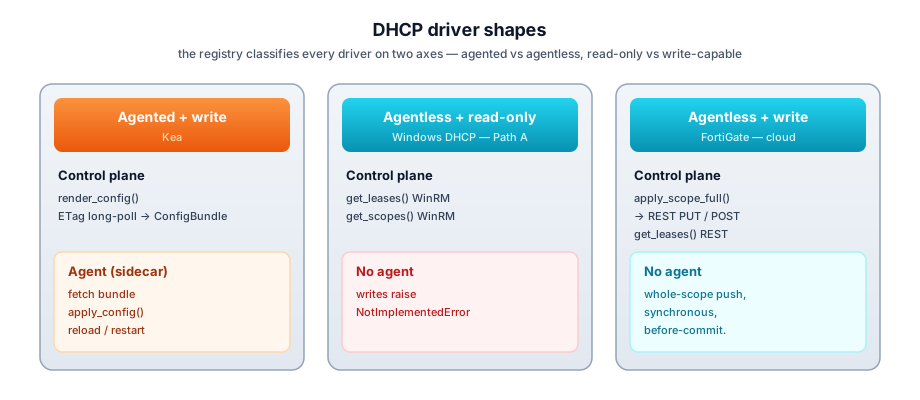
The abstract base (DHCPDriver) has methods for both halves. Read-only agentless drivers (Windows) implement only the read methods + a stub apply_config / reload / restart / validate_config that raises; the API layer consults READ_ONLY_DRIVERS before offering write endpoints. Cloud agentless drivers (FortiGate) are write-capable but push the whole scope object synchronously over a REST API instead of rendering a daemon config bundle — see §5.
2. Abstract base class
Key methods on DHCPDriver:
class DHCPDriver(ABC):
    name: str = "abstract"

    # Rendering (agented drivers).
    @abstractmethod
    def render_config(self, bundle: ConfigBundle) -> str: ...

    # Applying on the server host (agent-side).
    @abstractmethod
    async def apply_config(self, server: Any, bundle: ConfigBundle) -> None: ...
    @abstractmethod
    async def reload(self, server: Any) -> None: ...
    @abstractmethod
    async def restart(self, server: Any) -> None: ...
    @abstractmethod
    def validate_config(self, bundle: ConfigBundle) -> tuple[bool, list[str]]: ...

    # Reads.
    @abstractmethod
    async def get_leases(self, server: Any) -> list[dict[str, Any]]: ...
    @abstractmethod
    async def health_check(self, server: Any) -> tuple[bool, str]: ...
    @abstractmethod
    def capabilities(self) -> dict[str, Any]: ...

    # Optional per-object write APIs (Windows DHCP today). The default
    # batch impls below loop over the singular methods, which only the
    # Windows driver overrides; non-Windows drivers raise NotImplementedError.
    async def apply_reservations(self, server: Any, *,
                                 items: Sequence[ReservationItem]
                                 ) -> list[ReservationResult]: ...
    async def remove_reservations(self, server: Any, *,
                                  items: Sequence[RemoveReservationItem]
                                  ) -> list[ReservationResult]: ...
    async def apply_exclusions(self, server: Any, *,
                               items: Sequence[ExclusionItem]
                               ) -> list[ExclusionResult]: ...
Neutral data classes (ScopeDef, PoolDef, StaticAssignmentDef, ClientClassDef, ConfigBundle) are frozen dataclasses — hashing them gives the ETag that drives long-poll.
3. Kea driver (agented + write)
Located at app/drivers/dhcp/kea.py. Agent image: agent/dhcp/.
Update strategy
| Operation | Mechanism | Notes |
|---|---|---|
| Full scope/pool/reservation push | ConfigBundle → agent fetches via long-poll → agent renders + writes /etc/kea/kea-dhcp4.conf → config-test → config-reload over the Kea unix control socket |
Incremental config — no daemon restart. |
| Validate | config-test on the unix socket (with the full config doc as arguments) |
Preflight — a config Kea rejects is never reloaded. |
| Read leases | Agent tails the memfile lease CSV (/var/lib/kea/kea-leases4.csv) |
Not the lease_cmds HTTP API. The hook is still loaded (HA depends on it), but leases reach the control plane by CSV tail → POST /dhcp/agents/lease-events. |
| HA state | status-get on the unix socket, every ~15 s |
Drives the live HA pill in the UI. |
| Metrics | statistic-get-all on the unix socket, every ~60 s |
Deltas of the pkt4-* counters. |
There is no HTTP Control Agent. kea-ctrl-agent was removed in #637: Kea 3.0 deprecates it, and SpatiumDDI never spoke to it. Everything above rides the unix control sockets (/run/kea/kea4-ctrl-socket, /run/kea/kea6-ctrl-socket) via agent/dhcp/spatium_dhcp_agent/kea_ctrl.py. :8000 is the HA hook’s peer-to-peer listener and is now the only TCP port the image exposes.
Note also that the backend’s KeaDriver.apply_config() / reload() / get_leases() are no-ops — the backend renders config only for the ETag / audit / shape-validation path. The renderer that actually feeds the daemon is the agent’s render_kea.py. Two renderers exist; the agent one is the load-bearing one.
The agent drives Kea by:
- Rendering the config bundle into Kea JSON (
Dhcp4for IPv4,Dhcp6for IPv6 — address-family split onDHCPScope.address_family). - Sending
config-testwith the rendered doc to catch validation errors before touching the live config (a daemon too old to know the command answersresult=2, which is treated as a soft pass). - Calling
config-reload, which re-reads the file without dropping in-flight leases.
Kea 3.0 path restrictions
Kea 3.0 (CVE-2025-32801/2/3) refuses to start if hook libraries, unix control sockets, lease files or log files sit outside its compiled-in default directories. Enforcement is a literal string compare of the config path’s parent — there is no realpath(), so even /var/run/kea vs /run/kea fails. Alpine builds Kea with -Dprefix=/usr -Dlocalstatedir=/var -Drunstatedir=/run, so the enforced defaults are /usr/lib/kea/hooks, /run/kea, /var/lib/kea, /var/log/kea — exactly SpatiumDDI’s existing layout, which is why the 2.6 → 3.0 jump needed no config changes. Do not relocate any of them. Verify with kea-dhcp4 -W (“Hooks directory”) and kea-dhcp4 -T <conf>.
The IPv6 path renders a Dhcp6 tree in parallel to Dhcp4. Dhcp6 option-name translation lands via _KEA_OPTION_NAMES_V6 in both backend/app/drivers/dhcp/kea.py and the agent’s render_kea._options_from_mapping_v6; v4-only options (routers, broadcast-address, mtu, time-offset, tftp-*) are dropped from v6 scopes with a warning.
Wire shape from control plane → renderer
The HTTP envelope returned by GET /api/v1/dhcp/agents/config is:
{
  "server_id": "<uuid>",
  "etag": "sha256:…",
  "bundle": {
    "server_name": "…",
    "driver": "kea",
    "roles": [...],
    "server": { "interfaces": ["*"], "dhcp_socket_type": "raw",
                "kea_thread_pool_size": 1, "kea_packet_logging": true },
    "scopes": [
      {
        "subnet_cidr": "10.0.0.0/24",
        "lease_time": 3600,
        "options": {…},
        "pools": [{"start_ip": "...", "end_ip": "...", "pool_type": "dynamic"}, …],
        "statics": [{"ip_address": "...", "mac_address": "...", "hostname": "..."}, …],
        "ddns_enabled": false
      }, …
    ],
    "client_classes": [{"name": "...", "match_expression": "...", "options": {…}}, …],
    "failover": { ... } | null
  },
  "pending_ops": [...]
}
Shipped 2026.04.21-2: render_kea.py:_scope_to_subnet maps each wire scope to a Kea subnet4 entry — subnet_cidr → subnet, pools[start_ip,end_ip,pool_type] → {"pool": "start - end"} (only dynamic pools are emitted; excluded / reserved are IPAM bookkeeping and must not become Kea lease pools), statics[ip_address,mac_address,hostname] → reservations[ip-address,hw-address,hostname]. Client-class match_expression → Kea test. Subnet id is derived deterministically from the CIDR via truncated SHA-256, so a config reload never orphans active leases by renumbering subnets.
Socket type (issue #365). The server.dhcp_socket_type field drives Dhcp4.interfaces-config.dhcp-socket-type. It is derived from the server group’s dhcp_socket_mode in services/dhcp/config_bundle.py (direct → raw, relay → udp) and is part of ConfigBundle.compute_etag(), so flipping the mode shifts the ETag and the agent re-renders on its next long-poll. The default is raw (AF_PACKET) so Kea hears broadcast DHCPDISCOVERs from directly-attached clients; the agent’s render_kea.py also falls back to raw when an older control plane omits the server block. raw needs CAP_NET_RAW (appliance DaemonSet + shipped compose Kea services grant it). DHCPv6 has no socket-type concept — the field applies to Dhcp4 only.
Packet path (issue #980). Two more server fields, both rendered
explicitly rather than left to Kea’s defaults, both folded into the ETag.
kea_thread_pool_size → Dhcp4/Dhcp6 multi-threading.thread-pool-size.
Kea’s own default is 0, meaning one worker per CPU hardware_concurrency()
reports — the machine’s count, with no regard for the container’s cgroup
share. Verified against kea-dhcp4 3.0.3: a container limited to 0.20 CPU
starts ten workers, which then compete inside that cgroup with the single
thread draining the receive socket, and packets are lost in the kernel before
Kea reads them. The default is 1; 0 restores Kea’s auto-sizing. Note that
enable-multi-threading stays true — this is a resize, not a mode change,
because MT-off makes one thread both receive and process (measured 15,170
socket drops where a pool of one had none) and also flips host-reservation
lookup order.
Kea’s HA hook does not keep independent HTTP pools by default:
http-listener-threads / http-client-threads default to 0, which Kea
reads as “same as thread-pool-size“, not as an independent auto-size.
Measured by counting OS threads with the hook loaded — pool=1 gave 8 threads
and pool=8 gave 29, a delta of 21 for a pool delta of 7, i.e. three pools of
N. Left alone, the packet-path fix would have taken HA’s peer HTTP
concurrency to 1 as a side effect, so _ha_hook now renders an explicit
multi-threading block pinning both to 4 (a decoupling constant, not a
tuned one — the HA threads do short LAN POSTs and never contend for the
receive thread). With it, the same measurement gives 14 threads at pool=1 and
21 at pool=8: a delta of exactly the core pool.
kea_packet_logging → when false, appends a kea-dhcpN.packets logger at
WARN, silencing DHCP4_PACKET_RECEIVED / DHCP4_PACKET_SEND. Default
true (today’s behaviour); off is worth ~1.30x more packets served. The child
declares no output_options and inherits the parent’s — verified against
kea-dhcp4 3.0.3: at DEBUG with no outputs of its own every packet line still
reached both stdout and the shipped file, and at WARN none did while the
parent’s INFO lines kept flowing. Copying the parent’s appenders also works
but puts a second RollingFileAppender on one path with its own rotation
state, so at 50 MB one renames the file while the other holds the old
descriptor. kea-dhcpN.dhcpN is deliberately never silenced: at INFO it
carries DHCP4_OPEN_SOCKETS_FAILED, DHCP4_CONFIG_COMPLETE,
DHCP4_STARTED and DHCP4_MULTI_THREADING_INFO, the last being the line
that confirms the pool size took effect.
Both also appear in the control-plane-side KeaDriver.render_config, which
backs the Rendered config tab. That render is a preview, not a copy of
the file the agent writes — it omits the control socket, hooks, timers,
expired-lease processing and the full logger block, and does not parse as a
Kea config on its own. What it does carry is the group tunables an operator
just set, which is the same rule dhcp_socket_type (#365) and
cache-threshold (#637) already follow: thread-pool-size renders in full,
and kea_packet_logging renders as the kea-dhcpN.packets severity
override alone (nothing when it is on). Full measurements:
DHCP.md §4c.
HA coordination
Kea’s built-in libdhcp_ha.so hook handles pool coordination between paired servers. Under the group-centric data model (shipped 2026.04.21-2), SpatiumDDI treats a DHCPServerGroup with exactly two Kea members as an implicit HA pair — HA tuning lives on the group, per-peer URLs live on each DHCPServer.ha_peer_url. There is no separate “failover channel” object any more.
_resolve_failoverinbackend/app/services/dhcp/config_bundle.pywalks the server’s group. If the group has ≥ 2 Kea members and each has a non-emptyha_peer_url, it emits aFailoverConfigcarrying the group’s mode / heartbeat / max-response / max-ack / max-unacked tuning and both peers’ URLs. Members are sorted byidso both peers render an identicalpeersarray.- The agent’s
render_kea.py:_ha_hook()injectslibdhcp_ha.soalongside the always-loadedlibdhcp_lease_cmds.so(the HA hook depends on it). - Peer URL hostname resolution — Kea’s HA hook parses peer URLs with Boost asio directly and only accepts IP literals. Hostnames like
http://dhcp-kea-2:8000/fail withbad url ...: Failed to convert string to address.render_kea._resolve_peer_urlresolves the hostname agent-side (via the container’s resolver — Docker DNS on compose, k8s DNS on Kubernetes) before emitting the URL into Kea config. IPv4/v6 literals pass through unchanged. - Peer IP drift self-healing —
PeerResolveWatcher(agent/dhcp/spatium_dhcp_agent/peer_resolve.py) runs as a 30 s background thread, re-resolves every peer hostname from the last-applied bundle’s failover block, and if any resolution has changed, triggers the renderer + reload via the agent’s existing apply pipeline. Resolution failures are treated as transient (cached IP kept, retried next tick) so a brief DNS outage doesn’t thrash reloads. Matters most on k8s where pod IPs churn; on compose bridges IPs are mostly stable acrossrestart, butdocker compose --force-recreateWILL reshuffle bridge allocations. - Port topology — Kea 2.6’s HA hook spins up its own
CmdHttpListenerbound to thethis-serverpeer URL to receive peer-to-peer traffic. That must not collide withkea-ctrl-agent. SpatiumDDI’s Kea image dedicates::8000— HA hook peer-to-peer HTTP (the URL advertised to the partner).:8544—kea-ctrl-agentoperator-facing REST (deliberately off 8000).
- Each peer’s
this-server-nameis derived from itsDHCPServer.name; thepeersarray carries both entries with rolesprimary+ (standbyin hot-standby /secondaryin load-balancing). - Agent-side
HAStatusPoller(agent/dhcp/spatium_dhcp_agent/ha_status.py) callsstatus-geton the Kea unix socket every ~15 s and POSTs the state to the control plane — drives the live HA pill in the UI. Kea 2.6 moved HA state into the genericstatus-getresponse underarguments.high-availability[]; the poller also accepts pre-2.6ha-status-getshapes for forward-compat. - Bootstrap reload — on agent startup the entrypoint launches
kea-dhcp4in the background with the Dockerfile-baked config, then the agent re-renders the cached bundle and issuesconfig-reloadwith up to 15 s of retry so Kea picks up HA even on cold starts where the control socket isn’t live yet. - Daemon supervision — both
kea-dhcp4andkea-ctrl-agentrun under per-daemon supervise loops in the container entrypoint. Each loop scrubs stale/run/kea/*.pidfiles before every launch (Kea only removes its own PID on GRACEFUL shutdown, so SIGKILL / hard crash / mid-init SIGTERM leaves the file behind andcreatePIDFilerefuses to start withDHCP4_ALREADY_RUNNING), restarts the daemon on transient crashes (e.g. the Docker bridge-attach race that intermittently fails HA-hook bind with “Address not available” right after a container restart), and trips a 5-in-30s crash-loop guard so a truly broken config surfaces instead of looping forever. SIGTERM handlers inside each loop forward to the live daemon AND flip a stopping flag so we don’t restart during container shutdown. - The driver does not replicate leases itself — Kea’s hook talks directly to the peer’s HA listener. SpatiumDDI just renders the config.
- Scope mirroring is automatic under the group-centric model: scopes / pools / statics / client classes live on the group, and every member of the group renders the same Kea config. Operators configure scopes once, both peers serve them.
Agent bootstrap
Identical pattern to the DNS agent (DNS_AGENT.md):
- Agent starts with
SPATIUM_AGENT_KEY(PSK) in its environment; the control plane validates it against its ownDHCP_AGENT_KEY. - Calls
POST /api/v1/dhcp/agents/registerwith the PSK in theX-DHCP-Agent-Keyheader → receives a per-server rotating JWT (agent_token). - Long-polls
GET /api/v1/dhcp/agents/configwith the JWT and anIf-None-MatchETag. - On 401 or 404, re-bootstraps from the PSK.
- Caches the last-good bundle under
/var/lib/spatium-dhcp-agent/.
4. Windows DHCP driver (agentless + read-only, Path A)
Located at app/drivers/dhcp/windows.py. Class: WindowsDHCPReadOnlyDriver.
Capabilities
| Operation | Status | How |
|---|---|---|
get_leases |
✅ | Get-DhcpServerv4Scope → Get-DhcpServerv4Lease per scope via WinRM. |
get_scopes |
✅ | Get-DhcpServerv4Scope + options + exclusions + reservations in one PowerShell call, JSON-serialised back. |
apply_scope / remove_scope |
✅ | Add-DhcpServerv4Scope / Remove-DhcpServerv4Scope. Called per-object from the API — not via a bundle push. |
apply_reservation / remove_reservation |
✅ | Add-DhcpServerv4Reservation / Remove-DhcpServerv4Reservation. |
apply_exclusion / remove_exclusion |
✅ | Add-DhcpServerv4ExclusionRange / Remove-DhcpServerv4ExclusionRange. |
render_config |
❌ | Raises NotImplementedError. Windows DHCP is cmdlet-driven, not config-file-driven. |
apply_config / reload / restart / validate_config |
❌ | Raise NotImplementedError. |
The /sync endpoint (bundle push) rejects read-only drivers; the /{server_id}/sync-leases endpoint and per-object CRUD drive all writes instead.
Credentials
Stored on DHCPServer.credentials_encrypted as a Fernet-encrypted JSON dict:
{
  "username": "CORP\\spatium-dhcp",
  "password": "…",
  "winrm_port": 5985,
  "transport": "ntlm",
  "use_tls": false,
  "verify_tls": false
}
The service account needs to be in the Windows DHCP Users local group (read-only) or DHCP Administrators (for per-object writes). See WINDOWS.md for the account setup and WinRM configuration.
PowerShell calls
The driver shells out to pre-built PowerShell strings with $ErrorActionPreference = 'Stop' and ConvertTo-Json -Compress -Depth 3 for machine-readable output. An example — the lease pull:
$scopes = Get-DhcpServerv4Scope | Where-Object { $_.State -eq 'Active' }
$all = @()
foreach ($s in $scopes) {
    $leases = Get-DhcpServerv4Lease -ScopeId $s.ScopeId -AllLeases
    foreach ($l in $leases) {
        $all += [PSCustomObject]@{
            ScopeId       = $s.ScopeId.ToString()
            IPAddress     = $l.IPAddress.ToString()
            ClientId      = $l.ClientId
            HostName      = $l.HostName
            AddressState  = $l.AddressState
            LeaseExpiryTime = if ($l.LeaseExpiryTime) { $l.LeaseExpiryTime.ToString('o') } else { $null }
        }
    }
}
$all | ConvertTo-Json -Compress -Depth 3
WinRM transport is pywinrm (winrm.Session), wrapped in asyncio.to_thread because pywinrm is synchronous. Transport, port, and TLS options come from the credential dict.
Lease → IPAM mirror
Leases drive a scheduled Celery beat task (app.tasks.dhcp_pull_leases.auto_pull_dhcp_leases). Beat fires every 60s; the task gates on PlatformSettings.dhcp_pull_leases_enabled / dhcp_pull_leases_interval_seconds, so the UI can change cadence without restarting beat.
Per poll cycle:
- Enumerate agentless DHCP servers.
- For each, call
driver.get_leases(server). - Upsert into
DHCPLeaseby(server_id, ip_address). - If the lease’s IP falls inside a known subnet, mirror it into
IPAddresswithstatus="dhcp"andauto_from_lease=True. - Absence-delete — any active
DHCPLeaserow for this server whose IP didn’t come back in the wire response is deleted along with itsauto_from_lease=TrueIPAM mirror. The driver’sget_leases()returns only currently-active leases, so absence means the server deleted it (admin purged / client released / etc.).PullLeasesResultgainsremoved+ipam_revokedcounters; both flow into the scheduled-task audit row and the manual sync response. See features/DHCP.md §15.3 for the rationale. - The time-based
dhcp_lease_cleanupsweep still handles leases that drift pastexpires_atbetween polls. The two mechanisms overlap harmlessly.
Scope reconcile (topology)
The same beat task runs a topology phase ahead of the lease phase, for any driver that implements get_scopes — which today means Windows DHCP alone. For each wire scope whose CIDR exactly matches an IPAM Subnet.network (no auto-create), the scope row is upserted and its pools + reservations are diff-merged against the wire. Reservations are keyed on MAC, pools on (start, end); a MAC / range that is already tracked is updated in place, so a reservation keeps its row id across polls.
That id stability is load-bearing (#620). A reservation owns an ip_address mirror that back-links to it by id, so anything that re-creates the row (the pre-#620 reconciler Core-DELETEd and re-inserted every reservation, every poll) leaves the mirror pointing at a row Postgres has dropped — an address that is neither allocated nor free, and that deleting the reservation in the UI never frees, because the lookup keys on the current id. Merging also means an unchanged reservation is not written at all, which is what keeps the reconciler from re-publishing its DNS records on every tick.
Reservations found on the server are mirrored into IPAM exactly like UI-created ones (status="static_dhcp"), via the same upsert_ipam_for_static helper — a reservation is an allocation whoever made it, and an IPAM that doesn’t show it is an IPAM that will hand the address out twice. The mirror upsert (and therefore the DNS re-sync it performs) fires only when the reservation’s address or hostname actually moved, or when its mirror is missing or stale.
Three things the merge deliberately refuses to do:
- Absence-delete against a wire it can’t trust. Absence normally means “deleted on the server” — the reservation is dropped, its mirror deleted and its DNS torn down. But
_PS_LIST_TOPOLOGYenumerates options / exclusions / reservations inside per-listtry/catchblocks, so a failure hands back an empty array, not an error. The driver therefore reportspools_ok/statics_okalongside each list, and the reconciler also declines to delete when a wholly-empty list arrives while it tracks rows (the same call the lease path’s zero-wire floor guard makes, #482). Both cases record a soft error on the sync result. The trade is deliberate: a stale reservation an operator can delete beats a reservation and its A record torn down on a blip. - Act on rows newer than its own information. The wire is a snapshot taken before a multi-second WinRM round-trip. A reservation created or edited after that snapshot is judged against stale data, so it is skipped — otherwise a reservation created in the UI mid-poll is “absent from the wire” and gets deleted out from under the operator.
- Write an address change row-by-row. Renumbering reservations on the server (
AtakesB’s address) produces a wire whose end state is legal but whose intermediate states violateuq_dhcp_static_scope_ip— which would abort the poll, and keep aborting it, since the wire keeps reporting the same state. Movers are lifted out of that partial index (it isWHERE deleted_at IS NULL) inside the transaction, re-addressed, and put back.
PullLeasesResult reports scopes_imported / scopes_refreshed / scopes_skipped_no_subnet plus pools_synced / statics_synced (created or changed) and pools_removed / statics_removed. Because the merge is a diff, a steady-state poll reports zeros.
The orphaned-mirror backstop
A reservation owns its ip_address mirror by id, and every path that destroys a reservation is responsible for releasing that mirror first. When one doesn’t, the result is nasty out of proportion to the mistake: the address sits at status="static_dhcp" pointing at a row Postgres has dropped, so it is neither allocated nor free, nothing hands it out, and no amount of clicking in the UI frees it — every release path looks the mirror up by the reservation’s current id and matches nothing. It took a one-shot repair migration (d7b3f2a9c15e) to clear the last batch.
So there is a recurring backstop: app.tasks.dhcp_mirror_sweep.sweep_orphaned_mirrors, hourly, which is that migration’s step 1 made permanent. It frees any static_dhcp row whose non-NULL back-link resolves to no live reservation, deleting the row (a freed-but-persisted row still renders in the subnet table and still counts toward utilization) after tearing down its DNS. If the reservation is merely soft-deleted, the operator-authored columns are snapshotted onto it first so a Trash restore stays lossless.
The predicate is deliberately narrow: a static_dhcp row with a NULL back-link is left alone, because an operator can set that status by hand and a sweep that deletes hand-made rows is worse than the bug it fixes. On a healthy install it matches nothing and writes nothing — so a non-zero mirrors_freed (logged at WARNING, and audited) is itself the signal that some path is still skipping its mirror release.
Batched WinRM writes
Per-object writes against Windows DHCP used to round-trip WinRM per reservation / exclusion — a bulk delete of 200 reservations took minutes. The driver now groups writes into a single PowerShell script per (server, scope) chunk.
Driver surface. New plural methods on the ABC:
class DHCPDriver(ABC):
    async def apply_reservations(
        self, server: Any, *, items: Sequence[ReservationItem]
    ) -> list[ReservationResult]: ...

    async def remove_reservations(
        self, server: Any, *, items: Sequence[RemoveReservationItem]
    ) -> list[ReservationResult]: ...

    async def apply_exclusions(
        self, server: Any, *, items: Sequence[ExclusionItem]
    ) -> list[ExclusionResult]: ...
Default ABC impls call the singular method in a loop — Kea inherits the plural interface without changes.
Windows batch size — 30 ops per chunk. pywinrm.run_ps ships the script as a single CMD.EXE command line (8191-char cap, see DNS_DRIVERS.md §3.7 for the full math). DHCP payloads are leaner than DNS — each reservation / exclusion op is ~60 raw chars of JSON vs. DNS’s ~160 — so the cmdline limit is farther away, but capped at 30 to stay comfortably inside it. Documented in _WINRM_BATCH_SIZE in drivers/dhcp/windows.py.
Dispatcher. push_statics_bulk_delete groups by (server, scope) so the IPAM purge-orphans path went from N×M WinRM calls to one per server. Unlike the DNS side there is no state-aware commit here: the dispatcher returns nothing and the caller deletes the DHCPStaticAssignment rows regardless — the push is best-effort, and the next lease poll / config bundle reconciles the server.
5. FortiGate driver (agentless + cloud push)
fortigate.py is the first cloud agentless DHCP driver: the control plane drives a FortiGate’s per-interface DHCP server directly over the FortiOS REST API with an API-admin Bearer token, VDOM-scoped, no co-located agent. It subclasses AgentlessDHCPDriverBase (the shared cloud base) rather than rendering a daemon config.
Model mapping
One SpatiumDDI DHCPServer(driver="fortigate") = one FortiGate device + VDOM. A DHCPScope (one subnet) maps to the system.dhcp.server object on the interface whose primary IP+netmask CIDR equals the scope CIDR — SpatiumDDI never creates interfaces or changes interface IPs; no match / multiple matches raise a clear error. Dynamic pools → ip-range; excluded/reserved pools → exclude-range (clipped to the dynamic range — FortiGate rejects an exclude outside the ip-range); statics → reserved-address; scope options → first-class fields (default-gateway / dns-server1..4 / domain / ntp-server1..3 / filename / lease-time) or the generic options subtable. Numeric options (mtu, time-offset) are emitted as type: "hex" big-endian — a string MTU would reach the client as ASCII, not a 16-bit integer.
Write unit
The whole DHCP-server object per scope: any scope / pool / static / option edit rebuilds the full desired object from the DB and PUTs it (create-if-absent). The cloud write-through (services/dhcp/cloud_writethrough.py) runs synchronously, before commit, so a REST failure raises CloudPushError (502) and rolls the transaction back — keeping the DB and the FortiGate in sync. push_cloud_scope_upsert fans a scope out to every cloud member of its group; cascade / group / restore paths reach it through the shared windows_writethrough seam.
Child-table id stability. FortiOS applies a parent PUT to child tables (reserved-address / ip-range / exclude-range / options) per entry id, not as an atomic replace. Positionally renumbered ids therefore break deletion: removing a non-last reservation shifts every later entry onto a different id, the per-id update transiently duplicates a MAC still present at the next id, and FortiOS aborts mid-apply — the wrong entries end up deleted and the push errors out. Before an update PUT, _reconcile_child_ids pins each desired entry to the id its logical match (by MAC / range / option code) already holds on the device, assigns new entries ids above every id in play, and removes stale device entries via explicit child-endpoint DELETEs (excludes before the ranges they depend on; a 404 counts as already-gone). Fresh POSTs keep the positional ids — there is no device state to pin to.
Ownership + adopt-guard (#630)
So a push never silently overwrites or deletes a DHCP server an operator hand-managed on the FortiGate, the control plane records the FortiOS mkey of the object SpatiumDDI created on the scope (DHCPScope.provider_refs, keyed per cloud server) and passes it back as provider_ref:
- recorded mkey present → PUT that object;
- no mkey + interface empty → POST, then record the new mkey;
- no mkey + an object already exists → raise
CloudDHCPAdoptionError→ 409, unless the operator opts in withadopt_existing(query param onPOST /{id}/sync).
_remove_scope only deletes an object whose mkey we recorded. The GET /{id}/fortigate-interfaces preflight surfaces any pre-existing DHCP server (ip-range / reservation / option counts + a managed flag) so the clobber risk is visible before an adopt-and-sync.
Credentials + TLS
Fernet-encrypted on DHCPServer.credentials_encrypted: {"api_token", "vdom", "verify_tls", "ca_bundle_pem"}. verify_tls defaults to True (the admin Bearer token is sensitive) with an optional ca_bundle_pem to pin a private-CA FortiGate; disabling verification logs a WARNING. The API echoes the non-secret vdom + verify_tls on the server response so the edit modal seeds the checkbox from the stored value instead of silently re-disabling it. API-created cloud servers default to port 443 when the caller omits port.
Endpoints
POST /dhcp/servers/test-fortigate-credentials (dry-run probe), GET /dhcp/servers/{id}/fortigate-interfaces (preflight), POST /dhcp/servers/{id}/sync?adopt_existing= (synchronous full reconcile). All three call assert_safe_target (advisory SSRF guard) before dialing the host.
6. Error handling
All driver methods:
- Raise
DriverConnectionErrorfor network / auth failures. - Raise
DriverOperationErrorfor a successful connection but failed operation (e.g. PowerShell cmdlet failed, Kea validation rejected the bundle). - Never swallow errors. Log full details at
ERRORbefore raising. - Are safe to retry — service layer handles retry via Celery task retries, drivers are not responsible for retry.
For WinRM drivers, pywinrm errors get caught and re-raised as DriverConnectionError with the PowerShell std_err in the message — the API surfaces this verbatim in the 502 response so the UI “Test Connection” button shows the real Windows error.
7. Adding a new driver
- Subclass
DHCPDriver. Implement all abstract methods. If read-only, raiseNotImplementedErroron writes. - Register in
app/drivers/dhcp/registry.py:_DRIVERS["my_driver"] = MyDriverClass - If agentless, add to
AGENTLESS_DRIVERS. If read-only, add toREAD_ONLY_DRIVERS. - Add the driver name to the enum in
DHCPServer.driver(Alembic migration). - Update the UI’s server create modal to render the right credential fields (see how
windows_dhcpconditionally shows WinRM fields infrontend/src/pages/dhcp/CreateServerModal.tsx). - Add a “Test Connection” PowerShell / API probe (e.g.
POST /dhcp/servers/test-windows-credentials) so operators can validate before saving.
8. Importing existing daemon configs (issue #129)
The DHCP configuration importer is separate from the driver
abstraction: drivers render + push config to managed servers; the
importer reads a foreign daemon’s config one-shot and writes the
canonical SpatiumDDI rows. It never touches a live daemon’s config
file. Code lives in backend/app/services/dhcp_import/.
Canonical IR (canonical.py) — every source parses into the same
neutral shapes: ImportedScope (CIDR, address family, lease times,
options, DDNS), ImportedPool, ImportedReservation,
ImportedClientClass, rolled into an ImportPreview. The shared
commit.py is the only module that touches the DB, so all three
sources share IPAM linkage, conflict handling, audit logging, and the
per-scope savepoint pattern.
Parsers:
kea_parser.py— strips Kea’s JSON-with-comments (//,#,/* */) string-aware, then walksDhcp4.subnet4/Dhcp6.subnet6. Inverts the Kea driver’s option-name map (options.pybuilds the inverse of_KEA_OPTION_NAMES/_KEA_OPTION_NAMES_V6). Pools parse both"a - b"and CIDR forms;code:NNoption-data round-trips the same way the driver renders it. DUID-only v6 reservations are skipped (our reservations are MAC-keyed). Top-levelclient-classesimport verbatim — Keatestexpressions are SpatiumDDI’s native class shape.hooks-libraries/control-socket/lease-database/loggersare listed unsupported.windows_dhcp_pull.py— reusesWindowsDHCPReadOnlyDriver.get_scopes()(the same Path A read path the Logs surface uses), reshaping its neutral dicts. IPv4 only; option names already arrive canonical.isc_dhcp_parser.py— a self-contained tokeniser (comment- + string-aware) → recursive-descent statement tree → walker.subnet/subnet6→ scopes;range/range6/pool {}→ pools (withallow members of "class"→class_restriction);host→ reservations (global hosts attach to the subnet containing theirfixed-address);option→ canonical options;shared-network/groupare flattened. ISC’s runtime-expression classifier DSL doesn’t map to our model, soclassdeclarations are emittedsupported=false(manual review, never auto-created);failover/key/zone/includeare listed unsupported.
IPAM linkage — DHCPScope.subnet_id is mandatory, so each commit
resolves a Subnet: link to an existing one whose CIDR matches, or
auto-create under the operator-chosen IP space + block (containment +
non-overlap validated). Link-only mode (no space/block) reports an
actionable per-scope error for unmatched CIDRs rather than failing the
whole batch.
Provenance — import_source (kea / windows_dhcp / isc_dhcp)
imported_atare stamped on everydhcp_scope/dhcp_pool/dhcp_static_assignment/dhcp_client_classrow the importer creates (migrationc7f1a3e58b94). Endpoints under/api/v1/dhcp/import/{kea,windows,isc}/…are gated by thedhcp.importfeature module + superadmin RBAC.
See Migration for the operator-facing flow and the DNS-importer sibling.
Related docs
- DHCP Features — user-facing: scopes, pools, leases, HA modes.
- Getting Started — where DHCP fits in the setup order.
- Windows Setup — WinRM prerequisites, service accounts.
- DNS Drivers — the parallel structure on the DNS side.
Kea 3.0 — HA has no rolling-upgrade path (#637)
Kea 3.0’s HA hook is wire-incompatible with peers older than 2.7.0. 3.0
introduced the “released” lease state (value 3) into the lease updates that HA
partners exchange, and an older peer rejects them outright.
There is therefore no rolling 2.6 → 3.0 upgrade for an HA pair — both members must cross in the same window. This is upstream’s guidance, not a SpatiumDDI limitation, and there is nothing the orchestrator can do about it.
That collides directly with the #296 rolling-upgrade orchestrator, whose whole primitive is one node at a time: cordon → drain → swap slot → reboot → uncordon → next. Midway through such a run, one Kea is on 3.0 and its partner is still on 2.6, and the pair falls out of sync until the second node lands.
Two things make this visible rather than a surprise:
dhcp_server.kea_version— the agent reads the running daemon’s version off the control socket (version-get) and reports it on every heartbeat. This is the Kea daemon version, distinct fromagent_version(the Python agent).NULLmeans “not reported yet” and must be treated as unknown, never as “old”.-
The
kea_ha_version_skewpreflight check — runs as part of the rolling-upgrade preflight and classifies the fleet:Condition Level Why Members of one HA group already on different Kea majors warnHA lease sync is broken now — and finishing the upgrade is what converges them. An HA group is on pre-3.0 Kea warnThis run will cross the boundary node-at-a-time; HA degrades until it completes. A member has never reported a version warnUnknown, so we can’t rule out the crossing. Every member already on Kea ≥ 3 okNothing to do — and the check self-clears, so it isn’t a permanent nag.
Two pieces of scoping keep the check honest, and getting either wrong turns it into something that blocks unrelated work:
- Appliance nodes only. The orchestrator never touches docker / k8s DHCP
agents (they upgrade through the manual copy-paste path), so counting them
would let two unrelated containers veto an appliance-cluster upgrade.
deployment_kindis matched strictly againstappliance. - Real HA pairs only. HA is not “≥ 2 Kea members” —
_resolve_failoverrenders the HA hook only when there are ≥ 2 Kea members and every one has a non-emptyha_peer_url. Without a URL there is no HA relationship and nothing for an upgrade to disrupt. The check uses the same predicate, or it would invent pairs the renderer never built.
The check never returns fail. A fail sets can_start=False, and blocking
would be exactly backwards: an already-mixed pair has broken HA right now, and
completing the rolling upgrade is what gets both members onto one version.
Refusing to start would strand the operator in the broken state. DHCP also keeps
serving throughout (each Kea answers from its own lease store) — only the HA
replication between peers is disrupted.