DHCP Feature Specification
Implementation status (2026-04-28): Kea driver, agent runtime, container image, backend API, and frontend UI shipped in the
2026.04.16-1release. Pool overlap validation, existing-IP warning, resize, static ↔ IPAM sync (including DNS forward/reverse), lease → IPAM mirror (with auto-cleanup on expiry), DHCP Pool membership column in the IPAM subnet view, per-scope DHCP defaults prefilled from Settings. Windows DHCP driver shipped — Path A (agentless, WinRM + PowerShell, read-only lease monitoring + per-object scope / pool / reservation CRUD). DDNS pipeline shipped for both paths — agentless lease pull (2026-04-19) and agent-side Kea lease events (2026-04-21). Group-centric Kea HA shipped (2026.04.21-2) — load-balanced or hot-standby pairs with self-healing peer-IP drift, supervised daemons, and livestatus-getreporting. Scope authoring helpers (2026.04.28-2): 95-entry RFC 2132 + IANA option-code library with autocomplete on the custom-options row, plus named group-scoped option templates (e.g. “VoIP phones”, “PXE BIOS clients”) with a one-click “Apply template…” picker on the scope create / edit modal. PXE / iPXE provisioning profiles (issue #51) and passive DHCP fingerprinting (Phase 2 device profiling) have since shipped — see §17 and §18. Still deferred: Option 82 (relay agent info) class matching, lease histogram by hour, reconciliation report, lease import. NTP (DHCP option 42) is a first-class option.
Overview
SpatiumDDI manages DHCP servers as authoritative configuration sources. The IPAM database is the source of truth — DHCP server configs are pushed from IPAM, not read from the servers. DHCP servers are configured to report lease events back to SpatiumDDI for real-time IP status tracking and DDNS updates.
Supported backends: ISC Kea DHCP (preferred) and Windows Server DHCP (agentless). ISC DHCP v4 is intentionally not supported — upstream declared end-of-life in 2022; Kea is the successor.
1. DHCP Server Model
DHCPServer
  id, name, description
  driver: enum(kea, windows_dhcp)
  host, port
  credentials (encrypted Fernet)
  roles: [enum(dhcp4, dhcp6)]     -- server can run both
  server_group_id (nullable)      -- logical grouping for HA pairs
  status: enum(online, offline, degraded, syncing)
  last_sync_at, last_health_check_at
  config_cache_path: str          -- local path where agent caches last-good config
DHCP Server Groups
DHCPServerGroup is the primary configuration container. Scopes, pools, statics, and client classes all belong to a group — every member server renders the same Kea config. A group with one member is a standalone DHCP service; a group with two Kea members is implicitly an HA pair, driving the libdhcp_ha.so hook.
DHCPServerGroup
  id, name, description
  mode: enum(standalone, hot-standby, load-balancing)
  dhcp_socket_mode: enum(direct, relay)   -- Kea dhcp-socket-type selector
  heartbeat_delay_ms, max_response_delay_ms, max_ack_delay_ms, max_unacked_clients
  auto_failover: bool
  servers: [DHCPServer]          -- 2 Kea members = HA pair
  scopes: [DHCPScope]            -- rendered on every member
  client_classes: [DHCPClientClass]
Client reachability (dhcp_socket_mode, issue #365). Kea’s
dhcp-socket-type is a per-daemon setting — it can’t vary per subnet —
so it lives on the group and applies to every member Kea. Two values,
surfaced in the create/edit modal as Client reachability:
| Mode | Renders | Use when |
|---|---|---|
direct (default) |
dhcp-socket-type: raw |
The server is on the same L2 as its clients. Raw (AF_PACKET) sockets receive broadcast DHCPDISCOVERs from clients that have no IP yet and relayed traffic — the superset, and Kea’s own default. Needs CAP_NET_RAW (granted on the appliance DaemonSet + the shipped compose Kea services). |
relay |
dhcp-socket-type: udp |
Kea sits exclusively behind a DHCP relay (ip helper-address / dhcrelay), or the runtime can’t grant raw-socket capability. UDP datagram sockets cannot receive direct L2 broadcasts. |
The value flows to every deploy path (k8s / compose / appliance) through
the ConfigBundle long-poll and is folded into the bundle ETag, so a
change re-renders the running Kea within a heartbeat. It is distinct from
network_mode (host vs bridged), which controls the container’s network
namespace on supervisor-managed appliances — a directly-attached server
typically wants network_mode: host and dhcp_socket_mode: direct.
See TROUBLESHOOTING.md
for the “no DHCPOFFER” diagnosis flow.
2. DHCP Scopes and Pools
This is the most granular part of the DHCP model. Within a subnet, you can define:
- Multiple pools with different behaviors (dynamic, reserved, excluded)
- Static assignments (fixed IPs by MAC address)
- Pool-level DHCP options that override subnet defaults
Hierarchy
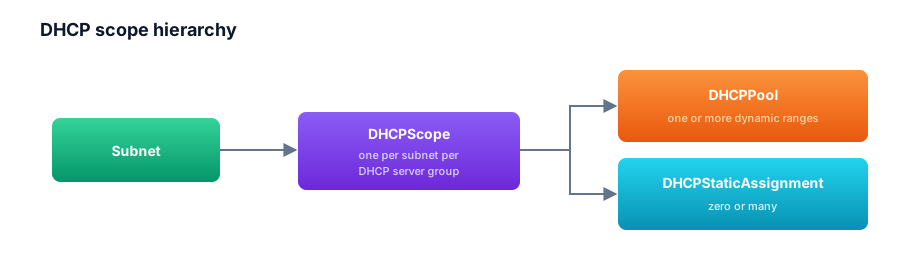
DHCPScope Model
DHCPScope
  id, group_id, subnet_id
  is_active: bool
  lease_time: int (seconds, default 86400)
  max_lease_time: int
  options: JSONB {               -- scope-level options (override server defaults)
    "routers": ["10.1.2.1"],
    "dns-servers": ["10.0.0.53", "10.0.0.54"],
    "domain-name": "internal.example.com",
    "domain-search": ["internal.example.com", "example.com"],
    "tftp-server-name": "10.0.0.10",   -- for PXE
    "bootfile-name": "pxelinux.0",
    "vendor-class-identifier": "...",
    custom_options: { "176": "..." }   -- vendor-specific options by code
  }
  ddns_enabled: bool
  ddns_hostname_policy: enum(client_provided, client_or_generated, always_generate, disabled)
  dns_track_dynamic_leases: bool (default true)  -- see "Dynamic-lease DNS drift" below
  address_family: enum(ipv4, ipv6)   -- inferred from the bound subnet's CIDR
  v6_address_mode: enum(stateful, stateless, slaac)  -- v6 only (issue #52)
  ra_managed_flag: bool              -- intended RA M-flag (router-side intent)
  ra_other_flag: bool                -- intended RA O-flag (router-side intent)
  last_pushed_at: timestamp
Dynamic-lease DNS drift (dns_track_dynamic_leases)
When SpatiumDDI pulls active leases from an agentless DHCP server (Windows DHCP,
FortiGate) it mirrors each into IPAM as an auto_from_lease address row. A
pulled lease carries the client-supplied hostname, so the IPAM ↔ DNS drift
check (services/dns/sync_check.compute_subnet_dns_drift, surfaced as the “DNS”
column / “N out of sync” banner and the Sync DNS flow) would treat every
ephemeral lease with no forward/reverse record as missing — flagging the
whole dynamic pool as “out of sync” even though the operator has no intention of
publishing DNS for transient leases.
dns_track_dynamic_leases is the per-scope opt-out. When false, the drift
check ignores this scope’s dynamic-pool lease mirrors (auto_from_lease IPs
whose address falls inside one of the scope’s dynamic pools), and any leftover
auto-generated records for them are reported as stale so a Sync DNS run offers
to clean them up.
Design decision (documented for the MR): the flag defaults to true —
preserving the prior behaviour (dynamic-lease rows are drift-checked) so no
existing install silently changes. Operators opt out per scope when lease DNS is
noise. The gate is scope-level (not a global toggle) because dynamic pools —
and the decision to publish DNS for them — belong to a scope; and it keys on
auto_from_lease and dynamic-pool membership so a manually-allocated IP that
happens to sit in the pool is still tracked. Static reservations
(status="static_dhcp") are never affected — only dynamic-lease mirrors.
Rejected alternatives: a global setting (too coarse — mixed scopes want
different policies) and suppressing the hostname on the mirror row (loses
operator-visible lease hostnames in IPAM).
DHCPv6 operating mode (issue #52)
For IPv6 scopes, v6_address_mode chooses how clients on the subnet get
their address, and drives what the Kea driver renders into the subnet6:
| Mode | Kea subnet6 render |
RA flags (set on the router) | Client behaviour |
|---|---|---|---|
stateful |
address pools + option-data + reservations |
M=1, O=1 | DHCPv6 hands out the address (IA_NA) and options |
stateless |
no pools, option-data only + reservations |
M=0, O=1 | Client SLAACs its address from the RA prefix, asks DHCPv6 (Information-Request) for DNS / domain-search |
slaac |
bare subnet — no pools, no options, no reservations | M=0, O=0 | The router’s RA does everything; DHCPv6 is not involved |
The ra_managed_flag (M) / ra_other_flag (O) columns record the
intended Router-Advertisement flags, auto-suggested from the chosen mode
(and freely overridable). Historically these were pure “set this on your
router” intent — as of issue #524 SpatiumDDI can also emit RAs itself
by running radvd on the DHCP agent from control-plane-rendered config
(opt-in per scope via ra_enabled; see §19). The mode picker only appears on IPv6
scopes; v4 scopes ignore these columns and always serve addresses +
options. Changing the mode shifts the agent ConfigBundle ETag, so the
Kea agent re-pulls and re-renders.
DHCPPool Model (Dynamic Ranges)
Each scope can have multiple pools, each with its own range and optional class restrictions.
DHCPPool
  id, scope_id
  name: str (optional label, e.g., "Workstations", "Printers", "VoIP")
  start_ip: inet
  end_ip: inet
  pool_type: enum(dynamic, excluded, reserved)
    -- dynamic:   IPs handed out to any eligible client
    -- excluded:  range exists in subnet but DHCP will NOT offer these IPs
    -- reserved:  range held for static assignments only (not auto-assigned)
  class_restriction: str (nullable)   -- Kea client class
  lease_time_override: int (nullable) -- overrides scope lease_time for this pool
  options_override: JSONB (nullable)  -- additional options for this pool only
Earlier revisions of this document listed
utilization_percentandcurrent_lease_countas computed model fields. Neither ever existed on the row — occupancy is derived at request time from mirrored lease and reservation state, and is served by the endpoints below (#913, corrected in #917).
Pool occupancy over REST (issue #913)
GET /api/v1/dhcp/pools/{pool_id}/occupancy
GET /api/v1/dhcp/scopes/{scope_id}/pools/occupancy    # every pool, one call
{
  "pool_id": "…", "scope_id": "…", "pool_name": "Workstations",
  "start_ip": "10.1.2.101", "end_ip": "10.1.2.200",
  "pool_type": "dynamic",
  "total": 100, "assigned": 97, "free": 3, "percent": 97.0,
  "computed_at": "2026-08-23T12:00:00.000Z"
}
assigned is the count of distinct in-range addresses unavailable to
a dynamic client: active leases unioned with in-pool static
reservations. Both halves matter and neither is obvious from outside:
- A reservation withholds its address whether or not the reserved device is currently online, so counting leases alone under-reports exhaustion (#631) — and a wrong “the pool is fine” sends the technician looking in the wrong place.
- A reserved-and-currently-leased address is one address, not two, which is why this is a union rather than a sum.
“Is this pool exhausted?” is one of the first questions asked when a
client cannot get an address, and until #913 the API could not answer it:
the computation had existed since #339 but was reachable only from the
find_dhcp_pool_occupancy copilot tool and the dhcp_pool_exhaustion
alert evaluator. Every consumer had to fetch pools, leases and
reservations separately and redo the range arithmetic — three round
trips and an easy thing to get subtly wrong.
The scope-level shape is the one that matters operationally: a scope with several pools is exactly where a call-per-pool is wasteful, and also where “the scope looks fine” hides one exhausted class-restricted pool. It runs a single batched lease + reservation query for all of them.
Dynamic pools only. The scope listing omits every other type and the
per-pool route returns 422 for one, because each would produce a
misleading number — and because the dhcp_pool_exhaustion alert
evaluator and the find_dhcp_pool_occupancy copilot tool already filter
the same way, so answering differently here is how a wrong “the pool is
fine” gets produced:
excluded— a range DHCP will never offer, so “percentage full” is not a fact about it.reserved— held for static assignments, so a correctly configured one is supposed to approach 100% and would render as a red exhaustion bar for doing its job.pd(#368) —start_ip/end_ipare NOT NULL placeholders holding the delegated prefix’s network address rather than a range, so the arithmetic reports a one-address pool at 0%.
computed_at is returned because occupancy is derived from the mirrored
lease rows, so its freshness follows the last lease pull rather than
being instantaneous.
Fleet-wide lease lookup (issue #917)
GET /api/v1/dhcp/leases          # active leases across every server
GET /api/v1/dhcp/lease-history   # expired / released, across every server
The per-server routes (/dhcp/servers/{id}/leases and
/dhcp/servers/{id}/lease-history) answer “what is this server handing out”,
which is the server-detail question. They cannot answer the one a technician
starts from — “does this MAC have a lease anywhere?” — without a call per
server plus a client-side merge, and that merge is order-sensitive: page 1 of
server A and page 1 of server B are not the newest rows overall.
Both fleet routes take the same filters as their per-server counterparts, with
the server restriction moved to optional server_id / group_id query
parameters, and return the same row shapes (including the OUI vendor and
Fingerbank device fields). /leases additionally accepts exact mac and
ip filters alongside the substring search, because a substring match on a
MAC also returns unrelated devices whose address happens to contain the same
bytes.
mac is normalised before matching, so AA-BB-CC-DD-EE-FF, aabb.ccdd.eeff
and aa:bb:cc:dd:ee:ff are the same query — a lookup that answers “no lease”
because the operator pasted a different separator is worse than one that
errors.
Example: Multiple Pools in One Subnet (10.1.2.0/24)
| Pool Name | Range | Type | Notes |
|---|---|---|---|
| Infrastructure | 10.1.2.1–10.1.2.20 | excluded | Gateways, servers — never DHCP |
| Static Only | 10.1.2.21–10.1.2.50 | reserved | Printers with static assignments |
| VoIP Phones | 10.1.2.51–10.1.2.100 | dynamic | Class: VoIP, short lease, option 150 |
| Workstations | 10.1.2.101–10.1.2.200 | dynamic | Standard lease, all defaults |
| Guest WiFi | 10.1.2.201–10.1.2.240 | dynamic | Class: Guest, 2h lease, no internal DNS |
| Management | 10.1.2.241–10.1.2.254 | excluded | Network equipment |
3. Static DHCP Assignments
Static assignments bind a MAC address (or client identifier) to a specific IP, hostname, and optional per-host options.
DHCPStaticAssignment
  id, scope_id                  -- NOT NULL / ON DELETE CASCADE; part of the reservation's identity
  ip_address: inet              -- must fall inside the scope's subnet (422 if not — issue #619)
  mac_address: macaddr          -- primary identifier
  client_id: str (nullable)     -- DHCP client identifier (alternative to MAC)
  hostname: str
  description: str
  options_override: JSONB (nullable)  -- host-specific options
  ip_address_id (FK → IPAddress)      -- linked IPAM record
  deleted_at, deleted_by_user_id, deletion_batch_id  -- soft-delete, as a cascade child of the scope (#617)
  created_by_user_id, created_at
scope_id cannot be re-pointed. Kea renders a reservation nested inside its
scope’s subnet4 stanza and Windows binds it to the scope’s network address, so
there is no renderable form of a relocated reservation — a body scope_id on
create/update is rejected with a 422 (issue #619). To move one, delete it and
re-create it under the target scope.
Static Assignment UI Workflow
Static assignments are created from the IPAM side, at IP-allocation time. A
static is a child of a DHCP scope (it carries scope_id), and Kea renders
reservations per scope — so a scope for the subnet must exist first, or there
is nothing for the reservation to attach to and Kea’s reservations array stays
empty.
Prerequisite — create a scope for the subnet. A scope lives on a DHCP
server group that has at least one Kea member (DHCP is group-centric —
scopes / pools / statics / classes all belong to the group). Create it from
IPAM → the subnet → “DHCP Pools” tab → Create Scope, or from
DHCP → the server group → Scopes tab → New Scope. A dynamic pool is optional;
the scope alone is enough to emit the subnet4 block that reservations hang off.
Create the reservation — two equivalent paths:
From the DHCP page: DHCP → the server group → “Static Assignments” tab → New static assignment. Pick the scope (a picker appears when the group has more than one), then enter the MAC + IP + hostname and save. Edit and Delete live on the per-row right-click menu. Creating / editing / deleting a reservation requires a superadmin.
From IPAM (at allocation time):
- IPAM → select the subnet → “Allocate IP” (the primary header button; also reachable from a free-range gap row or the subnet context menu).
- In the Allocate IP Address modal set Type / Status =
static_dhcp. This reveals the DHCP Scope picker. - Pick the DHCP Scope, enter the MAC address (required — see caveat below), and set the hostname. If no scope exists for the subnet yet, the picker offers a Create a scope button that opens the scope modal inline.
- Click Allocate. IPAM creates the address row with
IPAddress.status = static_dhcpand mirrors it into the scope as aDHCPStaticAssignment(viaPOST /api/v1/dhcp/scopes/{scope_id}/statics).
Either way, the Kea agent picks up the new ConfigBundle (a group wake fires +
the ETag shifts) and renders the host reservation within seconds. The Static
Assignments tab lists every reservation across the group’s scopes.
Caveats / common “nothing happened” traps:
- A MAC is mandatory — a blank MAC is rejected, not silent. Allocating a
static_dhcpaddress without amac_addressreturns 422 (mac_address is required when status is 'static_dhcp') from both thecreateandnext-addressendpoints, so nothing is created — neither the IPAM row nor the reservation. static_dhcpwith a MAC but no scope creates the IPAM row and silently skips the reservation. If no DHCP scope is selected (e.g. none exists for the subnet yet), the IPAM address is created but the mirror to Kea is not attempted — this is the real “I set it static but nothing happened” trap. Create a scope first (see the prerequisite above).- Editing an existing IPAM row to
static_dhcpdoes not create a reservation. Flipping an existing IP tostatic_dhcpvia Edit (or bulk-edit) updates the IPAM row but does not mirror it to Kea. Add the reservation from the DHCP Static Assignments tab, or delete and re-allocate via the IPAM flow. - Creating a static currently requires a superadmin. A non-superadmin who
allocates a
static_dhcpIP gets the IPAM row but the mirror call returns 403.
Troubleshooting — reservations render empty in Kea
Reservations are emitted per subnet, nested inside each subnet4 / subnet6
object — there is no top-level reservations list, so check the reservations
array inside the relevant subnet4. If a reservation you created never shows
up, walk this checklist — each item is a real, mostly-silent drop point:
- The static was never actually created. Confirm it exists via
GET /api/v1/dhcp/scopes/{scope_id}/staticsor the group’s Static Assignments tab. If it’s absent, distinguish two cases: the allocation was rejected (a blank MAC 422s the whole allocation — nothing was created), or it succeeded without mirroring (a MAC was given but no scope was selected, or a non-superadmin hit 403 on the mirror call). See the caveats above. - The scope is inactive. Only
is_active = truescopes (and the statics under them) are assembled into the config bundle — a disabled scope silently drops every reservation it holds. - The scope’s subnet was deleted. If the
Subnetbacking a scope is gone but the scope survived, the scope and all its statics are silently skipped during bundle assembly. - The scope’s group has no Kea member. A server not attached to a group (or a group with zero Kea members) renders an empty bundle — nothing polls for the reservation.
- The reservation IP is outside the scope’s subnet. Rejected with a
422since issue #619 — but a row created before that landed (or written by an importer) can still be out of range, and Kea rejects the entire config at load when a host reservation falls outside its subnet, so one out-of-range IP makes all statics on that server silently fail while the agent keeps serving its last-good config. Keep the reserved IP inside the subnet CIDR. - Pure-SLAAC IPv6 scopes emit no reservations by design — a v6 scope in
SLAAC-only mode has no stateful addressing role, so its
reservationsis always empty.
Conflict Detection
create_static / update_static reject (never silently) on:
- Duplicate MAC within the server group — a MAC can be reserved only once across every scope in the same group (409).
- IP inside a
dynamicpool on the scope — the IP must be excluded from any dynamic pool first (409). (Reserved/excluded pools do not block a static.) - IP outside the scope’s subnet — 422 (issue #619). See §16 for the rationale.
- A body
scope_id— 422 (issue #619). The scope comes from the path on create and cannot change on update. - Malformed IP — 422.
- Malformed hostname — 422. The reservation hostname is operator-entered,
so it is validated against the RFC 1123 host rule rather than sanitized (see
DNS.md§18).
3a. Scope deletion, cascade, and restore
Deleting a DHCP scope is a soft delete by default: the row is stamped
(deleted_at / deleted_by_user_id / deletion_batch_id), disappears from
every read surface, and is recoverable from Administration → Trash for the
retention window (PlatformSettings.soft_delete_purge_days, default 30
days) before the nightly purge sweep hard-deletes it. DELETE
/api/v1/dhcp/scopes/{id}?permanent=true skips the trash — but the UI never
sends that flag, so the soft path is what an operator actually exercises.
Four things happen on that path. Each was a shipped bug until 2026.07.11-1
(issues #616–#619, migration b3e7d21c9f04).
Pools and reservations cascade with the scope (#617)
DHCPPool and DHCPStaticAssignment carry SoftDeleteMixin and ride the
scope’s deletion_batch_id
(backend/app/services/soft_delete.py::_collect_descendants), so one Restore
brings the scope back whole — its ranges and its reservations with it. They
are cascade-only children: never soft-deleted on their own, never listed in the
trash individually (SOFT_DELETE_RESOURCE_TYPES deliberately omits them), but
present in TYPE_TO_MODEL so restore_batch sweeps them.
Before this, a scope was treated as a cascade leaf — its pools and reservations stayed live and un-stamped under a hidden parent:
- still answering
GET /api/v1/dhcp/scopes/{id}/statics, - still enforcing the group-wide MAC conflict check, which
409‘d naming a scope UUID the operator could no longer see, - still visible to the
find_dhcp_staticsMCP tool, - and the approval-workflow preview reported a zero blast radius for a scope holding hundreds of reservations.
Restore is conflict-checked per row: while the scope sat in the trash a live
scope in the same group may have claimed one of its MACs, so
default_conflict_check refuses the restore rather than resurrecting a
group-wide duplicate the create path would have refused. The two reservation
uniqueness rules are partial unique indexes (WHERE deleted_at IS NULL), so
a trashed reservation never holds the (scope, mac) / (scope, ip) slot against
a live one.
Agentless write-through fires on the soft path (#616)
Soft-delete means stop serving, and that has to hold on every backend. Kea
members converge on their own — a stamped scope drops straight out of the
rendered ConfigBundle and the ETag shifts. Agentless members (Windows DHCP
today) only converge on an explicit push, and push_scope_delete previously ran
only on the permanent=true branch. Since the UI never sends that flag, a
UI-deleted scope vanished from SpatiumDDI and from Kea’s rendered config while
the Windows DHCP server kept serving it — and its reservations — forever.
Nothing removed it later either: the trash permanent-delete skips the
write-through hooks, and the purge sweep is a Core DELETE that runs no Python.
The push is now driven off the soft-delete batch
(backend/app/services/ai/operations_risky.py::_push_agentless_scope_deletes)
rather than a hand-rolled per-handler query, so every delete whose cascade
can reach a scope — scope, subnet, block, space — is covered, and a new ancestor
type added to _collect_descendants cannot silently skip it. Order is
load-bearing: the push runs before apply_soft_delete stamps the batch, or the
global filter would hide the subnet the push needs to resolve the scope’s CIDR.
Restore pushes the inverse — push_scope_restore re-creates the scope, its
non-dynamic pools, and its reservations on every Windows member. It is
best-effort by design (failures are logged, not raised): a 502 from an
unreachable Windows box would roll the DB restore back and make the row
unrestorable, which is the opposite of what a recovery action should do.
The IPAM mirror is released on wholesale deletes (#618)
A reservation owns an ip_address row at status="static_dhcp", back-linked via
IPAddress.static_assignment_id. _detach_ipam_for_static used to live in the
router, so it was only reachable from the per-reservation CRUD handlers — every
path that destroys reservations in bulk (FK CASCADE, or a Core DELETE: no
Python runs) stranded the mirror at status="static_dhcp" pointing at a
reservation Postgres had already dropped. Not allocated, not free, not
reclaimable by any sweeper.
It is now backend/app/services/dhcp/static_ipam.py —
detach_ipam_for_static + detach_ipam_for_scope_statics — and wired into every
wholesale path:
| Path | Where |
|---|---|
| Scope permanent-delete | services/ai/operations_risky.py::_apply_delete_scope |
| Trash permanent-delete | api/v1/admin/trash.py::permanent_delete_from_trash |
| Nightly purge sweep | tasks/trash_purge.py::_release_ipam_mirrors |
| DHCP server-group delete | services/ai/operations_risky.py::_apply_delete_group |
DHCP importer overwrite mode |
services/dhcp_import/commit.py |
The row is released to available (not allocated): a leftover allocated row
is skipped by the agent’s lease-mirror refresh, so it would shadow a future
dynamic lease at that IP and never be reaped (#478). Migration b3e7d21c9f04
repairs the rows already stranded by pre-existing hard-deletes.
Known gap — Windows scope sync (issue #620)
services/dhcp/pull_leases.py::_upsert_scope still Core-DELETEs a Windows
scope’s reservations and re-inserts them from the wire without going through the
release path, so a UI-created reservation’s IPAM mirror can be stranded on the
next Windows scope sync. It is deliberately not patched with a plain detach:
that reconciler runs on a schedule, and a detach would tear down and recreate the
forward A record on every pass for reservations that never changed. It needs a
re-point-by-IP reconcile instead.
The IPAddress.static_assignment_id varchar → uuid FK retype is deferred
alongside it — it breaks the #296 rolling-upgrade contract and needs a
two-release expand/contract.
4. DHCP Client Classes
Client classes let you define rules for how clients are categorized and which pool or options they receive.
DHCPClientClass
  id, group_id          -- all members of the group get the same classes
  name: str             -- e.g., "VoIPPhones"
  match_expression: str -- Kea expression
                        -- e.g., "option[60].hex == 'Cisco7960'"
  description: str
Classes are referenced by pool class_restriction field. The DHCP driver translates these to server-native syntax.
Hand-authoring a match expression is not the only way to get a class: §17a compiles one from fingerbank device classes, so “printers get a short lease and a restricted resolver” does not have to start from Kea syntax.
4a. DHCP MAC Blocklist
A group-level deny list. Any MAC address listed here is dropped on every scope served by every member of the group — no leases, no response packets at all.
DHCPMACBlock
  id, group_id             -- every member blocks every listed MAC
  mac_address: MACADDR     -- unique per (group_id, mac_address)
  reason: str              -- rogue | lost_stolen | quarantine | policy | other
  description: str
  enabled: bool            -- soft-disable toggle
  expires_at: timestamptz  -- nullable; expired rows stay in DB, stripped from rendered config
  created_at, created_by_user_id
  updated_at, updated_by_user_id
  last_match_at, match_count  -- telemetry (wiring deferred)
How each driver enforces the block
| Driver | Enforcement | Update mechanism |
|---|---|---|
| Kea | Packets matching the reserved DROP client class are silently dropped before allocation. The agent renders active blocks as hexstring(pkt4.mac, ':') == '…' OR-clauses inside DROP.test. |
ConfigBundle — blocklist changes shift the bundle ETag; agent long-poll picks them up and re-renders. |
| Windows DHCP | Server-level deny filter list (Add-DhcpServerv4Filter -List Deny). Deny filter is server-global — every scope on the server enforces it. |
60 s Celery beat task diffs desired-set against Get-DhcpServerv4Filter -List Deny and ships one batched PS script per WinRM round trip. |
Group-global is deliberate. Kea supports per-subnet via class/pool pinning; Windows doesn’t support per-scope deny at all. A single “this device is bad, nowhere gets to serve it” rule is the usage pattern — per-scope precision is deferred until a concrete need surfaces.
MAC input shapes — the API accepts the common operator formats (aa:bb:cc:dd:ee:ff, aa-bb-cc-dd-ee-ff, aabb.ccdd.eeff, or bare aabbccddeeff, any case) and canonicalizes to colon-separated lowercase server-side. Agents see canonical form only.
Expiry — null = permanent; setting expires_at in the past is idempotent with enabled=False (both filter the row out of the rendered config). The beat task scanning for Windows DHCP means expiry transitions propagate within 60 s even without a config push.
UI — DHCP server → “MAC Blocks” tab. Filter-as-you-type over MAC / vendor / IP / hostname; vendor column sourced from oui_vendor (opt-in feature, null when OUI lookup is disabled); IPAM cross-ref shows any IPAddress rows currently tied to the blocked MAC, with IP + subnet + hostname. Per-row edit toggles enabled, expires_at, reason, and description — the MAC itself is immutable so the audit trail for each MAC stays linear (rename = delete + re-add).
Permission — dhcp_mac_block. The built-in “DHCP Editor” role gets it automatically.
4b. Kea Lease Cache (#637)
Kea 3.0 (shipped from Alpine 3.23) enables lease caching by default —
cache-threshold: 0.25. When a client re-requests a lease that still has more
than 75% of its lifetime remaining, Kea hands back the same lease with an
unchanged expiry and skips the lease-database write entirely.
That is a sensible default for a standalone Kea. It is not a safe default for SpatiumDDI, because our lease pipeline is driven by exactly those writes:
kea-dhcp4 → memfile CSV write → agent tails the file → POST /dhcp/agents/lease-events
                                                          ↓
                                              DDNS record + IPAM lease mirror
Suppress the write and the lease event never happens — so a chatty client’s DDNS record and its IPAM “last seen” timestamp quietly go stale, with nothing in the UI to indicate why.
So SpatiumDDI renders the value explicitly rather than inheriting Kea’s
default, and ships it as an operator setting that defaults to 0.0
(disabled) — i.e. every renewal writes through, exactly as on Kea 2.6. An
install upgrading across the Kea major keeps its existing behaviour with no
action required; operators who want the reduced database churn opt in.
| Setting | Where | Default | Meaning |
|---|---|---|---|
lease_cache_threshold |
DHCPServerGroup |
0.0 |
Fraction of the lease lifetime (0–1). 0.0 disables caching. |
lease_cache_max_age |
DHCPServerGroup |
NULL |
Cap on how long a cached lease may be reused. NULL = uncapped (Kea’s own default). |
lease_cache_threshold |
DHCPScope |
NULL |
Per-scope override. NULL = inherit the group. |
lease_cache_max_age |
DHCPScope |
NULL |
Per-scope override. NULL = inherit the group. |
Rendered as Kea’s cache-threshold / cache-max-age on the Dhcp4 / Dhcp6
root (group-wide) and on the individual subnet4 / subnet6 entry (per-scope
override).
0.0is a value, not an absence. A scope withlease_cache_threshold = 0.0means “caching explicitly off for this scope” and must survive even when the group has caching on;NULLmeans “inherit”. Every layer therefore testsis not Nonerather than truthiness — a truthy check silently converts an explicit disable into an inherit (and"0"is falsy in JS too, which is why the scope modal compares the input string against"").
4c. Packets lost before Kea reads them (#980)
A Kea server that is short of CPU does not slow down — it loses packets, in
the kernel, before the server ever sees them. Everything Kea can tell you
about itself stays green: it answers 100 % of what it reads, its own
pkt4-receive-drop stays at zero, its health check passes, it heartbeats
normally and its pools have free addresses. The only symptom is clients
taking several retransmit rounds (4 s apart, and up) to get an address,
which from the server looks like somebody else’s problem.
Measured on a 4 vCPU appliance serving a relayed burst: at 1,200 devices / 20 DORA per second, 32-48 % of first DISCOVERs had to be resent, while Kea reported having answered every packet it received.
Where the loss actually is, and where it isn’t
Three counters, and only one of them moves:
| Counter | What it means | Moves here? |
|---|---|---|
per-socket sk_drops (/proc/net/udp) |
the kernel found the receive buffer full and discarded the datagram | yes |
pkt4-receive-drop / pkt6-receive-drop |
Kea read the packet and discarded it (unparseable, DROP class, no subnet) |
no |
pkt4-discover-received vs pkt4-offer-sent |
Kea answering what it read | always equal |
Verified against kea-dhcp4 3.0.3: a run that lost 9,700 datagrams to
buffer overflow reported pkt4-receive-drop = 0 for its entire duration.
Both are reported per 60 s bucket on dhcp_metric_sample as socket_drop
and receive_drop, but only the first is treated as loss.
receive_dropis context, not a fault. Kea counts a packet there when it reads one and throws it away — including on purpose. Verified against kea-dhcp4 3.0.3: a client matching aDROPclient-class increments it once per packet, and aDROPclass is exactly what the shipped DHCP MAC blocklist renders; Kea’s HA hook drops out-of-scope queries inhot-standbythe same way. So the DROPPED line, theN droppedchip and the alert rule all readsocket_dropalone — a rule that countedreceive_dropwould fire permanently, and never auto-resolve, on any install with a blocklisted MAC or an HA pair.receive_dropis still surfaced beside it, labelled as what it is.
The server detail modal’s Stats tab draws a dashed DROPPED line and a
red N dropped chip from socket_drop, and the default-on
dhcp_packets_dropped alert rule fires on any confirmed kernel-side loss
over a 15-minute window (raise the rule’s minimum-count threshold to alert
only past a number of packets).
NULLis not zero, anywhere in this chain. An agent older than #980, or one whose runtime cannot read/proc/net/udp, reports nosocket_dropand the column stays NULL. That renders as loss not measured, the alert skips the server rather than vouching for it, and nothing folds it to 0 — a wall of green zeros from an un-upgraded fleet is precisely the false reassurance this section exists to remove. Every “was this measured?” test keys onsocket_dropby itself:receive_dropalways arrives from a #980 agent, so testing the pair would report a server whose kernel-side loss is unmeasurable as measured-and-clean.A partial read counts as no read. If one of
/proc/net/udp//proc/net/udp6exists but cannot be read, the whole sample is discarded rather than returning the half that succeeded — otherwise the missing inodes drop out of the baseline, and when the next read succeeds they return as new sockets whose entire lifetimesk_dropsis charged to that one bucket. On a socket up for days that is a fabricated spike, on a rule whose floor is one packet. (A file that is absent is different, and is a valid partial answer: no IPv6 stack means no v6 sockets to miss.)One real blind spot: the AF_PACKET socket Kea opens for
dhcp-socket-type: rawis not covered./proc/net/packetcarries no drop column and its statistics can only be read by the process that owns the socket. Relayed traffic is unicast and therefore arrives on the UDP fallback socket, which is fully covered; directly-attached broadcast traffic is not.
What actually helps
Two things do not, and it is worth knowing why before reaching for them:
- A bigger socket receive buffer removes the drops and replaces them with latency. Measured under #952: with 8 MiB of buffer the drops vanish and a DORA takes 34 s instead of 1.5 s, because Kea then works through a backlog answering requests whole retransmit rounds late.
- A bigger
packet-queue-sizedoes nothing at all. 64 → 2048 (32x) changed neither throughput nor drops; that queue sits behind the receive thread, and the bottleneck is the receive thread not being scheduled.
What helps is giving the receive thread the CPU. The chart already ships a
500m CPU request on the Kea pod (#953 / #967 — see
APPLIANCE.md), whose node_pressure alert
reads the kernel’s PSI stall time and names the cause where socket_drop
names the effect; a node stalling with no DHCP loss still has headroom.
Two group settings tune the packet path itself:
| Setting | Where | Default | Meaning |
|---|---|---|---|
kea_thread_pool_size |
DHCPServerGroup |
1 |
Kea’s multi-threading.thread-pool-size. 0 = let Kea auto-size. |
kea_packet_logging |
DHCPServerGroup |
true |
Log every packet received and sent. |
kea_thread_pool_size is the important one, and its default changed.
Left to Kea, thread-pool-size is 0 — one worker per CPU that
hardware_concurrency() reports, which is the machine’s CPU count and
knows nothing about the cgroup share the container is held to. Verified: a
container limited to 0.20 CPU starts ten workers, which then compete,
inside that one cgroup, with the single thread that has to drain the receive
socket. Packets served on kea-dhcp4 3.0.3 (memfile, relayed unicast, 12,000
pkt/s offered, median of 4 runs):
| cgroup CPU | pool = 1 | pool = 2 | pool = 4 (what “auto” gives on 4 vCPU) |
|---|---|---|---|
| 0.25 | 19,381 | 11,119 | 6,723 |
| 4.0 (no quota) | 93,717 | 73,089 | 55,957 |
Monotonic in both shapes, so the default is 1 and every existing group picks
it up on upgrade (one Kea config-reload, no restart). Note this is a resize
and not enable-multi-threading: false — with MT off one thread must both
receive and process, which measured 15,170 socket drops in a run where a
pool of one measured none, and it also changes host-reservation lookup
order.
Kea’s HA hook does not keep independent HTTP pools by default —
http-listener-threads / http-client-threads default to 0, which Kea
reads as “same as thread-pool-size“. Counting OS threads with the hook
loaded: pool=1 gave 8, pool=8 gave 29, a delta of 21 for a pool delta of 7,
i.e. three pools of N. Left alone, this change would have taken a failover
pair’s peer HTTP concurrency to 1 as an unmeasured side effect, so the agent
pins both to 4 and the setting moves only the packet-worker pool.
kea_packet_logging defaults to on, which is exactly today’s behaviour.
At INFO, Kea writes four lines per transaction to two appenders, one of them
flushed. Turning this off raises only the kea-dhcpN.packets child logger to
WARN — silencing DHCP4_PACKET_RECEIVED and DHCP4_PACKET_SEND, which carry
the source address and receiving interface — for 1.30x more packets served
(24,997-26,077 against 19,026-20,403 on the same rig). The lines naming the
client and the address handed out come from other loggers and stay, so the
Logs tab keeps one entry per transaction. It is an opt-in because it removes
something an operator can see; the socket_drop counter above is what tells
you whether you are at the knee where it is worth it.
kea-dhcpN.dhcpNis not touched, though it looks like the same kind of noise. At INFO it also carriesDHCP4_OPEN_SOCKETS_FAILED— a real failure Kea logs at INFO — plusDHCP4_CONFIG_COMPLETE,DHCP4_STARTEDandDHCP4_MULTI_THREADING_INFO, the last being the line that reports whether the pool size above took effect.
5. DHCP Lease Tracking
Leases are read-only in SpatiumDDI — they are pulled from the DHCP server, not managed directly.
DHCPLease (not persisted long-term — cached in Redis, written to DB for history)
  ip_address, mac_address, hostname
  scope_id, server_id   -- per-server (each Kea owns its own memfile)
  starts_at, ends_at, expires_at
  state: enum(active, expired, released, abandoned)
  client_id, user_class
  last_seen_at
Lease Sync Strategy
- Real-time (preferred): Kea
lease_cmdshook + webhook to SpatiumDDI on lease events - Polling fallback: Celery task pulls lease dump every N minutes via DHCP driver API
- Leases are used to update
IPAddress.status,IPAddress.last_seen, and trigger DDNS
Lease History (forensic trail)
Landed in 2026.04.26-1 via migration
f4e1d2a09b75_lease_history_and_nat. The dhcp_lease_history
table records every lease that ever expired, was reassigned to a
different MAC, or got swept on absence-delete — gives operators a
“who had this IP last week” audit trail when the live
dhcp_lease row is gone.
- Written from three sites: the
dhcp_lease_cleanupexpiry sweep, the agent lease-event ingest path on MAC change, andpull_leaseson absence-delete. - Surfaced on the DHCP server detail as a new Lease History tab with filtering by MAC / IP / time window.
- Daily prune task (
app.tasks.dhcp_lease_history_prune) honoursPlatformSettings.dhcp_lease_history_retention_days(default 90; set to 0 to keep forever).
6. Local Config Caching on DHCP Agents
Critical resilience requirement: DHCP servers must continue operating even when SpatiumDDI control plane is unreachable.
Caching Architecture
Each DHCP server is managed by an SpatiumDDI Agent — a lightweight sidecar process running on or near the DHCP server.
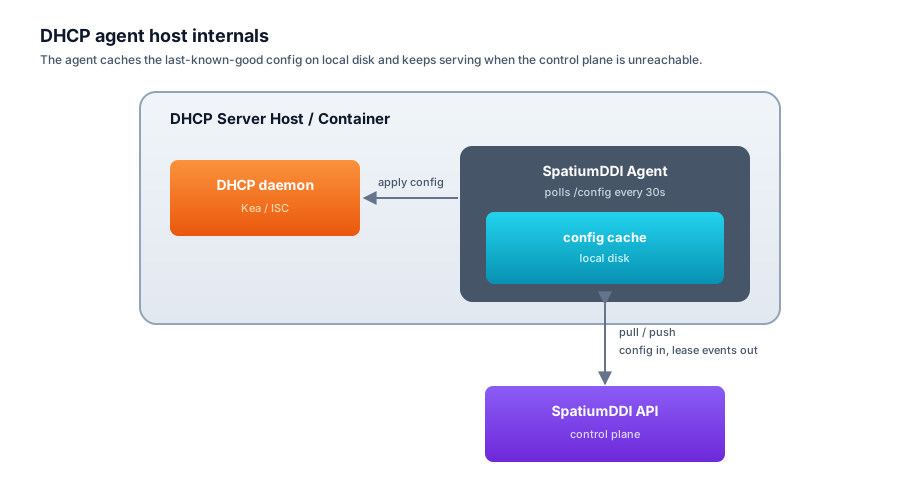
Agent Behavior
When control plane is reachable:
- Agent polls SpatiumDDI API for config changes every N seconds (configurable, default 30s)
- On config change: agent validates new config, writes to local cache, applies to DHCP daemon
- Agent reports lease events back to SpatiumDDI API in real time
- Agent writes a “last successful sync” timestamp to local disk
When control plane is unreachable:
- Agent detects connectivity failure after 3 consecutive failed polls
- Agent logs:
"Control plane unreachable — operating from cached config" - Agent continues serving from cached config — DHCP service is NOT interrupted
- Agent retries connectivity every 60 seconds
- On reconnect: agent reports “gap period” lease events in bulk
Cache Format
Cached config is stored in a structured JSON file:
{
  "version": "1.4.2",
  "generated_at": "2024-01-15T14:30:00Z",
  "checksum": "sha256:...",
  "scopes": [...],
  "pools": [...],
  "static_assignments": [...],
  "client_classes": [...]
}
The Kea daemon config file (JSON) is generated from this cache. On startup, the agent always checks if the cache is newer than the running daemon config and applies if so.
Cache Invalidation
- Cache is never automatically deleted
- A manual “force resync” is available from the admin UI (
POST /api/v1/dhcp/servers/{id}/sync) - Cache version is tracked; SpatiumDDI will reject applying a cache version older than the current DB version
Last-known-good revert (issue #882)
The section above covers a control plane that is unreachable. It does not cover one that is wrong — a bundle that renders to a Kea config the daemon refuses.
Two files back the fallback, under config/ in the agent state dir:
previous.json is the last bundle Kea accepted (not, as it used to be,
whichever bundle came before this one — that rotation destroyed the fallback
after two poll cycles), and quarantine.json records an etag whose apply
failed so it is not re-rendered on every poll.
Kea’s config-test is what makes the distinction usable: a rejection is a
verdict about the config, whereas an unreachable control socket says nothing
about it — Kea may simply be restarting. Only a rejection reverts; reverting
on an unreachable socket would discard a good bundle because of a timing
accident.
The revert rewrites the on-disk kea-dhcp4.conf / kea-dhcp6.conf, not just
the agent’s bookkeeping. config-test rejects without disturbing the
running daemon, so Kea itself is fine either way — but the refused document
has already been written to those paths, and that file is what Kea reads on
its next start. Leaving it turns a rejected apply into a crash loop the next
time the container restarts.
Before #882 a refused config was reported as a success: the loop advanced
its etag, called _record_success(), logged dhcp_config_applied and stamped
the Kubernetes readiness marker. The agent now reports the verdict on its
heartbeat (config field → dhcp_server.config_apply_*), which drives the
server-row chip, the agent_config_rejected alert rule and the
find_agents_with_config_failures Copilot tool.
7. DHCP ↔ IPAM Synchronization
Push (IPAM → DHCP Server)
Triggered by:
- Scope/pool/static assignment create/update/delete
- Manual “Force Sync” from UI
- Scheduled full sync (default: every 5 minutes)
The push is diff-based — only changed objects are sent, not a full config replacement. This prevents unnecessary DHCP server disruption.
Pull (DHCP Server → IPAM)
Triggered by:
- Lease events (real-time via webhook or Kea hook)
- Scheduled lease dump pull (fallback)
- Manual “Import Leases” from UI
Reconciliation Report
Available from the admin UI: compares IPAM DB state vs. live DHCP server state and flags:
- IPs in DHCP scope but not in IPAM
- Static assignments in DHCP not in IPAM
- Scopes in DHCP not known to IPAM
8. Import / Export
Export (IPAM → file)
- Export all DHCP scopes + pools + static assignments for a server or subnet
- Formats: JSON (native), Kea config JSON
Import (file → IPAM)
- Import from Kea JSON config
- Import from CSV (static assignments: IP, MAC, hostname columns)
- Dry-run mode: shows what would be created before committing
- Conflict resolution: skip / overwrite / error on duplicates
Migrating from an existing DHCP server (issue #129)
The DHCP configuration importer is the one-shot path for loading a
real DHCP estate into SpatiumDDI without retyping every scope, pool,
reservation, and option-set. It lives under DHCP Import in the
sidebar (gated by the dhcp.import feature module, default-on) and
covers three sources:
- Kea — upload a
kea-dhcp4.conf/kea-dhcp6.conffrom a non-managed daemon. - Windows DHCP — live-pull every IPv4 scope from a registered
windows_dhcpserver over WinRM (reuses the Path A read driver). - ISC DHCP — upload a
dhcpd.conf(the importer ships its own tokeniser; ISC is supported as an import source only — SpatiumDDI does not run ISC daemons).
The flow is preview → commit: the preview parses the source and shows
the would-create scopes (with pool / reservation counts, conflicts,
IPAM linkage, and a “didn’t import” panel) before any DB write; commit
writes each scope in its own savepoint. Every imported row is stamped
with import_source + imported_at provenance. Each scope either
links to an existing IPAM subnet on its CIDR or auto-creates one under
an operator-chosen IP space + block. Live leases are never imported
— they repopulate from the running daemon once a Kea server is attached
to the target group.
Full reference: Migration. Parser internals: DHCP Drivers § Importing existing daemon configs.
9. DHCP Permissions
| Role | Capability |
|---|---|
| superadmin | Full server, scope, pool, static assignment management |
| admin (subnet scope) | Manage scopes and static assignments within their subnets |
| operator (subnet scope) | Add/modify/delete static assignments; cannot change pool ranges |
| viewer | View scopes and leases; no modifications |
10. Environment Variables for DHCP
DHCP_SYNC_INTERVAL_SECONDS=30       # How often agents poll for config
DHCP_LEASE_SYNC_INTERVAL_MINUTES=5  # Fallback polling for leases
DHCP_CONFIG_CACHE_PATH=/var/cache/spatiumddi/dhcp-config.json
DHCP_AGENT_RECONNECT_INTERVAL=60    # Seconds between reconnect attempts
DHCP_AGENT_MAX_CACHE_AGE_HOURS=72   # Alert if cache older than this
11. DHCP Options Reference
The following standard DHCP options can be configured at the scope, pool, or host level. All options are configurable in the UI and via API. Parent scope options are inherited by child pools unless overridden.
| Option Code | Name | Description |
|---|---|---|
| 1 | Subnet Mask | Auto-computed from subnet prefix |
| 3 | Router | Default gateway IP(s) |
| 6 | Domain Name Server | DNS server IPs. Canonical option name is dns-servers; the IANA name domain-name-servers is accepted as a legacy alias on write and still maps to code 6 on read |
| 12 | Host Name | Override hostname sent to client |
| 15 | Domain Name | DNS search domain (e.g., corp.example.com) |
| 28 | Broadcast Address | Auto-computed |
| 43 | Vendor Specific | Raw hex or vendor-specific encapsulated options |
| 51 | IP Address Lease Time | Seconds; default lease time |
| 58 | Renewal Time | T1 (default: 50% of lease time) |
| 59 | Rebinding Time | T2 (default: 87.5% of lease time) |
| 66 | TFTP Server Name | Boot server hostname (PXE) |
| 67 | Bootfile Name | PXE bootfile path |
| 119 | Domain Search | Multiple search domains |
| 150 | TFTP Server Address | Cisco VoIP boot server IP |
Min/Max lease times: Configured as min_lease_time / max_lease_time on the DHCPScope. Clients requesting shorter/longer leases are clamped to this range.
12. Parent/Child Setting Inheritance
DHCP options follow the same inheritance model as IPAM:
IPSpace → IPBlock → Subnet → DHCPScope → DHCPPool → DHCPStaticAssignment
At each level, options can be:
- Inherited (not set → use parent’s value)
- Overridden (set → use this level’s value, ignoring parent)
- Extended (for list-type options like domain-search: append to parent list)
Example:
IPSpace: Corporate
  domain-name: corp.example.com

  Subnet: 10.1.2.0/24 (HR VLAN)
    domain-name: hr.corp.example.com   ← overrides parent

    DHCPPool: Guest
      domain-name: guest.corp.example.com  ← overrides subnet
      lease-time: 7200                      ← 2-hour lease for guest
13. Hostname → IPAM Sync (Configurable)
When a DHCP client receives a lease, the hostname provided by the client can be automatically written back into the IPAM module (setting IPAddress.hostname).
DHCPScope.hostname_to_ipam_sync: enum(disabled, on_lease, on_static_only)
| Mode | Behavior |
|---|---|
disabled |
No hostname sync — IPAM hostname is managed manually |
on_lease |
Hostname from every new DHCP lease is written to IPAM |
on_static_only |
Only static DHCP assignments sync hostname to IPAM |
Recommendation: Set to disabled or on_static_only for large dynamic subnets (e.g., WiFi /16) where lease hostname data is noisy. Set to on_lease for server subnets where every IP should have a known hostname.
14. DHCP Pool Coordination — Kea HA on a Server Group
When two DHCP server containers serve the same pool, they must not hand the same IP to different MACs. SpatiumDDI solves this by treating a DHCPServerGroup with two Kea members as an implicit HA pair — HA tuning lives on the group, per-peer URL lives on each server, and Kea’s libdhcp_ha.so hook is rendered on every member’s config. There is no separate “failover channel” row any more (that was removed in 2026.04.22-1 when scopes moved to the group).
Data model
- HA config fields live on
DHCPServerGroup:mode,heartbeat_delay_ms,max_response_delay_ms,max_ack_delay_ms,max_unacked_clients,auto_failover. - Each
DHCPServerhas its ownha_peer_url— the listener endpoint the partner calls for heartbeats + lease updates. Empty string for standalone servers. - A group with one Kea member is standalone; HA fields are ignored. A group with two Kea members + non-empty
ha_peer_urlon both renders HA into their configs. Three-or-more Kea members is nonsensical forlibdhcp_ha.so(it only speaks pairs) and should be validated at the CRUD layer. - Mixed groups (Kea + Windows DHCP read-only) are allowed — only the Kea members participate in HA.
Modes
hot-standby— one active peer + one passive standby. The primary serves all clients; the standby takes over onpartner-down. Secondary peer’s role is rendered asstandbyin the HA hook.load-balancing— both peers active; Kea splits traffic by hash of client identifier. Secondary peer’s role is rendered assecondary.
What the agent ships
On each ConfigBundle long-poll, the control plane emits a failover block alongside scopes / client-classes when the server’s group is an HA pair. The agent’s render_kea.py injects two hook entries in Dhcp4.hooks-libraries:
{ "library": "/usr/lib/kea/hooks/libdhcp_lease_cmds.so" }
{ "library": "/usr/lib/kea/hooks/libdhcp_ha.so",
  "parameters": {
    "high-availability": [{
      "this-server-name": "<local server name>",
      "mode": "hot-standby|load-balancing",
      "heartbeat-delay": 10000,
      "max-response-delay": 60000,
      "max-ack-delay": 10000,
      "max-unacked-clients": 5,
      "peers": [
        {"name": "dhcp1", "url": "http://10.0.0.5:8000/", "role": "primary",   "auto-failover": true},
        {"name": "dhcp2", "url": "http://10.0.0.6:8000/", "role": "standby",   "auto-failover": true}
      ]
    }]
  }
}
The libdhcp_lease_cmds.so hook is a hard prerequisite for HA and is loaded unconditionally — leaving it out will cause the HA hook to refuse to load.
Live state reporting
A fourth thread in the agent (HAStatusPoller, agent/dhcp/spatium_dhcp_agent/ha_status.py) calls status-get against the local Kea control socket every ~15 s with small jitter and POSTs the result to POST /api/v1/dhcp/agents/ha-status. Kea 2.6 folded HA state into the generic status-get response under arguments.high-availability[0].ha-servers.local.state; the extractor also accepts pre-2.6 ha-status-get shapes for forward-compat. The control plane stores the state on DHCPServer.ha_state + ha_last_heartbeat_at. The poller self-disables when the most recent bundle carried no failover block, so standalone servers don’t spam Kea with commands that return an error.
Kea state names pass through verbatim (normal / hot-standby / load-balancing / ready / waiting / syncing / communications-interrupted / partner-down / backup / passive-backup / terminated). The DHCP server detail header renders a colored HA: <state> pill. The dashboard’s DHCP column lists one row per HA-paired group with a state dot per peer. The group detail view shows the same pill inline per-server so you can see HA state without drilling into each server page; use the Refresh button there after changing HA mode to repaint without waiting for the 30 s React Query poll.
Peer IP drift self-healing
Kea’s HA hook parses peer URLs with Boost asio, which only accepts IP literals — hostnames aren’t looked up by Kea itself. The agent resolves hostnames at render time via _resolve_peer_url, but the IP can change afterwards (compose --force-recreate, k8s pod restart, bridge-IP reshuffle), leaving Kea pointing at a stale peer. A fifth thread (PeerResolveWatcher, agent/dhcp/spatium_dhcp_agent/peer_resolve.py) re-resolves peer hostnames every 30 s and, if any have drifted, triggers a render + config-reload with the fresh URL. Resolution failures are treated as transient (keep the cached IP, try again next tick), so a brief DNS outage doesn’t thrash reloads.
Not yet shipped (follow-up)
- State-transition actions —
ha-maintenance-start,ha-continue, force-sync. The state machine is observable today but operators can’t drive it from the UI;kubectl exec+ manualkea-shellis the workaround. - Peer compatibility validation — the control plane doesn’t yet refuse groups with ≥ 3 Kea members (Kea HA only supports pairs).
- Per-pool HA scope tuning — the Kea HA hook supports per-subnet scope overrides; we render the relationship globally only.
- Kea version skew guard —
status-getHA shape shifted between Kea 2.4 and 2.6. The extractor handles both, but the control plane still accepts pairing peers on mismatched Kea versions. - DDNS double-write under HA — agent-side
apply_ddns_for_leasedoesn’t gate on HA state. If the standby ever serves a lease (pre-sync window, partner-down), both peers could try to write the same RR. - HA DHCP e2e test — the kind-based workflow stands up a single DNS agent; an HA DHCP variant would have caught all the bootstrap / port-split /
status-get/ wire-shape regressions shaken out in 2026.04.21-2.
Managing HA
HA is configured on the server group, not a separate page. Edit the group under the DHCP tab, pick mode (hot-standby / load-balancing), tune the heartbeat / max-response / max-ack / max-unacked fields if the defaults don’t fit your network, and make sure each Kea member has its HA Peer URL filled in (the server-level field) — typically http://<host>:8000/ on the SpatiumDDI-shipped image. The HA hook renders automatically once the group has two Kea peers with non-empty URLs. Removing a server from the group or clearing its URL drops the hook on the next config push.
15. Windows DHCP — Path A (read-only)
SpatiumDDI supports Windows Server DHCP as an agentless backend. Today’s implementation (Path A) is WinRM-driven and focused on lease mirroring — SpatiumDDI polls the Windows server for its active leases and reflects them into IPAM, but does not push config bundles. Path B (full scope/reservation CRUD via WinRM) is on the roadmap.
15.1 What’s implemented
| Capability | Status | Mechanism |
|---|---|---|
| Read leases | ✅ | Get-DhcpServerv4Scope + Get-DhcpServerv4Lease per scope, JSON-serialised back. |
| Read scopes | ✅ | Get-DhcpServerv4Scope + options + exclusions + reservations in one PowerShell call. |
| Per-object scope CRUD | ✅ | Add-DhcpServerv4Scope / Remove-DhcpServerv4Scope. |
| Per-object reservation CRUD | ✅ | Add-DhcpServerv4Reservation / Remove-DhcpServerv4Reservation. |
| Per-object exclusion CRUD | ✅ | Add-DhcpServerv4ExclusionRange / Remove-DhcpServerv4ExclusionRange. |
Bundle push (/sync) |
❌ | READ_ONLY_DRIVERS — rejected by the API. Windows DHCP is cmdlet-driven, not config-file-driven. |
reload / restart / validate_config |
❌ | Not applicable to Windows; raise NotImplementedError. |
The driver lives at app/drivers/dhcp/windows.py (class WindowsDHCPReadOnlyDriver). See DHCP_DRIVERS.md for internals.
15.2 Credentials
Stored on DHCPServer.credentials_encrypted as a Fernet-encrypted JSON dict:
{
  "username": "CORP\\spatium-dhcp",
  "password": "…",
  "winrm_port": 5985,
  "transport": "ntlm",
  "use_tls": false,
  "verify_tls": false
}
Service account requirements:
- Read-only lease mirroring: member of the Windows
DHCP Userslocal group. - Per-object scope/reservation/exclusion CRUD: member of
DHCP Administrators.
See WINDOWS.md for the WinRM + account setup.
15.3 Scheduled lease pull
Scheduled Celery beat task: app.tasks.dhcp_pull_leases.auto_pull_dhcp_leases. Beat fires every 10 seconds; the task gates on platform settings so the UI can change cadence without restarting beat. A 10-second beat tick means operators can configure near-real-time IPAM population from Windows DHCP — the interval is the only knob that limits poll frequency now.
| Setting | Default | Description |
|---|---|---|
dhcp_pull_leases_enabled |
off | Master toggle. |
dhcp_pull_leases_interval_seconds |
15 | How often to poll each agentless server, in seconds. Floor is 10 (matching the beat tick). Operators who don’t need sub-minute freshness can raise it to 60 / 300 / etc to reduce WinRM load. |
dhcp_pull_leases_last_run_at |
— | Populated after each pass; visible in Settings. |
Windows DHCP has no streaming primitive. The lease audit log (
DhcpSrvLog-<Day>.log) andGet-DhcpServerv4Leaseare the only real windows into the running service, and both are pull-based. WinRM itself is request/response —Get-Content -Waitdoes exist in PowerShell but it holds the HTTPS connection open indefinitely and can’t flush partial output back throughpywinrm.run_ps, so true push-style streaming would require an agent process on the DC that POSTs events back to SpatiumDDI. Short-interval polling is the practical upper bound without adding that complexity.
Per poll:
- Enumerate agentless DHCP servers (
DHCPServer.driver in AGENTLESS_DRIVERS). - For each, call
driver.get_leases(server)over WinRM. - Upsert the lease into
DHCPLeaseby(server_id, ip_address). - If the lease’s IP falls inside a known subnet, mirror it into
IPAddresswithstatus="dhcp"andauto_from_lease=True. - Absence-delete — any active
DHCPLeaserow for this server whose IP didn’t appear in the wire response is deleted, along with its mirroredauto_from_lease=TrueIPAM row. The Windows DHCP driver only returns currently-active leases, so absence from the response is the server’s way of saying “that lease is gone” (admin purged it, client released it, etc.). Before this fix, deleted-on-server leases persisted in our DB indefinitely becausepull_leaseswas upsert-only and the time-based cleanup sweep only looked atexpires_at. The response adds two counters —removed(lease rows dropped) andipam_revoked(IPAM mirrors cleaned up alongside) — both surface in the scheduled-task audit row and the manual sync modal. - The existing time-based
dhcp_lease_cleanupsweep still handles leases that drift pastexpires_atbetween polls (e.g. when lease pull is disabled). The two mechanisms overlap harmlessly.
Scope absence — not yet deleted. If an operator removes a scope on the Windows server, the DHCPScope row stays in SpatiumDDI’s DB until deleted via the UI. Scope-absence cleanup is tracked separately.
15.4 Manual “Sync Leases” button
Agentless DHCP servers have a Sync Leases button on the server detail header that runs the same lease pull immediately without waiting for the scheduled task. Useful after adding a new server, or when debugging a new lease. From the subnet detail, a [Sync ▾] dropdown with a DHCP entry fans out POST /dhcp/servers/{id}/sync-leases across every unique server backing a scope in that subnet and opens a result modal with per-server counters (active / refreshed / new / removed / IPAM revoked + any errors).
sync-leases is an agentless-only operation — agent-based Kea streams lease events continuously and converges scope/config via the ConfigBundle long-poll, so there is nothing to pull. As of 2026.06.25-1 (#453) calling it against an agent-based server is no longer a 400: the endpoint returns a no-op SyncLeasesResponse with an explanatory note (and nudges the agent to re-poll its config so the scope definition converges immediately), rendered as an info line in both the subnet sync modal and the server-detail banner.
15.5 Scope auto-import
The first lease pull against a Windows DHCP server also imports its scopes — scopes found on the server but not in SpatiumDDI are created with their options, exclusions, and reservations. This mirrors the auto-import pattern from the DNS “Sync with Servers” flow.
15.6 Not yet (Path B full CRUD)
Full config-push to Windows DHCP (analogous to Windows DNS Path B) would unlock:
- Scope options pushed from SpatiumDDI instead of being managed in the Windows DHCP MMC.
- Client class / policy rendering.
- DHCP failover pair configuration from SpatiumDDI.
The per-object CRUD methods are already in place (apply_scope, apply_reservation, apply_exclusion) — what’s missing is the API-side wiring that routes write events from the scope / pool / static endpoints into those methods for agentless drivers.
15.7 Migrating off Windows DHCP entirely (issue #756)
Everything above treats Windows as a supported backend. When the goal is to stop using it, the guided Windows cutover surface (feature module migration.cutover, ships disabled, /api/v1/migration/cutover, superadmin) drives the switch per scope: parity against the live server (lease time, pools, reservations, options), the lease handover, the switch itself, and a decommission checklist.
Two things matter here. The lease handover exists because the DHCP importer (§8) deliberately skips live leases — so a naive switch hands clients to a Kea with an empty lease database, and the first renewal offers a fresh pool address to a client still using the one Windows gave it. The handover promotes each live Windows lease to a reservation (stamped import_source="windows_cutover") so a renewing client keeps the address it already holds. And the switch is ordered: the Windows scope is deactivated before the managed scope is activated, so the two never answer the same subnet at once; if the managed side then fails to come up, the Windows scope is re-activated. Rollback reverses it, with the recovery-time expectation stated as the scope’s lease time. See MIGRATION.md.
16. Rules & constraints
Server-side validations that reject requests with a human-readable
error. Clients should render the detail string into their UI — every
rule here has been surfaced to an operator, not just silently logged.
Scopes
- Scope already exists for this group + subnet. A subnet may host
at most one scope per server group.
409atbackend/app/api/v1/dhcp/scopes.py. - Overlapping CIDR from another IP space (#844). IPAM allows the
same CIDR in different IP spaces (VRF semantics), but one Kea server
renders one
subnet4/subnet6entry per scope and rejects the whole config at load on a duplicate prefix — an outage for every scope on the group. Creating or activating a scope whose subnet overlaps another active scope’s subnet in the same group is refused.409atbackend/app/api/v1/dhcp/scopes.py; the bundle build additionally drops any raced-in duplicate (oldest scope wins, logged asdhcp_bundle_duplicate_prefix_dropped) so a bad combination can never reach an agent. Overlapping IP spaces need a separate DHCP server group per space. group_idrequired when multiple groups are registered. If more than one DHCP server group is defined, scope-create must name one explicitly; single-group deployments can omit the field.422atbackend/app/api/v1/dhcp/scopes.py.- Hostname sync mode must be one of the configured values. Mode
picker is validated against
VALID_SYNC_MODES; reserved / internal modes are not selectable from the API.422. - DDNS hostname policy enum.
ddns_hostname_policymust match one of the documented values (see §13). Pydantic validator. - A field must not be set twice, under both its names, to different
values. Two scope fields are accepted under two names:
enabled(what the response emits) is the same column asis_active(what the model, the services layer and this document call it), andhostname_sync_modeis the same ashostname_to_ipam_sync. Sending both names of a pair with values that disagree is a422; sending either name alone works as it always has. This closes a silent no-op: a read-modify-write —GET, editis_active,PUTthe whole representation back — used to resolve in favour of theenabledtheGETsupplied and answer200while the scope kept handing out addresses. Anullor empty string on either name counts as “not supplied”, not as a disagreement.422, #774.
Pools
- Pools in the same scope cannot overlap. Start/end ranges are
checked against every other pool on the scope before insert.
409atbackend/app/api/v1/dhcp/pools.py:143. - Pool type enum.
pool_typemust be inVALID_POOL_TYPES(dynamic,reserved,excluded). Validator atbackend/app/api/v1/dhcp/pools.py:40.
Static reservations
- Duplicate MAC in the same group. A MAC can only be reserved
once per server group, regardless of which scope it’s attached to
— under the group-centric model every peer in the group serves
the same reservation so duplicates across scopes in the same
group are rejected.
409atbackend/app/api/v1/dhcp/statics.py. - Static IP inside a dynamic pool is allowed (#631). Pinning a
reservation whose IP falls inside a
dynamicpool is the standard idiom on every driver we ship — Kea honours it (defaultreservations-out-of-pool: falsewon’t hand the reserved address to another client), FortiGate rendersreserved-addressindependently ofip-range, and Windows requires the reservation to fall inside the scope’s range. No conflict check refuses it. Pool occupancy counts in-pool reservations as assigned so exhaustion isn’t under-reported even while the reserved device is offline. - Reservation IP outside the scope’s subnet.
422atbackend/app/api/v1/dhcp/statics.py:177(issue #619). Kea renders a reservation nested inside its subnet’ssubnet4stanza and Windows binds it to the scope’s network address, so an out-of-CIDR reservation ships structurally invalid config to the agent — Kea refuses the whole config at load, taking every other reservation on that server down with it. Caught here as a legible 422 instead of a downstream agent failure. - A body
scope_idon create / update.422atbackend/app/api/v1/dhcp/statics.py:41(issue #619). A reservation belongs to its scope (uniqueness is keyed on it, and there is no renderable form of a relocated row), so on create the scope comes from the path and on update it cannot change at all. It used to be silently dropped with a200(Pydantic’s defaultextra="ignore"), so a caller re-pointing a reservation got no error and no effect. Rejected as a declared field rather than via a blanketextra="forbid"— that would also422an ordinary GET → edit → PUT round-trip, sinceStaticResponsecarries the server-ownedid/created_at/modified_at. - Malformed IP. Non-parseable IP strings return
422atbackend/app/api/v1/dhcp/statics.py:162. - Malformed hostname. The reservation hostname is operator-entered, so a
bad value is rejected (
422), not sanitized — RFC 1123 host rule, viaapp.core.dns_names.validate_hostnameatbackend/app/api/v1/dhcp/statics.py:30. (A client-supplied hostname arriving off the DHCP lease wire is sanitized instead — seeDNS.md§18.) - Malformed
domain-name/domain-searchscope option.422— validated as an FQDN atbackend/app/api/v1/dhcp/scopes.py:90.
Servers & server groups
- Duplicate server name. Each
DHCPServer.nameis globally unique.409atbackend/app/api/v1/dhcp/servers.py:228. - Driver enum.
drivermust be one ofkea,windows_dhcp.422atbackend/app/api/v1/dhcp/servers.py:73. - Read-only drivers refuse config push. Attempting to push a
config bundle to an agentless read-only driver (e.g.
windows_dhcp) returns400with a message directing the operator to/sync-leasesinstead.backend/app/api/v1/dhcp/servers.py:378. - Windows credentials must be complete on first set. Setting
credentials on a
windows_dhcpserver requires bothusernameandpassword— you can’t partial-update an empty credential blob. Later edits may include either field alone.400atbackend/app/api/v1/dhcp/servers.py:310. - Duplicate server-group name.
409atbackend/app/api/v1/dhcp/server_groups.py:73. - Server-group mode enum.
VALID_MODESonly; enforced atbackend/app/api/v1/dhcp/server_groups.py:35.
Kea HA (on a server group)
- At most 2 Kea members in a group.
libdhcp_ha.soonly supports pairs; adding a third Kea member makes the config ambiguous. Validation is a deferred follow-up (seeCLAUDE.md), not enforced at the CRUD layer today. - Group mode enum.
modemust bestandalone,hot-standby, orload-balancing. Enforced atbackend/app/api/v1/dhcp/server_groups.py. - HA rendering requires both peers’ URLs. If either Kea member in
a 2-member group has an empty
ha_peer_url, the config bundle drops thefailoverblock and neither peer loads the HA hook — silent fall-through to “not-yet-configured” state. - Mixed driver groups are OK. A group can contain Windows DHCP servers alongside Kea; only Kea members participate in the HA rendering path.
Client classes
- Duplicate client-class name per group. Class names are scoped
to the server group — every member renders the same classes.
409atbackend/app/api/v1/dhcp/client_classes.py.
17. Passive DHCP Fingerprinting (Phase 2 device profiling)
Auto-populate “what is this thing?” for every DHCP-leasing client by
sniffing each DISCOVER / REQUEST and looking the resulting
option-55 / option-60 signature up against fingerbank’s device
taxonomy. Pairs with the active layer (auto-nmap on lease) — both
write into the same IPAddress.device_type / device_class /
device_manufacturer columns, so the IP detail modal shows one
consolidated answer regardless of which layer enriched the row.
How it flows
- The DHCP agent’s
DhcpFingerprintShipperthread runs scapy’sAsyncSnifferagainst the BPF filterudp and (port 67 or port 68)and extracts option-55 (parameter request list), option-60 (vendor class), option-77 (user class) and option-61 (client id) from each DISCOVER / REQUEST. - Observations are buffered + deduped at the agent layer (one
batch per MAC per minute) and POSTed to
/api/v1/dhcp/agents/dhcp-fingerprintsevery 10 s in batches of up to 50. - The control plane upserts the fingerprint into the
dhcp_fingerprinttable (keyed by MAC) and enqueues a Celery task per fresh / changed signature. - The task hits fingerbank’s
/api/v2/combinations/interrogateendpoint, caches the result on the row for 7 days, and stamps matchingIPAddressrows (joined on MAC) with the resolveddevice_type/device_class/device_manufacturer. Rows withuser_modified_atset are left alone — the operator’s edits win.
Enabling it
The feature is default off for two reasons: it requires
CAP_NET_RAW to bind a BPF socket, and sniffing every DHCP
transaction is privacy-sensitive on guest / BYOD subnets.
On the agent — add the env var and the Linux capability to your compose override:
services:
  dhcp-kea:
    cap_add:
      - NET_RAW
    environment:
      DHCP_FINGERPRINT_ENABLED: "1"
      # Optional — defaults to "any" which works for host-networked
      # containers. Bridge-networked containers should pick a real
      # interface name (eth0, etc).
      DHCP_FINGERPRINT_IFACE: "any"
The shipped docker-compose.yml does not add NET_RAW
unconditionally — operators who don’t need fingerprinting shouldn’t
have to grant the capability. Same reasoning for not enabling it via
default env.
On the control plane — set the fingerbank API key in Settings → IPAM → Device Profiling. The form is a password-style input with a “Configured ✓ Replace… Clear” view once a key is on file (the encrypted value is never echoed back). Without a key, the agent still ships raw signatures (visible as the option-55 / option-60 strings under the “Raw signature” disclosure on the IP detail modal), but no enrichment runs. Get a key at https://fingerbank.org (free tier: 30 lookups / hour / account is plenty for small-to-medium fleets).
Privacy + data shape
The fingerprint table is MAC-keyed, not lease-keyed. We don’t record per-transaction history; one row per device, refreshed in-place on every observation. That means:
- A device that comes and goes still produces a single row with
last_seen_atbumped on every observation. - The raw option-55 / option-60 strings persist in the DB for operator triage. There’s no separate retention sweep — the table is bounded by the number of unique MACs the agent has ever seen, which scales with the size of your physical fleet.
- We don’t capture client IPs in fingerprints — the linkage to a
specific IP comes from
IPAddress.mac_addressand is updated on every lease event (the existing path).
Operator-facing UI
The IP detail modal surfaces both the enriched device line and (in a “Raw signature” disclosure) the option-55 / option-60 strings. The same surface lets operators force a re-lookup if they think the fingerbank result is wrong (the dispatched task ignores the cache window for that one MAC).
17a. Fingerprint-driven device policies (issue #700)
Section 17 tells you what a device is. Section 4 lets you treat
classes of device differently. This joins them: the operator picks
fingerbank device classes and an outcome — an option set, a lease
time, and optionally a pool — and SpatiumDDI compiles it into a real
Kea client-class test expression.
Device classes are fingerbank’s strings, not tidy categories
Worth setting expectations before the first policy: device_class is
fingerbank’s own taxonomy (the first parent of the matched device), and
it sits at mixed granularity. Verified against a live key, real values
look like:
device_class |
device_name |
score |
|---|---|---|
HP Print Server |
HP JetDirect Print Server | 89 |
Operating System |
Windows OS | 78 |
Generic Android |
Samsung Android | 60 |
Hardware Manufacturer |
Apple, Inc. | 29 |
Generic IoT |
Raspberry Pi | 15 |
There is no plain Printer or IoT class to select. Always pick from
GET …/device-observations rather than typing a string — one that does
not appear there compiles to an empty expression and renders nothing,
which looks configured and does nothing.
The score is part of the safety story, not decoration. A low
fingerbank score means it could not identify the device and fell back to
the MAC vendor — which is exactly what Hardware Manufacturer at 29
above is. A class like that groups unrelated hardware, so building a
quarantine on it targets an arbitrary set of unidentified devices. The
class picker shows the score per class and flags anything under 30, and
the compiler adds a warning when the best score among matched devices is
below that.
That produces NAC-lite outcomes with no 802.1X and no switch configuration: unknown and IoT devices get a short lease, a restricted resolver and a quarantine pool; corporate laptops get the normal treatment.
What the expression actually matches
Fingerbank classifies by querying their corpus with the signature a
device emitted. Kea cannot do that mid-packet, and there is no
device-class == IoT predicate to render. So the compiler matches
the signatures we have observed and had classified into the
selected classes — not the abstract category.
Two consequences, repeated in the UI rather than hidden:
- A device whose signature we have never seen matches nothing, however obviously it belongs to the category. It is classified on its first lease and the policy applies from the next renewal. Nothing here is instant enforcement.
- The policy tracks observation. As new signatures land in a selected class the expression grows on its own — which is the feature, but it also means the rendered config changes with no operator edit, and the bundle ETag legitimately shifts. It is bounded by distinct signatures, not device count, so it settles once the estate has been seen: a fleet of 500 identical handsets adds one term, not 500.
Ambiguous signatures are excluded by default
DHCP signatures are not unique to a device class. A minimal parameter
request list like 1,3,6,15 is emitted by embedded Linux in a
doorbell and by a rack server alike. If a signature appears on devices
both inside and outside the selected classes, matching it applies
the policy to devices the operator did not choose — which for a
feature whose headline use is “put unknown devices in a quarantine
pool” is how the CEO’s laptop ends up quarantined.
Such signatures are excluded, counted, and listed in the preview.
include_ambiguous is the explicit, audited opt-in.
Devices fingerbank has not classified are treated differently: they are not evidence of a different class (excluding an otherwise clean signature because of one would make the feature unusable before an API key is set), so they do not trigger ambiguity. They will receive the policy, so the count is reported instead — and only for signatures that survived filtering and the term cap, so the number reflects devices the rendered expression actually reaches.
Nothing device-controlled becomes syntax
Option 60 is a value the device chooses, and it lands inside a config file with quoting. Both halves of every term are emitted as hex literals:
(option[55].hex == 0x0103060F and option[60].hex == 0x4D53465420352E30)
so a vendor class of ' or 1-- becomes inert bytes rather than
expression syntax. Verified against kea-dhcp4 3.0.3.
A device that sent no option 60 compiles to not option[60].exists
rather than omitting the test — ignoring the absence would widen the
match to every device sharing the request list, including ones that
do send a vendor class.
The compiled expression is visible and overridable
GET /dhcp/device-policies/{id}/preview returns the expression, the
signatures behind it, the excluded ones, and the MACs currently
matched. match_override replaces the generated expression entirely,
and the preview still shows what the compiler produced so the two can
be compared. Nobody should end up debugging a black box against
kea-dhcp4.log.
An override is structurally checked at the API (balanced parentheses
and quotes, length). This is deliberately not a Kea expression parser
— operators need the real language for the escape hatch to be usable —
but Kea rejects a malformed config whole, so an unbalanced paren
would stop every other class, scope and reservation in the group
converging, not just this policy. Same blast radius named.conf
validation exists for in #876 / #899. The agent still runs Kea’s own
config-test before applying, and #882’s quarantine means a rejected
bundle is reverted rather than re-applied in a loop.
Rendering
| Property | Value |
|---|---|
| Table | dhcp_device_policy (migration f3b8d21c74ae) |
| Kea class name | spatium-device-<slug>, stored not derived |
| Per-class lease | Kea valid-lifetime on the class |
| Address family | DHCPv4 only — options 55/60 are v4 option codes |
| Order | After operator, PXE and phone classes |
class_name is a stored column rather than derived from name at
render time. Pools bind to a class by name via
DHCPPool.class_restriction, so regenerating it on rename would leave
every pool restricted to a class that no longer exists — which Kea
accepts, and which silently stops the pool serving anyone.
A policy that compiles to nothing is dropped, never rendered with
an empty test: a Kea client class with no test matches every packet,
which would hand a quarantine’s option set and lease time to the whole
network. The agent renderer fails closed the same way.
The maximum number of signature terms in one expression is 128. Kea’s parser is not the constraint (a 1024-term / 32 KB expression loads fine); per-packet evaluation cost and operator legibility are. Hitting the cap is reported, never silent.
Endpoints
| Method | Path |
|---|---|
| GET/POST | /dhcp/server-groups/{gid}/device-policies |
| GET/PUT/DELETE | /dhcp/device-policies/{id} |
| GET | /dhcp/device-policies/{id}/preview |
| GET | /dhcp/server-groups/{gid}/device-observations |
Permissions ride on dhcp_client_class — a device policy is a
client class, generated rather than hand-written — so the builtin DHCP
Editor role gains read with no role migration. Writes are
superadmin, matching the hand-authored client-class surface rather
than quietly widening it: the two produce the same Kea object, and a
policy that can move devices into a quarantine pool is not a smaller
privilege than typing that class by hand.
The preview is genuinely read-only — it commits nothing, so it cannot
become an unaudited write on a path authorised by read and not gated
by maintenance mode.
A vendor class that was stored after a lossy decode (option 60 arrived
as non-UTF-8 and DHCPFingerprint decodes with errors="replace") is
refused, not re-encoded: EF BF BD is not what the device puts on
the wire, so the term could never match while the preview claimed the
device was caught. It falls back to matching option 55 alone.
MCP: find_dhcp_device_policies and preview_dhcp_device_policy,
both read-only and default-enabled.
Deferred: auto-creating the quarantine pool alongside the policy (today the operator points a pool’s class restriction at the generated class name); DHCPv6, which needs the option 16 / ORO equivalents and a different fingerbank input; and rules that key on fingerbank device name rather than class.
18. PXE / iPXE provisioning profiles (issue #51)
Operator-curated pxe_profile rows wrap the per-architecture TFTP
boot story so the same scope can serve legacy PXE BIOS, EFI x86_64,
EFI ARM64, and EFI x86 clients without hand-written client classes.
Data model. New pxe_profile table — name + description +
next_server (TFTP host) + four nullable boot_filename_* columns
keyed on architecture (bios_x86 / efi_x86_64 / efi_arm64 /
efi_x86) + an optional ipxe_script body. Profiles live at the
DHCP server-group level so the same profile serves every Kea
server in the group.
Per-scope binding. DHCPScope.pxe_profile_id is a SET-NULL FK
to pxe_profile. The scope create / edit modal surfaces a “PXE
profile” picker; null = no PXE on this scope.
Kea render. When a scope has a PXE profile attached, the agent
renders one client-class per arch-match (matching DHCP option 93
via option dhcp.client-arch) plus one iPXE class guarded by a
substring match on option dhcp.user-class so legacy PXE clients
see the BIOS bootfile and iPXE clients (which loop back with the
iPXE user-class set) jump straight to the chained iPXE script.
Admin UI. New /dhcp/groups/{id}/pxe page lists profiles for a
group with create / edit / delete + an in-line preview of the
rendered Kea client-class block.
19. IPv6 Router Advertisements + rogue-RA detection (issue #524)
SpatiumDDI ships DHCPv6 via Kea, but Kea does not emit ICMPv6 Router
Advertisements. This feature lets the DHCP agent run radvd from
config rendered by the control plane, and passively watches the segment
for rogue RAs. Both live behind the ipv6.router_advertisements feature module, which
ships disabled (Settings → Features): it is the one DHCP-adjacent surface
that ends in something transmitted onto the wire, and a v4-only install has no
use for it (#1069).
19.1 RA management (radvd)
RA config is per-IPv6-scope, opt-in via DHCPScope.ra_enabled. When on,
the control plane renders a full radvd.conf stanza for the subnet and
ships it in the DHCP ConfigBundle (radvd_conf, folded into the
bundle ETag so a change wakes the agent long-poll — same path as the Kea
config). The agent writes it to RADVD_CONFIG_PATH and reloads radvd
(SIGHUP via pidfile); the last-known-good config rides the on-disk bundle
cache, so radvd keeps advertising if the control plane is unreachable
(non-negotiable #5).
Per-scope RA columns (v6 scopes only; edited in the scope modal’s IPv6 section):
| Column | Meaning |
|---|---|
ra_enabled |
Opt-in — emit RAs for this subnet |
ra_mo_override |
Use ra_managed_flag/ra_other_flag verbatim instead of deriving M/O from the mode |
ra_router_lifetime |
AdvDefaultLifetime (s); 0 = not a default route |
ra_max_interval |
AdvMaxInterval (s) between unsolicited RAs |
ra_prefix_valid_lifetime / ra_prefix_preferred_lifetime |
Advertised prefix lifetimes (s) |
ra_prefix_on_link / ra_prefix_autonomous |
Per-prefix AdvOnLink / AdvAutonomous (SLAAC) |
ra_interface |
Host NIC radvd advertises on (blank = agent RADVD_DEFAULT_IFACE) |
M/O derivation. By default the advertised M (Managed) / O (Other)
flags derive from the scope’s v6_address_mode: stateful → (1,1),
stateless → (0,1), slaac → (0,0). Set ra_mo_override to advertise
the literal ra_managed_flag/ra_other_flag instead.
RDNSS / DNSSL. The RA advertises RDNSS (RFC 8106 IPv6 resolvers) from
the scope’s dns-servers option (IPv6 only), falling back to the
subnet’s dns_servers; DNSSL search domains come from domain-search /
domain-name / the subnet’s domain_name.
Running radvd. radvd is baked into the Kea agent image but started
only when RADVD_MANAGED=1 (needs CAP_NET_RAW + CAP_NET_ADMIN and
host net.ipv6.conf.all.forwarding=1). The entrypoint waits for the
agent to render a config before launching radvd. The /dhcp/groups/{id}
→ Router Adverts tab previews the rendered radvd.conf + resolved
per-subnet M/O.
19.2 Rogue-RA detection
The IPv6 twin of the rogue-DHCP probe. An opt-in passive sniffer on the
DHCP agent (DHCP_RA_SNIFFER_ENABLED=1, same CAP_NET_RAW posture as
the fingerprint sniffer, default OFF) uses a scapy AsyncSniffer for
ICMPv6 type-134 RAs and ships each observed router (source IP + MAC,
advertised prefixes, M/O flags, router lifetime) to
POST /dhcp/agents/ra-observations.
The control plane classifies each source against the group’s
expected-router allowlist (ra_router_allowlist, matched on source
IP or MAC): on the list → expected, otherwise → rogue, upserting a
ra_observed_router row per (group, source IP). The rogue_ra alert
rule (seeded disabled, enable once the sniffer is on) fires on rows
classified rogue within its recency window and rides the standard
AlertEvent fan-out (syslog / webhook / SMTP / chat). Acknowledging a
router from the Router Adverts tab allowlists it and reclassifies it so
the alert auto-resolves.
19.3 API + MCP
REST (gated by the module): GET /dhcp/ra/groups/{id}/ra-config
(rendered preview), GET|POST /dhcp/ra/groups/{id}/observed-routers
(+/{id}/acknowledge), and GET|POST|DELETE
/dhcp/ra/groups/{id}/ra-allowlist. Operator-Copilot tools:
find_ra_subnets, find_observed_ra_routers, count_rogue_ra_routers
(reads, default on) + propose_allowlist_ra_router (write proposal).