DNS Agent / Container Architecture
Design spec for how SpatiumDDI ships, enrolls, configures, and operates the managed DNS service containers (BIND9) that sit on the data plane.
Status: Implemented — see post-#170 architecture note below.
Related:
CLAUDE.md(#5 config caching, #8 incremental DNS, #10 driver abstraction, #11 multi-arch),docs/features/DNS.md,docs/drivers/DNS_DRIVERS.md,docs/OBSERVABILITY.md.
Post-#170 architecture (2026-05-14)
The Appliance role (was “Application” pre-#272) + spatium-supervisor from
#170
reshape this document’s scope. Read this first; the historical
sections below describe the pre-#170 agent surface (still
functional for in-field installs — they keep registering against
/dns/agents/register with the long PSK).
What stays in the DNS service container: the agent sidecar
(agent/dns/spatium_dns_agent/) still owns every DNS-service-level
call: POST /dns/agents/register (the service identity, distinct
from the supervisor’s appliance identity), the ConfigBundle long-poll
(GET /dns/agents/config), DDNS lease events, per-zone serial
reporting on POST /dns/agents/zone-state, BIND9 query-log shipping,
and metrics push. None of those changed in #170 wave C.
What moved to the supervisor (#170 Wave C1): every
appliance-host concern. Slot telemetry, slot-upgrade trigger writes,
reboot trigger, SNMP / chrony reload triggers, deployment-kind
detection. The DNS service container drops the four host bind mounts
(/etc/spatiumddi-host, /boot/efi-host,
/var/lib/spatiumddi-host/release-state, /run/udev); the supervisor
mounts them instead and is the single producer of host-side state.
Service heartbeats (POST /dns/agents/heartbeat) no longer
carry the slot / deployment / upgrade-state block. The supervisor’s
new POST /api/v1/appliance/supervisor/heartbeat is the single
producer of appliance-row telemetry now.
Installer wizard for fresh installs uses the Appliance
role (was “Application” pre-#272; one of Full stack / Frontend / core /
Appliance). Operators no longer pick dns-agent-bind9 /
dns-agent-powerdns at the installer prompt; the control plane assigns
roles after admin approval in the Fleet tab. The legacy dns-agent-*
role names alias to the appliance role in firstboot so existing
in-field appliances keep booting through a slot upgrade.
The rest of this document — driver protocol, config layout, etc. — is unchanged and still authoritative for the service-container half of the split.
0. Terminology
| Term | Meaning |
|---|---|
| Control plane | The SpatiumDDI FastAPI + PostgreSQL + Celery stack. Source of truth. |
| Data plane | Running DNS daemons (BIND9) that actually answer queries. |
| Agent | The SpatiumDDI-shipped sidecar process that supervises a DNS daemon, renders configs, applies records, and talks to the control plane. |
| DNS container | A container image containing both the DNS daemon and the agent. |
| Driver | Server-side (control-plane) Python code implementing DNSDriverBase per daemon flavor (see docs/drivers/DNS_DRIVERS.md). |
1. Container Role & Topology
Decision
One image per DNS flavor, agent baked in as a second process, supervised by a lightweight init (tini + a small Python supervisor).
The agent images that ship:
| Image | Processes | Purpose |
|---|---|---|
ghcr.io/spatiumddi/dns-bind9 |
named + spatium-dns-agent |
Authoritative and/or recursive BIND9 |
ghcr.io/spatiumddi/dns-powerdns |
pdns_server + spatium-dns-agent |
Authoritative PowerDNS (LMDB backend) |
ghcr.io/spatiumddi/dns-technitium |
dotnet DnsServerApp.dll + spatium-dns-agent |
Authoritative Technitium DNS Server (v1: primary zones + standard records) |
The agent is the same Python codebase (spatium_dns_agent) in every image; the DNS daemon differs. The agent abstracts daemon specifics internally (symmetric to the control-plane driver, but on the container side).
Rationale
- Single image per flavor keeps operational surface small and lets the agent run
rndc, writenamed.conf, manage the SQLite/pgsql backend, and own the daemon lifecycle locally — none of which a detached sidecar can do without shared volumes and ambient capabilities. - Not a standalone sidecar because BIND9 config-file edits +
rndc reconfigrequire filesystem and UNIX socket co-location. A sidecar model adds complexity (shared PID namespace, shared volumes) with no benefit at our scale. - Not a single universal image because the daemons have different footprints and dependencies. Bundling every flavor into one image bloats it and widens the attack surface.
Alternatives considered
- Thin sidecar + upstream image (e.g.
internetsystemsconsortium/bind9): rejected — we lose control of base OS, healthchecks, multi-arch, and CVE response cadence. - Agent-less pure API management (control plane SSHes into each server): rejected — violates non-negotiable #5 (local config cache) and is brittle across network partitions.
2. Auto-Registration Protocol
Decision
Pre-shared bootstrap key (DNS_AGENT_KEY) for first-contact registration, then per-server JWT (agent_token) issued by the control plane, rotated on each heartbeat. The existing /api/v1/dns/agents/register + /agents/{id}/heartbeat endpoints are extended — the current shared-key model is kept as the bootstrap step and a token is issued on success.
Pairing-code path retired for standalone agents (#246)
The 8-digit pairing-code → PSK exchange originally landed in #169
shipped against a control-plane endpoint (POST /api/v1/appliance
/pair) that was retired under #170 Wave A3. Pairing-code flow now
lives entirely inside the Appliance supervisor —
the supervisor exchanges the code via POST /api/v1/appliance
/supervisor/register, gets the per-role agent keys back as part
of the heartbeat-response SupervisorRoleAssignment block, and
writes them into role-compose.env so the DNS / DHCP service
containers pick them up on first boot with zero operator action.
For standalone docker-compose / K8s DNS agents, paste the long
DNS_AGENT_KEY PSK directly into the agent’s env. The agent’s
pairing.py module was deleted in 2026.05.18-1 (#246) because the
/pair endpoint no longer exists — agents that had been bootstrapped
with BOOTSTRAP_PAIRING_CODE=<digits> were 404-looping forever
against the gone endpoint. The container entrypoint now requires
DNS_AGENT_KEY non-empty.
See docs/deployment/APPLIANCE.md §9 for the appliance
pairing-code workflow.
Flow
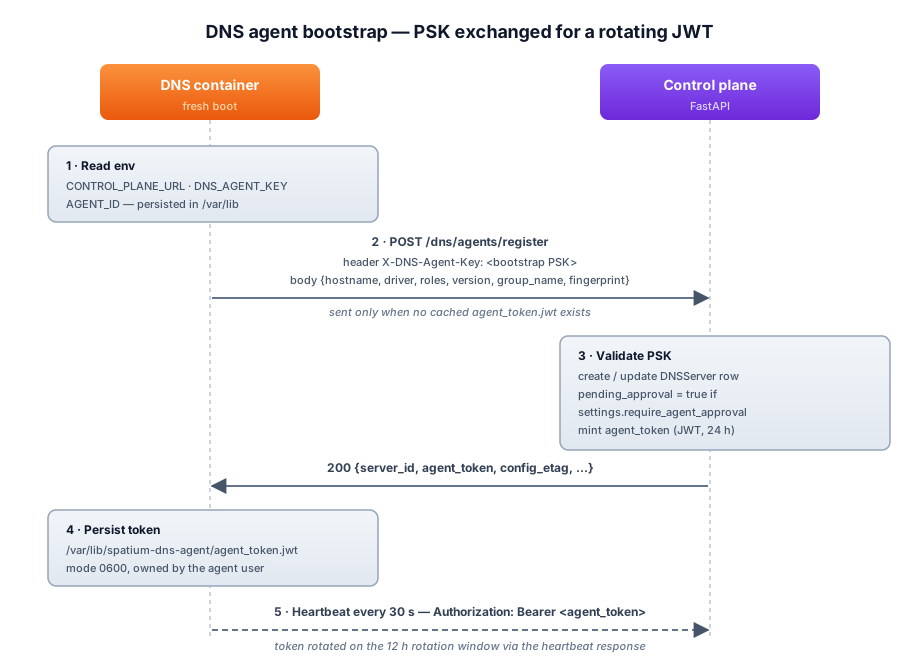
Identity
- AgentID — UUID generated once on first boot, persisted in
/var/lib/spatium-dns-agent/agent-id. Survives restarts; stable across re-registrations. - Fingerprint — SHA-256 of a locally-generated ed25519 public key, sent with registration; pinned on the
DNSServerrow. A changed fingerprint on re-registration triggerspending_approval=true(anti-hijack). - Bootstrap key rotation: admin rotates
DNS_AGENT_KEY; existing agents already hold a valid JWT and are unaffected until re-bootstrap.
Approval flow
A new platform setting require_agent_approval: bool (default false for homelab/single-tenant, recommended true for production) gates whether a freshly-registered agent is immediately active or sits in a pending_approval state visible in the DNS Server Group UI with an Approve / Reject action. Until approved:
- Agent receives
200and a token butconfig_version = null. - No config is served.
- Heartbeats still accepted (for telemetry).
Re-registration
On restart, the agent tries its cached token first. If the control plane returns 401, it falls back to bootstrap with the PSK. If the PSK has rotated too, the agent logs and enters a retry loop with jittered backoff (cap 5 min).
Alternatives considered
- mTLS with internal CA — more robust but requires a CA pipeline (cert-manager in K8s, something custom in Docker Compose). Deferred to Phase 4; the token model is a clean superset.
- First-contact UI approval with no PSK (Tailscale-style) — better UX but requires a pre-enrolled claim code in the container. Equivalent to our PSK with extra steps.
3. Config Sync Model
Decision
Hybrid: long-poll for config, push for urgent record changes, local disk cache as the source of truth for daemon operation.
Three channels:
| Channel | Direction | Transport | Purpose |
|---|---|---|---|
| Config long-poll | Agent → CP | GET /dns/agents/config with If-None-Match: <etag> (long hold) |
Full config bundle (views, ACLs, options, zone list). Returns 304 if unchanged, 200 with new bundle + new etag on change. The agent is identified by its JWT, not a path id. |
| Heartbeat | Agent → CP | POST /dns/agents/heartbeat (30 s interval) |
Liveness, daemon status, version, queued-change ACK, token rotation. |
Why not push / webhook from control plane to agent?
- Requires agent to expose an HTTPS listener, open an inbound port, and obtain a valid TLS cert. Non-negotiable #6 and general operational cost.
- Breaks behind NAT (on-prem appliances reaching a central control plane).
- Long-poll gives ~1 s effective latency and keeps the agent egress-only.
Why not pure polling (e.g. 30 s)?
- Record changes in DDNS flow must feel instant. Long-poll early-return delivers in <1 s.
Why not WebSocket / SSE?
- We considered it. Long-poll is simpler, survives hostile proxies, does not need sticky-session affinity on a multi-replica API. We can upgrade to SSE in a later phase without changing the agent contract (long-poll remains a compatible fallback).
RFC 2136 nsupdate responsibility
Agent-local. The control-plane BIND9 driver does not connect to named directly. Instead:
- Control plane computes the record delta and writes one
pending_record_opsrow per enabled agent-based server in the zone’s group (per-server queue keyed onserver_id). Pre-2026.05.14-1 the queue only went to theis_primary=Trueserver, which silently broke multi-server (and supervised-appliance) groups — secondaries’ on-disk zone files stayed frozen at the bundle they received on initial register. Under #170 every DNS agent renders the zone astype master(independent authoritative copy) so record CRUD has to land on every one. - Each agent pulls its own queued ops via config long-poll (the bundle ships
pending_record_opsfor any agent-based server regardless ofis_primary; theis_primaryflag now only matters for the agentless / Windows-DNS path where exactly one server writes). - The agent invokes
nsupdateagainst its own daemon over loopback. - The agent ACKs success/failure per-op on the next heartbeat.
Rationale: loopback nsupdate is simpler, never traverses the network as a TSIG-sensitive payload, and makes the agent the single enforcer of the local daemon state. The TSIG key lives only on the container.
The control-plane DNSDriverBase implementations become thin: they translate the DB model into a canonical AgentConfigBundle + RecordOp list. They do not speak nsupdate via RFC 2136 directly.
Local disk cache (non-negotiable #5)
Layout on /var/lib/spatium-dns-agent/:
agent-id                         # UUID, 0600
agent_token.jwt                  # current JWT, 0600
bootstrap.last                   # last-used PSK hash (for rotation detect)
config/
  current.json                   # last AgentConfigBundle FETCHED from the control plane
  current.etag
  previous.json                  # last bundle that APPLIED cleanly — the revert target
  previous.etag
  quarantine.json                # etag of a bundle that failed to apply, + its backoff
rendered/
  zones/
    example.com.db
    10.in-addr.arpa.db
  rpz/
    spatium-blocklist.rpz
tsig/
  ddns.key                       # 0600, owned by agent user; read by named via include
                                 #   ALL bundle keys, not just the group key: an
                                 #   operator DNSTSIGKey can be named in a zone's
                                 #   update ACL and in the allow-transfer grant,
                                 #   and BIND rejects a config naming a key it has
                                 #   no definition for
ops/
  inflight/                      # one file per unacked RecordOp
  failed/                        # ops that exhausted retries (surfaced in heartbeat)
Every path in the rendered
named.confis derived from the state dir (AGENT_STATE_DIR, default/var/lib/spatium-dns-agent) — zone files,rndc.key, the DoT/DoH cert and theincludefortsig/ddns.key. The key include was the one exception until #920: hardcoded to the default path, so under a non-default state dir the agent wrote the key file to one place and toldnamedto read another. If nothing exists at the default path that is a loudnamed-checkconffailure; if something does — a leftover from an earlier layout — it is silent, because the config validates, the apply reportsok, andnamedsimply holds a stale key set. Every TSIG-signed transfer then failsBADKEYwith nothing anywhere reporting a problem.agent/dns/tests/live_axfr_check.pynow asserts the include resolves to the render’s own state dir, and covers the operator-key-only group shape.
Offline operation: if the control plane is unreachable on boot, the agent loads config/current.json, renders configs if not already rendered, starts the daemon, and continues serving DNS. It enters a retry loop and resumes sync when the control plane returns. No query path ever depends on control-plane reachability.
Last-known-good revert (issue #882)
Offline operation covers a missing control plane. It does not cover a
wrong one: a bundle that parses fine but renders config named rejects.
Both agents wrote previous.json from the first release and neither ever
read it, so a bad-but-parseable bundle overwrote the cache and left the
agent with nothing to fall back to.
Two properties make the fallback real:
previousis the last bundle that APPLIED, not the last one fetched. It used to be rotated on every fetch, which destroyed the fallback in two poll cycles: a failing bundle leaves the etag unadvanced, so the next poll re-fetches the same bundle and rotates it — now known-bad — intoprevious. It is now written by an explicit commit after the driver accepts the bundle, and that commit refuses to run ifcurrentis not the bundle that was applied.- A failed etag is quarantined. The long-poll wakes on a 12 s tick with a 2 s poll fallback, so without this a bad bundle is not one failure but a re-render loop. The agent parks on the failing etag (the long-poll then blocks on a 304, costing nothing) and retries on a 60 s → 5 min → 15 min ladder, so a transient failure — a full disk mid-render, a daemon still starting — still recovers on its own. Any bundle that applies clears the record, as does the control plane simply serving a different etag.
The apply is phased — render → validate → swap/reload — and the phase decides
the recovery. BIND renders and validates into rendered.new, so a
named-checkconf failure never reached named: the daemon is already in the
state a revert would produce, and re-rendering the previous bundle there would
bounce a healthy server for nothing. Only a swap/reload failure, where the
live config directory has already been replaced, re-renders the previous
bundle. Kea is the mirror image — config-test rejects without disturbing the
running server, but the refused document has already been written to
kea_config_path, and that file is what Kea reads on its next start, so a
rejection there always rewrites the files even though the daemon is fine.
On restart the agent checks the quarantine before re-applying current.json:
a container that crash-loops must not re-break itself with the bundle that
broke it.
A revert is reported, never silent. That matters more than it sounds: a
reverted agent keeps serving and keeps heartbeating, so status, the health
check and last_seen_at all read normal while the zone the operator saved is
live nowhere. The verdict rides the heartbeat’s config field, lands on
dns_server.config_apply_*, and drives a chip on the server row, a banner on
the server detail, the agent_config_rejected alert rule and the
find_agents_with_config_failures Copilot tool.
4. Health & Telemetry
What the agent reports (heartbeat body)
{
  "agent_version": "2026.04.13-1",
  "daemon": {
    "flavor": "bind9",
    "version": "9.20.1",
    "running": true,
    "pid": 12,
    "started_at": "2026-04-14T12:00:00Z",
    "queries_per_sec_1m": 42.1,
    "cache_hit_ratio_5m": 0.87
  },
  "config": {
    "status": "ok",
    "etag": "sha256:...",
    "failed_etag": null,
    "phase": null,
    "error": null
  },
  "ops_ack": [
    {"op_id": "...", "result": "ok"},
    {"op_id": "...", "result": "error", "message": "NXRRSET"}
  ],
  "failed_ops_count": 0,
  "disk_free_bytes": 8123456789,
  "zone_serials": {"example.com.": 2026041407}
}
Endpoints
| Endpoint | Direction | Cadence |
|---|---|---|
POST /dns/agents/heartbeat |
agent → CP | every 30 s (jittered ±3 s) |
GET /dns/agents/config |
agent → CP | continuous long-poll |
POST /dns/agents/ops/{op_id}/ack |
agent → CP | piggybacked on heartbeat; separate endpoint reserved for out-of-band recovery |
POST /dns/agents/admin/rendered-config, POST /dns/agents/admin/rndc-status |
admin UI → CP → agent | pull-through for rendered config / rndc status |
Stale / unhealthy surfacing
- Control plane marks
DNSServer.status = unreachableif no heartbeat for 3 × heartbeat_interval (90 s default). - UI: the existing server-group view shows colored status dots; a new “Last seen” column uses
last_health_check_at. - A Celery beat job
dns_agent_stale_sweepruns every 60 s, flips statuses, emits an audit entry, and triggers notifications (Phase 4). - Metrics: Prometheus gauges
spatium_dns_agent_up,spatium_dns_agent_config_lag_seconds,spatium_dns_zone_serial,spatium_dns_failed_ops_total— scraped from the control plane (agent does not expose a scrape endpoint; keeps it egress-only).
5. Incremental Updates (Non-Negotiable #8)
Record lifecycle end-to-end
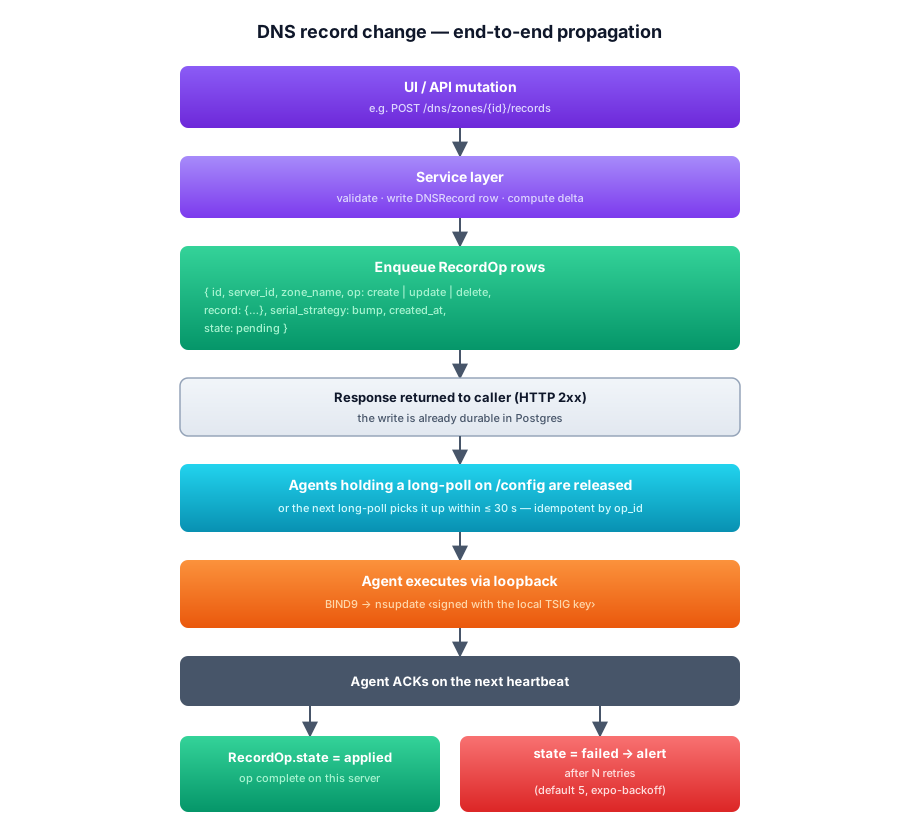
Serial bump responsibility
- Control plane bumps the logical serial when constructing the op:
YYYYMMDDNNformat, monotonically increasing per zone, persisted onDNSZone.last_serial. - The op carries the target serial. The agent’s
nsupdatescript explicitly deletes + re-adds the SOA with the target serial in the same update transaction (atomic under RFC 2136). - The API zone
PATCHincludes theserialfield. - Every enabled agent-based server in the zone’s group receives the record op — see “Group coordination” below. No server is skipped on the assumption that another server will hand it the data via transfer.
Group coordination (per-server-master fan-out — the default)
Under the post-#170 model (see §3), every enabled agent-based
server in a DNSServerGroup runs an independent authoritative copy
of each zone — the agent renders it as type master in named.conf
(agent/dns/spatium_dns_agent/drivers/bind9.py). There is no
primary→secondary push; SpatiumDDI is the source of truth and fans the
data out to every server directly.
- A record change enqueues one
DNSRecordOprow per enabled agent-based server in the group (enqueue_record_opinbackend/app/services/dns/record_ops.py). Each agent pulls its own queued ops via the config long-poll and applies them through loopbacknsupdateagainst its local daemon. DNSServer.is_primarydoes not mean “the only writer” for agent-based groups. It only orders the fan-out and identifies the server whose op the typed-event audit path reports back; every server still gets the write. (Pre-#170 the queue went to theis_primary=Trueserver only, which silently left every other agent’s on-disk zone files frozen at the bundle they received on initial register.)- If one agent is unreachable, its ops sit in
DNSRecordOp(state="pending")and drain when it returns; the other servers in the group apply immediately. The op state is per-server, so partial convergence is visible perserver_id.
Optional native secondary path. A zone may instead be declared a
secondary/slave/stubzone (issue #336) with an explicitmasterslist, in which case the daemon AXFRs the zone from those masters and the agent emits no zone file. That is an opt-in per-zone setting — not the default coordination model — and is the standard way to back a non-SpatiumDDI master.
Agentless / Windows DNS — the single-writer alternative
For agentless drivers (windows_dns plus the cloud-hosted DNS
drivers — see AGENTLESS_DRIVERS in
backend/app/drivers/dns/__init__.py)
there is no agent and no loopback nsupdate. Here the
is_primary=True server is the single writer: enqueue_record_op
detects the agentless driver and applies the op immediately from the
control plane via the driver (WinRM / PowerShell for Windows DNS,
provider REST for cloud DNS), landing the DNSRecordOp row directly as
applied or failed rather than queuing it for a long-poll. Any
native secondaries behind a Windows or cloud primary are coordinated by
that platform’s own NOTIFY/AXFR — SpatiumDDI neither proxies records to
them nor manages that transfer.
6. Security
| Concern | Decision |
|---|---|
| Bootstrap PSK | DNS_AGENT_KEY env var on both control plane and agent. 32-byte random (openssl rand -hex 32). Rotatable. Compared with hmac.compare_digest. |
| Agent token | JWT (HS256) signed by control-plane SECRET_KEY, 24 h lifetime, rotated silently via heartbeat response if within 12 h of expiry. Claims: sub=server_id, agent_id, fingerprint, exp. |
| TSIG keys | Generated by control plane on zone bind, stored encrypted at rest (Fernet, SECRET_KEY-derived). Transmitted to agent inside the config bundle over TLS. Agent writes to tsig/ddns.key at 0600, referenced by named.conf via include. |
| TLS | Agent↔CP is HTTPS-only. CP cert verified against the system CA bundle (+ optional CA_BUNDLE_PATH env for private CAs). Self-signed dev certs only when SPATIUM_INSECURE_SKIP_TLS_VERIFY=1 (dev only). |
| RBAC between agents | An agent’s JWT is scoped to its server_id. Config endpoint rejects requests for any other server. Record ops are likewise server_id-scoped; an agent cannot fetch another server’s TSIG keys. |
| Audit | Every config apply, op-apply, token rotation, and failed auth is audit-logged on the control plane. Agent-local audit is kept on disk for 7 days (rotated) and surfaced via /agents/{id}/diagnostics. |
7. Image Layout
Base
Alpine 3.23 for every agent image — except dns-technitium, which is not Alpine at all (see below). Multi-arch: linux/amd64, linux/arm64/v8 via docker buildx.
dns-powerdnscarries an LMDB schema guard. Alpine 3.23 ships pdns 5.0.5 (3.22 shipped 4.9.5), and PowerDNS 5.0 performs an automatic, silent, irreversible LMDB schema upgrade (v5 → v6) the first time it opens the database — a read is enough, and there is no opt-out. Afterwards pdns 4.9 cannot open the database at all (Somehow, we are not at schema version 5. Giving up). Because the LMDB is persisted on/varin every deployment shape, and the appliance A/B slot rollback swaps only the rootfs, an upgrade-then-rollback would otherwise leave pdns crash-looping with DNS down and no automatic recovery. #638 closed that: the entrypoint runsspatium-pdns-lmdb-guard snapshotbefore the agent spawnspdns_server, copying the database aside whenever the pdns major version changed and failing closed if it cannot. Rolling a PowerDNS node back is therefore a two-step operation — redeploy the old image AND runspatium-pdns-lmdb-guard restore latest. Full mechanics in DNS_DRIVERS.md §4.9.
Why
dns-technitiumis glibc/Ubuntu-based, not Alpine. Technitium ships no Alpine package and no binary release assets on GitHub at all (its releases carry notes only, zero attached artifacts — confirmed empirically). The only reproducible, versioned, multi-arch artifact it publishes is its own official Docker image (technitium/dns-server, Ubuntu 24.04 + .NET 10 aspnet runtime), soagent/dns/images/technitium/DockerfilebuildsFROMthat image and layers thespatium_dns_agentwheel on top rather than fetching a build artifact that doesn’t exist. The builder stage matches (Debianpython:3.12-slim-bookworm, not Alpine) sincespatium_dns_agentdepends oncryptography, which ships compiled wheels — a musllinux wheel built on Alpine wouldn’t load on the Ubuntu-based runtime. The image also explicitly upgrades to the distro’s patchedaspnetcore-runtime-10.0package and deletes the vendored/usr/share/dotnetcopy the upstream image ships, since Trivy’s .NET scanner reads shared-framework directories directly (notdotnet --list-runtimes) and would otherwise keep flagging CVEs in files nothing loads.
dns-bind9 image
FROM alpine:3.23 AS runtime
RUN apk add --no-cache bind bind-tools tini python3 py3-pip libcap ca-certificates tzdata
# Agent
COPY --from=agent-build /install /usr/local
COPY entrypoint.sh /usr/local/bin/spatium-dns-entrypoint
RUN addgroup -S spatium && adduser -S -G spatium spatium \
 && mkdir -p /var/lib/spatium-dns-agent && chown spatium:spatium /var/lib/spatium-dns-agent
VOLUME ["/var/lib/spatium-dns-agent", "/var/cache/bind"]
EXPOSE 53/udp 53/tcp
ENTRYPOINT ["/sbin/tini", "--", "/usr/local/bin/spatium-dns-entrypoint"]
Entrypoint (entrypoint.sh) responsibilities:
- Load/generate
agent-id. - Bootstrap / token refresh against control plane.
- Pull initial config bundle, render
named.conf, zone files, RPZ files, TSIG keys. - Validate with
named-checkconf. execa supervisor that runs two children:named -g -u namedand the agent’s sync loop. If either exits, kill the other and exit non-zero (let the orchestrator restart the container).
The dns-powerdns image follows the same shape — it swaps bind/named
for pdns_server (LMDB backend) but ships the same spatium_dns_agent
codebase and the same spatium-dns-entrypoint, and exposes the same
53/udp 53/tcp.
The dns-technitium image follows the same agent/entrypoint shape too,
but has no config file for the agent to render at all — Technitium is
configured entirely over its own HTTP API (http://127.0.0.1:5380), so
render()/validate()/swap_and_reload() collapse into “stash the
desired zone/record state as JSON, then reconcile it against the live
API.” The agent provisions a permanent API bearer token on first-ever
boot (via DNS_SERVER_ADMIN_PASSWORD + /api/user/createToken) the same
way the PowerDNS driver provisions its local API key.
Volumes
| Path | Purpose | Typical size |
|---|---|---|
/var/lib/spatium-dns-agent |
Agent state, config cache, TSIG, tokens | <10 MB |
/var/cache/bind (bind9 image) |
Zone files, journals | grows with zone count |
Both must survive restarts → named volumes in Compose / PVCs in K8s.
8. Kubernetes Shape
Decision
One StatefulSet per DNSServer row (umbrella chart,
charts/spatiumddi/templates/dns-agent.yaml), not per group. Headless
Service per StatefulSet (ClusterIP=None) plus an externally-exposed
Service of type LoadBalancer or NodePort for DNS traffic (UDP/TCP
53). On the appliance chart
(charts/spatiumddi-appliance/templates/dns-bind9.yaml) the same
service-container runs as a per-role-labelled DaemonSet instead.
Rationale
- DNS servers have stable identity (own TSIG keys, own agent token, own persistent zone files + config cache). That matches StatefulSet semantics.
- Each server is an independent authoritative copy. Per the
per-server-master fan-out model (§5), every agent in a group renders
the zone as
type masterand receives its ownDNSRecordOpqueue from the control plane — there is no primary→secondary AXFR/NOTIFY between them, and the control plane is the single source of truth. Therolevalue on a server is a cosmetic label (spatiumddi.org/dns-role, defaultprimary; passed to the agent asAGENT_ROLES); it does not wire up DNS-level replication. - Not a Deployment, because each server keeps per-replica persistent state (zone files, TSIG, agent identity) — replicas are not fungible.
- Not a DaemonSet in the umbrella chart, because placement is explicit (the appliance chart does use a DaemonSet, gated on a per-role node label).
- Shape:
DNSServerGroup "internal-resolvers"
 ├── StatefulSet/dns-internal-ns1  (replicas=1, type master, own record-op queue)
 │    └── Service/dns-internal-ns1 (LoadBalancer, 53/udp+tcp)
 └── StatefulSet/dns-internal-ns2  (replicas=1, type master, own record-op queue)
      └── Service/dns-internal-ns2 (LoadBalancer, 53/udp+tcp)
- Every record change fans out to both ns1 and ns2 as separate
DNSRecordOprows; each agent applies via loopbacknsupdateagainst its own daemon. There is no in-cluster zone transfer between them to coordinate. (A zone explicitly declaredsecondarywith amasterslist — issue #336 — is the opt-in exception that AXFRs from a non-SpatiumDDI master.) - Pod anti-affinity prefers landing ns1 and ns2 on different nodes.
Helm chart structure (Phase 2 deliverable)
charts/spatiumddi/                 # umbrella chart — DNS agents are one optional
  Chart.yaml                       # component under .Values.dnsAgents
  values.yaml                      # .dnsAgents.servers[] defines name, role, group, storage
  templates/
    dns-agent.yaml                 # StatefulSet + LB/headless Service per server
    service-headless.yaml
    pdb.yaml
    configmap-bootstrap.yaml # non-secret bootstrap config
    secret-agent-key.yaml    # references existing secret created by user
    servicemonitor.yaml      # optional, Prometheus
The SpatiumDDI control-plane operator (Phase 3 stretch) can render this from the DNSServerGroup DB state, but Phase 2 ships only the static Helm chart driven by values.yaml.
Docker Compose shape
One service per DNS server. Two servers in the same AGENT_GROUP are
independent type master copies that each get the group’s record-op
fan-out — there is no primary/secondary distinction at the Compose
level. Example added to docker-compose.yml:
dns-bind9-ns1:
  image: ghcr.io/spatiumddi/dns-bind9:${SPATIUM_VERSION}
  environment:
    CONTROL_PLANE_URL: http://api:8000
    DNS_AGENT_KEY: ${DNS_AGENT_KEY}
    AGENT_HOSTNAME: dns-bind9-ns1
    AGENT_GROUP: default
    AGENT_ROLES: authoritative   # cosmetic label; does not wire up replication
  volumes:
    - dns-bind9-ns1-state:/var/lib/spatium-dns-agent
    - dns-bind9-ns1-cache:/var/cache/bind
  ports:
    - "53:53/udp"
    - "53:53/tcp"
The agent reads
AGENT_ROLES(defaultauthoritative),AGENT_GROUP, andAGENT_HOSTNAME/SERVER_NAMEfrom the environment (agent/dns/spatium_dns_agent/config.py). The role is a label only — the control plane fans record ops out to every enabled agent-based server in the group regardless of role.
AGENT_GROUPonly decides where a BRAND-NEW agent lands. On re-registration the control plane resolves the existing row byagent_idand never rewrites itsgroup_id, so editing this variable does not move a server that has already registered — and leaving it stale does not drag a moved one back. To change a registered server’s group, move it in the control plane (group_idon the server PUT, or the Server group picker in its edit modal — seeDNS.md§1). Naming a group that does not exist still auto-creates an empty one, so a stale value here is untidy rather than harmful.
9. Deliverables for Wave 2 Implementation
Backend (control plane)
| File | Purpose |
|---|---|
backend/app/api/v1/dns/agents.py |
Split agent endpoints out of router.py: register, heartbeat, config (long-poll), ops/ack. |
backend/app/services/dns/agent_config.py |
Builds the AgentConfigBundle from DB state (zones, views, ACLs, options, TSIG keys, forwarders, blocklists). |
backend/app/services/dns/record_ops.py |
Enqueues RecordOp rows on record mutations; resolves primary server per zone. |
backend/app/services/dns/agent_token.py |
JWT mint/verify/rotate. |
backend/app/models/dns.py |
Extend with: DNSServer.agent_id, fingerprint, pending_approval, is_primary; new RecordOp model. |
backend/alembic/versions/<new>_dns_agent_ops.py |
Migration for the above. |
backend/app/tasks/dns.py |
Celery beat dns_agent_stale_sweep. |
backend/app/config.py |
Settings: DNS_AGENT_TOKEN_TTL, DNS_AGENT_LONGPOLL_TIMEOUT, require_agent_approval. |
Agent (new codebase)
| File | Purpose |
|---|---|
agent/dns/pyproject.toml |
Package spatium-dns-agent. |
agent/dns/spatium_dns_agent/__main__.py |
CLI entry; loads env, delegates to supervisor. |
agent/dns/spatium_dns_agent/supervisor.py |
tini-child; runs daemon + sync loop. |
agent/dns/spatium_dns_agent/bootstrap.py |
PSK registration + token persistence. |
agent/dns/spatium_dns_agent/sync.py |
Long-poll loop, config apply, op execution. |
agent/dns/spatium_dns_agent/cache.py |
Disk-cache read/write, atomic swap, rollback. |
agent/dns/spatium_dns_agent/drivers/bind9.py |
Render named.conf, zone files, RPZ; nsupdate loopback; rndc reconfig. |
agent/dns/spatium_dns_agent/heartbeat.py |
Heartbeat body, token rotation. |
Container images
| Path | Purpose |
|---|---|
agent/dns/images/bind9/Dockerfile |
Alpine + BIND9 + agent, multi-arch. |
agent/dns/images/bind9/entrypoint.sh |
Process-1 entrypoint. |
.github/workflows/build-dns-images.yml |
buildx, amd64+arm64, push to ghcr.io/spatiumddi/*. |
Kubernetes
| Path | Purpose |
|---|---|
k8s/dns/bind9-statefulset.yaml |
Reference StatefulSet. |
k8s/dns/service-dns.yaml |
Example LoadBalancer service (UDP+TCP 53). |
charts/spatiumddi/ |
Umbrella Helm chart — DNS agents are the dnsAgents section. |
k8s/README.md |
Add “DNS server deployment” section. |
Docker Compose
| File | Change |
|---|---|
docker-compose.yml |
Add optional dns-bind9-ns1 (+ dns-bind9-ns2) services under a dns Compose profile — independent type master copies in one AGENT_GROUP, no primary/secondary roles. |
.env.example |
DNS_AGENT_KEY= (with openssl rand -hex 32 hint). |
Docs
| File | Change |
|---|---|
CLAUDE.md |
Add docs/deployment/DNS_AGENT.md to Document Map. |
docs/deployment/DNS_AGENT.md |
This document. |
docs/drivers/DNS_DRIVERS.md |
Update: clarify that drivers emit AgentConfigBundle/RecordOp rather than speaking to daemons directly. |
docs/features/DNS.md |
Cross-link to this doc from §6 and §7. |
docs/OBSERVABILITY.md |
Add agent metrics (spatium_dns_agent_*). |
Acceptance criteria for Wave 2
docker compose --profile dns upstarts a BIND9 container that auto-registers and appears in the DNS UI within 10 s.- Creating an A record via the UI results in the record being resolvable via
dig @<container-ip> ...within 2 s. - Killing the control plane (
docker compose stop api worker) does not interrupt DNS resolution; restarting it within 1 h resumes sync with no record loss. - The container image passes
trivywith no high/critical CVEs at build time. - Helm chart deploys a 2-server group in
kind; both servers render the zone astype masterand a record created via the UI is resolvable against each server’sService(per-server record-op fan-out, no inter-server AXFR required).
10. Open Questions (Deferred)
- mTLS vs JWT: reconsider in Phase 4 once we have an internal CA story.
- IPv6-only deployments: agent must support AAAA-only control-plane URL; fine in theory, test in Phase 3.
- Windows DNS integration: explicitly out of scope for the agent model — Windows servers are managed via WinRM from the control plane (different driver branch, see roadmap).
- DNSSEC signing (online vs bump-in-the-wire): BIND9 inline-signing is assumed; key storage and rotation design now lives alongside the driver docs (
docs/drivers/DNS_DRIVERS.md§2.5).