System Administration Feature Specification
Overview
SpatiumDDI includes a comprehensive System Administration panel accessible to superadmins. This covers platform-level configuration, service management, health monitoring, notifications, and backup/restore. The goal is that a full platform can be configured entirely from the UI — no manual file editing required in normal operations.
0. Operator surfaces shipped after 2026.04.16-1
This document was originally written as a forward-looking spec. Several admin surfaces have since landed; the rest of this file remains the design reference for what hasn’t shipped yet.
Trash (/admin/trash) — landed in 2026.04.26-1
Soft-delete + 30-day recovery for IP spaces, blocks, subnets,
DNS zones / records, and DHCP scopes (with their pools + static
reservations cascading under the scope’s batch, so one Restore
brings the scope back whole — #617). See
IPAM § 15.16 for
the full data model + cascade-batch semantics. The admin page
lists deleted rows newest-first with type / since / q filters,
per-row Restore (with conflict-detail rendering when a live row
would clash) and Delete-permanently buttons. Nightly purge sweep
is operator-configurable via
PlatformSettings.soft_delete_purge_days.
Platform Insights (/admin/platform-insights) — landed in 2026.04.26-1
Read-only diagnostic surface so operators can see what their control plane is doing without standing up a separate Prometheus / pgwatch / Grafana pipeline. Five tabs:
- Postgres — version + DB size, cache hit ratio, current WAL
position, active vs max connections, longest-running
transaction (PID / age / state / query / app / client),
per-table size with autovacuum lag, connections grouped by
state with idle-in-transaction tinted amber, slow queries from
pg_stat_statementsif the extension is installed. - Redis — overview, keyspace breakdown, and the agent-wake pub/sub bus state.
- Containers — per-container CPU% (computed the same way
docker statsdoes), memory used / limit / %, network rx / tx, block-IO read / write. Default-filtered to thespatiumddi-*prefix; set the filter to empty to see every container on the host. Reportsavailable=falsewith a one-line setup hint when/var/run/docker.sockisn’t mounted into the api container. - Conformity — promoted from the Compliance surface; shows the latest conformity-evaluation rollup.
- Copilot Usage — Operator Copilot token / cost observability.
Backend at app/api/v1/admin/postgres.py (5 endpoints) +
app/api/v1/admin/containers.py (1 endpoint) +
app/api/v1/admin/redis.py (3 endpoints). All
superadmin-gated.
1. System Health Dashboard
The main Health Overview page gives a single-pane-of-glass view of the entire platform.
Component Health Grid
Each managed component shows a status card:
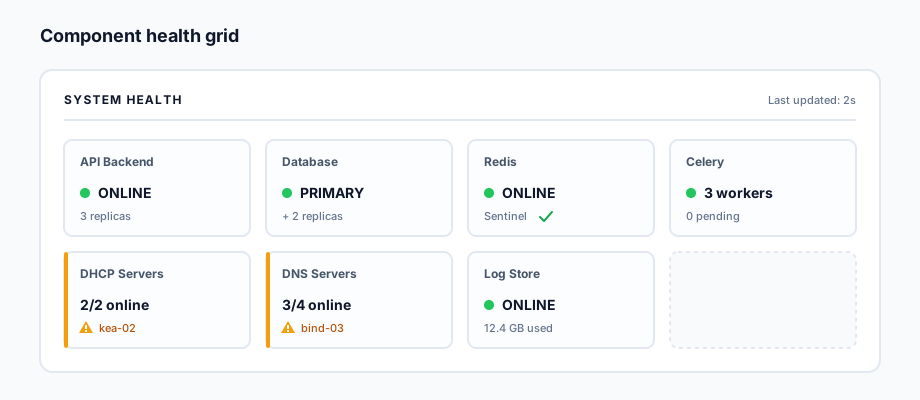
Per-Component Detail
Clicking any component opens a detail panel:
Database:
- Primary/replica status
- Replication lag (ms)
- Active connections / max connections
- Longest running query
- WAL archive status
- Last backup timestamp
DHCP/DNS Servers:
- Online/offline status per server
- Last successful sync timestamp
- Config version: IPAM DB version vs. pushed version
- Query rate (DNS), lease count (DHCP)
- Agent connectivity status
Celery Workers:
- Worker list with hostname, status, active tasks
- Queue depths per queue
- Failed task count in last hour
Redis:
- Sentinel / Cluster topology
- Memory usage
- Hit/miss ratio
Service Start / Stop / Restart (issue #890)
Admin → Platform Insights → Services. Superadmin-only, audited, and off by default on everything except the appliance.
This section previously described a Start/Stop/Restart surface spanning Docker, Kubernetes and bare-metal SSH
systemctl, none of which had been written — the appliance’s pod restart was the only thing that existed. What follows is what ships.
Capability first, not a 503
GET /api/v1/system/services answers which lifecycle backend this
deployment has before anything is attempted, so the UI renders the
actions that exist. That matters because the same 503 previously meant
both “this deployment cannot do that” and “the daemon is down”, and
those need opposite responses from the operator.
| Backend | Detected when | Actions | Mechanism |
|---|---|---|---|
kubernetes (flavor k3s-appliance or kubernetes) |
a Kubernetes ServiceAccount is projected into the api pod | restart |
rollout restart — bump kubectl.kubernetes.io/restartedAt on the pod template |
compose |
/var/run/docker.sock is mounted and the api can read its own com.docker.compose.project label |
start, stop, restart |
Docker API POST /containers/{id}/{action} |
none |
neither | — | the response names the missing mount |
start / stop are deliberately absent on Kubernetes. They would
mean scaling a workload to zero and back, and restoring the previous
replica count needs somewhere durable to remember it — a control plane
that forgets how many replicas a workload had is worse than one that
never offered to stop it.
Scope: the inventory is the allowlist
An action names a service from the inventory and is resolved against a fresh listing server-side. There is no second allowlist to keep in sync, and a caller-supplied id that is not currently one of ours is a 404 rather than a string handed to a daemon.
The id is the compose service name (api, worker) or Kind:name
for a Kubernetes workload (Deployment:spatiumddi-api) — never a
container id or pod name, which churn on exactly the restart the
operator just asked for. The separator is a colon, not a slash,
because the action route matches its path parameter as [^/]+ against
the unquoted path: a %2F in the id is unescaped before routing and
the request would 404 before reaching any handler.
- compose — only containers whose
com.docker.compose.projectlabel matches the api container’s own. This needs no configuration and cannot be widened by a request. It also fails closed: if the api cannot identify its own project (it is not running under compose, or the socket does not expose it), the backend reports unavailable rather than falling back to a name prefix, which a co-tenant container could match on purpose. - kubernetes — only workloads in the api pod’s own namespace
labelled
app.kubernetes.io/name=spatiumddiorapp.kubernetes.io/part-of=spatiumddi. An operator’s own Deployment in the same namespace is neither listed nor restartable.
Enabling it
| Deployment | Gate | RBAC / mount |
|---|---|---|
| Appliance | on — implied by appliance_mode |
granted by spatiumddi-firstboot (api.serviceControlRBAC) |
| Helm | api.serviceControl.enabled=true |
api.serviceControlRBAC.enabled=true (needs api.serviceAccount.enabled) |
| Raw manifests | SERVICE_CONTROL_ENABLED=true on the api |
kubectl apply -f k8s/service-control/rbac.yaml |
| docker-compose | SERVICE_CONTROL_ENABLED=true on the api |
mount /var/run/docker.sock + group_add: ["${DOCKER_GID}"] |
The two halves are independent and fail differently, which is why they are separate switches: without the gate the screen renders read-only and says so; without the RBAC, kubeapi answers 403 and the API reports “enable the service-control RBAC” instead of an empty inventory that would read as “nothing to restart”.
The appliance is exempt from the gate because
POST /api/v1/appliance/containers/{name}/{action} has shipped the same
control since #134 — requiring a new opt-in there would take a capability
away rather than add one. Everywhere else it is off because a
restart-capable docker.sock is equivalent to root on the host, and a
restart interrupts live DNS / DHCP / API traffic.
Restarting the API that serves the page
Allowed, and flagged in the response as self_targeted. The audit row is
committed and the 202 returned before the daemon is signalled — on
compose the container stops the moment the request is accepted, so
signalling inline would abort the response and the operator would see a
connection reset instead of confirmation. For the same reason the row
records result="accepted", not "success": nothing here survives to
observe the outcome. On Kubernetes a rollout keeps the current pod
serving until the replacement is ready, so this only bites on compose.
Fleet: remote appliances
The Fleet drilldown’s restart is a workload picker, fed by
GET /api/v1/appliance/appliances/{id}/k8s/workloads through the
supervisor’s kubeapi proxy, so it lists what that appliance actually
runs. It was previously a single button hardcoded to
deploy/dns-bind9 — a node running PowerDNS, Technitium or Kea had no
restart at all. Remote compose-based agents (legacy pre-#170 installs)
stay out of scope.
Not covered
Force sync and test connectivity are per-server DNS / DHCP
actions and live on those servers’ own pages, not here. Bare-metal
systemctl over SSH is not implemented and is not planned — the
supported non-container path is the appliance, which runs k3s.
MCP
find_services (read, default on, superadmin-only) reports the
capability and the inventory. propose_restart_service (default
off — non-negotiable #13) prepares a proposal the operator must
Apply; a restart is the widest non-destructive blast radius in the
product, so the copilot cannot offer it until an operator opts in.
2. System Configuration Sections
The System Configuration panel is organized into the following sections, each accessible via a settings menu.
2.1 Network Configuration (per node/container)
Configure the network settings for each SpatiumDDI node:
NodeNetworkConfig
  node_id
  interface: str         -- e.g., eth0, ens3
  ip_address: inet
  prefix_length: int
  gateway: inet
  dns_servers: inet[]
  search_domains: str[]
  mtu: int (default 1500)
  apply_method: enum(netplan, ifupdown, networkd, nmcli)
- Changes are applied via the SpatiumDDI agent on the target node
- Preview diff before applying
- Rollback available (reverts to previous config) if connectivity is lost after 60 seconds
2.2 Firewall Rules (per node/container)
Manage host firewall rules on SpatiumDDI nodes:
FirewallRule
  node_id (nullable — null = apply to all nodes)
  direction: enum(inbound, outbound)
  protocol: enum(tcp, udp, icmp, any)
  source_cidr: cidr (nullable)
  destination_cidr: cidr (nullable)
  port_range: str (nullable)   -- e.g., "80", "1024-65535"
  action: enum(allow, deny, log)
  priority: int
  description: str
Implemented via:
- Linux:
nftablesrules (preferred) oriptables - Containers: Rules applied to Docker network or Kubernetes NetworkPolicy
Default ruleset (enforced, cannot be deleted):
- Allow: HTTPS inbound (443)
- Allow: API port inbound from configured management networks
- Allow: Prometheus scrape from monitoring network
- Allow: all established/related
- Deny: all other inbound
2.4 Users and Groups (Platform-Level)
Separate from IP-range-scoped permissions — this section manages:
- Local user accounts (create, edit, enable/disable, reset password, force MFA)
- Local groups (create, manage membership)
- LDAP / OIDC sync configuration:
- Which LDAP OUs to sync groups from
- Group attribute mapping
- Sync interval
- Manual “Sync Now” trigger
- Last login per user
- Active sessions (with revoke capability)
2.5 API Tokens
APIToken
  id, name, description
  token_hash: str        -- only hash stored; token shown once on creation
  scope: enum(global, user)
  user_id (FK, nullable) -- if user-scoped
  permissions: JSONB     -- optional restriction (e.g., read-only, specific resource types)
  expires_at: timestamp (nullable)
  last_used_at: timestamp
  created_by_user_id, created_at
  is_active: bool
- Global tokens: used for automation, CI/CD, Terraform providers — permissions are explicit
- User tokens: scoped to the creating user’s permission set — cannot exceed user’s own rights
- Tokens are displayed once on creation (PBKDF2 hash stored)
- Tokens can be scoped to specific API paths (e.g.,
/api/v1/ipam/*only)
2.6 Syslog / Log Forwarding
SyslogTarget
  id, name
  protocol: enum(udp, tcp, tcp_tls)
  host, port
  format: enum(rfc3164, rfc5424, json)
  facility: enum(local0..local7, daemon, syslog)
  severity_filter: enum(debug, info, warning, error, critical)
  tls_ca_cert: text (nullable)
  is_enabled: bool
  applies_to: [enum(api, agent, dhcp, dns, audit)]
Multiple syslog targets can be configured simultaneously (e.g., local Loki + remote SIEM).
2.7 Audit Log Settings
- Retention period (default: 365 days)
- Export audit log: date range → CSV or JSON download
- Archive to S3-compatible storage (optional)
- Audit log is append-only — no delete capability, even for superadmin
- Fields logged on every mutation: user, timestamp, source IP, action, resource, old value, new value
2.8 Statistics / Reporting
Dashboard tiles showing platform-wide stats:
- Total IP spaces / blocks / subnets / addresses
- Overall utilization heatmap
- Top 10 subnets by utilization
- DHCP lease counts by server
- DNS query rates by server
- Recent audit log summary (top actors, most-changed resources)
- Scheduled report configuration:
- Report type (utilization, expiring leases, unused IPs)
- Schedule (daily/weekly/monthly)
- Output format (PDF, CSV, JSON)
- Delivery method (email, webhook, S3)
2.9 Backup and Restore
The Backup admin page (/admin/backup) ships four tabs: Manual (build-and-download / restore-from-file), Destinations (configured remote targets, scheduling, restore-from-destination), Restore Drills (scheduled proof that an archive is actually restorable), and Factory Reset (per-section wipe back to defaults). Everything described here is reachable from the UI; the same surface is exposed via REST under /api/v1/backup, /api/v1/backup/targets, and /api/v1/backup/drills so operators can drive it from automation.
What’s in the archive
A single .zip per backup, named spatiumddi-backup-{hostname}-{YYYYMMDD-HHMMSS}.zip:
| Member | Role |
|---|---|
manifest.json |
app_version, schema_version (alembic head), hostname, created_at, dump_format (plain or custom), secret_passphrase_hint |
database.dump (or database.sql for Phase 1 archives) |
Full pg_dump --format=custom of the SpatiumDDI database |
secrets.enc |
Operator-passphrase-wrapped JSON envelope carrying the source install’s SECRET_KEY + CREDENTIAL_ENCRYPTION_KEY (PBKDF2-HMAC-SHA256 600k → AES-256-GCM) |
README.txt |
Human-readable note covering format, restore steps, version compatibility |
The archive is the unit operators move around — single-file, easy to ship over SCP / drop into S3 / download to a laptop.
Passphrase rules
Operators supply a passphrase at backup time (min 8 chars). The passphrase wraps the secrets.enc envelope so the source install’s master key never lands in clear on disk anywhere. The same passphrase is required at restore. There’s also a passphrase_hint field — a free-text label (max 200 chars) that’s stored alongside the envelope so operators with multiple archives can remember which key decrypts which one.
The passphrase is not the destination’s auth credential — every destination type has its own credential fields (S3 keys, SCP password / private key, Azure account key, etc.) which are Fernet-encrypted at rest in the backup_target.config JSONB.
Destination kinds
All ten destination kinds register in the same driver registry; the UI’s destination picker reflects on GET /backup/targets/kinds so adding a new kind requires no frontend changes.
| Kind | Tier | Notes |
|---|---|---|
local_volume |
1 | Filesystem path on the api/worker container — production deployments mount this as a docker / k8s volume so archives survive container recycle. On the appliance this is also how a removable USB disk is used, via the mount plane below |
s3 |
1 | AWS S3 + S3-compatible (MinIO, Wasabi, Backblaze B2, Cloudflare R2, DigitalOcean Spaces) via the endpoint_url field |
scp |
1 | SSH password or PEM private key auth (paramiko); SFTP write/read; per-call connection lifecycle (no pooling) |
azure_blob |
1 | Azure Storage account via shared-key or full connection string |
smb |
2 | Windows / Samba shares (smbprotocol); NTLM auth, optional SMB3 encryption toggle |
ftp |
2 | Plain FTP / FTPS-explicit / FTPS-implicit; passive + active; verify_tls toggle for self-signed labs |
gcs |
2 | Google Cloud Storage; service-account JSON key (encrypted at rest) — no ADC by design |
webdav |
3 | WebDAV servers (Nextcloud, ownCloud, Apache mod_dav, IIS WebDAV, any RFC 4918 server) over httpx PUT / GET / PROPFIND / DELETE — no SDK dependency |
nfs |
2 | NFSv4 (default) / NFSv3 exports — a NAS (Synology / TrueNAS / QNAP) or a Linux file server. Speaks NFS in userspace via libnfs, so no kernel mount and no CAP_SYS_ADMIN; works identically on compose, Kubernetes and the appliance |
https_put |
3 | Any receiver that takes a PUT or POST — Artifactory / Nexus generic repositories, a presigned S3 URL, an internal receiver. Write-only by construction: no listing, no delete, no restore-from-destination, no drill |
Two export options decide whether NFS works at all. SpatiumDDI’s control
plane runs as a non-root user with no CAP_NET_BIND_SERVICE, so it connects
from an unprivileged source port — and Linux’s secure export option, which
requires a port below 1024, is the default (on a Synology the equivalent is
“allow connections from non-privileged ports”, also off by default). Add
insecure to the export options, or the mount is refused with a permission
error. The second is root_squash, covered below. The driver’s error message
names both, because they need opposite fixes and a confident diagnosis of the
wrong one sends the operator in circles: if the mount failed it is almost
certainly the port; if the mount succeeded and only the write was refused, it is
squash.
NFS has no authentication, and the form says so. AUTH_SYS is the only
security flavour v1 supports: the client asserts a uid and the server believes
it. A passing connection test therefore says nothing about who else on the
network can read the export. Archives are encrypted with the target passphrase,
so what an unrestricted export exposes is the metadata — archive names, sizes,
and how often you back up — not the contents. Restrict the export to the control
plane’s address on the server side, and set the destination’s uid / gid to an
identity the export grants write access (with the usual root_squash default,
presenting uid 0 gets mapped to nobody and every write fails; the driver
detects that errno and names squash as the likely cause rather than reporting a
bare EACCES). Kerberos (sec=krb5*) is out of scope for v1 — the same call
smb made for NTLM-only.
Two NFS behaviours differ from the object stores. Writes are staged to
<name>.part and renamed into place, because a PUT is atomic and an NFS write is
not — the staged name deliberately does not match the archive-name pattern, so a
run killed halfway leaves nothing a retention sweep or latest/download can see.
And version is an explicit choice rather than an auto-negotiation: NFSv3 also
needs the portmapper (111) and mountd reachable, so falling back silently would
turn a firewall rule into a mystery.
Every driver implements the same four operations: write / list_archives / delete / download + a test_connection probe (writes a 16-byte random payload, head/stats it, deletes it — same shape as the DNS / DHCP server probes).
Write-only and immutable destinations
By default the credential that writes an archive can also delete it, and the
retention sweep uses that credential on every scheduled run. So a compromised
control plane, a leaked backup_target.config, or an attacker who reaches the
API can wipe the backups with the same key that made them. Marking a target
write-only removes that:
| Behaviour | With write_only |
|---|---|
| Retention sweep | Skipped entirely — retention becomes the destination’s own policy |
DELETE /backup/targets/{id}/archives/{filename} |
409, naming the reason |
GET .../archives/latest/download (pull mode) |
409 — there is nothing to list |
| Connection test | A refused delete is tolerated and reported as probe_retained |
| Restore drill | cannot_drill, and recovery readiness reports the target unverified — never healthy |
Retention fields cannot be set alongside it: the API answers 422 rather than leave a keep-N on screen that silently does nothing every night.
The recommended shape, which keeps restores and drills working while making retention unshortenable:
- Create the bucket with Object Lock enabled (it cannot be turned on afterwards on S3) and add a lifecycle rule for eventual expiry.
- Mint an IAM key with
s3:PutObject,s3:GetObjectands3:ListBucket, and nos3:DeleteObject. - On the target, set
object_lock_modetocomplianceandobject_lock_daysto your retention period, and turn write-only on.
Under compliance mode not even the bucket owner can delete an object before its
retain-until date, so retention holds regardless of what credential leaks.
governance mode is the softer variant — a principal holding
s3:BypassGovernanceRetention can override it.
Two behaviours are worth knowing about:
- The connection probe object is written without lock headers. A probe under a 30-day compliance lock would be undeletable litter created every time somebody clicks Test. If the bucket carries a default retention rule the probe is retained anyway — that is the bucket’s choice, and the probe reports it rather than failing.
- When a target is not write-only but its objects are locked, the prune reads
ObjectLockRetainUntilDatefromhead_objectand skips locked objects quietly. A refused delete on a locked bucket is the feature working; warning about it per file per night would make a correct configuration look broken.
Azure immutability policies and GCS bucket retention are bucket-level and
already make deletes fail, so the write_only semantics above cover them.
Driving per-object policies from SpatiumDDI (Azure version-level WORM, GCS
object retention locks) is a follow-up once the S3 shape has proven itself.
The write_only tolerance in the connection probe is implemented in the drivers
where it is reachable — s3 (a key without DeleteObject) and https_put
(no delete verb at all). The filesystem-shaped kinds are not covered, because a
destination that grants write but not unlink is not a configuration those
protocols really produce.
Removable (USB) disks on the appliance
The single-appliance operator with no NAS and no cloud account backs up to a USB
disk. local_volume writes to a path inside the api and worker pods, so
pointing one at a block device needs that disk mounted on the host and
exposed to those pods — which is what the removable mount plane does. (NFS
avoided the same problem by speaking the protocol in userspace; a block device
has no userspace escape hatch.)
Appliance only. On Docker Compose, mount the disk yourself and point a
local_volume target at the path; on plain Kubernetes, use a PV.
Setting one up. Plug the disk in, then go to Fleet → the appliance → Removable storage:
- The disk appears under Detected disks within about a minute — the listing rides that node’s heartbeat, so it is not instant.
- Click Mount…, give it a short name (
backup-usb), and confirm. - Create a Local volume destination pointing at
/var/lib/spatiumddi/removable/<name>/spatiumddi. The mount modal shows the exact path to paste.
ext4 and exFAT only. FAT32 is refused, and not out of fussiness: it caps
a single file at 4 GiB, so an estate whose archive outgrows that would fail
mid-run, at the end of a long backup, on a destination that had worked for
months. A disk with no filesystem UUID is refused too — there would be nothing
stable to mount it by, since the kernel device name is reassigned on the next
plug. Archives are already encrypted with the target passphrase, so LUKS on the
disk is your choice, not a requirement.
On a multi-node cluster the Kubernetes node field on the destination is filled in for you from the fleet — the disk is plugged into one machine, and that is what lets a run scheduled elsewhere name the node instead of just reporting that nothing is mounted.
Disks that cannot be used are listed with the reason rather than hidden. A disk that simply does not appear reads as a broken feature, and you cannot tell that from “SpatiumDDI has not noticed it yet”. The appliance’s own root, ESP and STATE partitions are always refused — an appliance that boots from USB reports every one of them as a removable candidate with a perfectly good filesystem on it, and offering the running root as a backup destination is the worst thing this feature could do.
Ejecting. The Eject button flushes and unmounts. It deliberately does not refuse while a backup destination still points at the mount — you want your disk back, and refusing would leave you pulling it anyway with the filesystem un-flushed. A run against an ejected disk then fails loudly (see below). Pulling the disk without ejecting is also handled: the mount unit is bound to the device, so systemd tears the mount down and the path stops being a mountpoint.
Wait for the row to disappear before you pull it. If anything is holding a file open under the mount — a backup run, a shell you left there — the unmount is refused, and the appliance says so rather than removing the unit and reporting success. The mount stays listed, the apply is reported as failed with the reason, and the disk is not safe to pull yet.
A mount that reads present rather than waiting is the one to look at:
waiting means the disk is not plugged in (normal for a disk you rotate
off-site), while present means it IS plugged in and did not mount — a dirty
filesystem after a yank, a reformat, or a changed UUID.
A destination on a removable disk fails closed, and that is the whole point.
local_volume’s write does mkdir -p before it writes, so a path whose disk is
absent would otherwise be created and written to — on the appliance’s own
/var, with the run reporting success, retention pruning happily, and you
believing you had backups. Three independent things stop that:
- The per-disk mountpoint is
0500root-owned whenever nothing is mounted on it. That is the kernel refusing the write, and it holds even if everything above it is wrong. - Every read and write through a
local_volumepath under/var/lib/spatiumddi/removablerefuses unless the path is still on a live mount. One test, four causes: ejected, yanked, the mount unit failed, or the run landed on the wrong node. - The destination records which node the disk is on, so the error names it.
Multi-node clusters: node-local, and scheduling is not routed. A USB disk is
plugged into one node. On a multi-node control plane the api and worker each run
one replica per node, so a manual Run now lands on the right node roughly
one time in N, and a scheduled run likewise — the ones that land elsewhere fail
with this run is on node X and the removable disk is plugged into node Y
rather than writing to the wrong host. Routing a run to a particular node is not
implemented; on a cluster, prefer a destination every node can reach (nfs,
s3, smb) and keep USB for the single-appliance case it was built for.
How it works underneath, for anyone reading journalctl: the desired mount
set lives on the appliance row, rides the supervisor heartbeat like every other
host-config plane, and is applied by spatiumddi-removable-reload, which
renders one systemd .mount unit per disk and validates it with
systemd-analyze verify before installing it. Each unit is WantedBy its
dev-disk-by-uuid-….device unit rather than local-fs.target, so udev mounts
the disk when it appears and boot never waits for one that is absent. There is
deliberately no .automount: nofail-style non-blocking comes from the
device dependency, while autofs would add a way for a process touching the path
to block in the kernel — and the processes touching this path are the api and
the Celery worker. See APPLIANCE.md for the host
plane itself.
Pull mode — let a backup tool fetch, rather than pushing
Enterprise backup tooling (Veeam, Bacula, Commvault, a cron curl) wants to
fetch. That works today and is worth writing down:
# One archive, conditionally. The second run returns 304 and transfers nothing.
curl -sS -f -o backup.zip -D headers.txt \
     -H "Authorization: Bearer $SPATIUM_TOKEN" \
     -H "If-None-Match: $(cat etag.txt 2>/dev/null || echo '\"none\"')" \
     https://spatium.example/api/v1/backup/targets/$TARGET_ID/archives/latest/download
grep -i '^etag:' headers.txt | cut -d' ' -f2- > etag.txt
Three things make this a least-privilege pull rather than a full API key:
- Mint the token with
allowed_pathsrestricted to that one route. A token so restricted gets 403 onGET /backup/targets— it can fetch the archive and nothing else. - The response is conditional. Archive filenames carry a UTC timestamp and
the bytes under a name are never rewritten, so the filename is a legitimate
strong
ETag. A poller that already has the newest archive gets a304and the destination is not read at all — without this, a nightly poller re-downloads a multi-GB archive every run. - The archive is encrypted with the target passphrase, which the puller never needs and should not have. It fetches ciphertext.
Two limits: a destination must exist — for a pull-only deployment make a
local_volume target the staging destination, because a GET that triggers a
pg_dump would be neither idempotent nor safe to expose; and a write-only
target cannot serve pull (there is nothing to list), which answers 409 saying
so.
Schedule + retention
Each target carries:
| Field | Behaviour |
|---|---|
schedule_cron |
5-field UTC cron (0 2 * * * for “daily at 02:00 UTC”). Optional — leave blank for manual-only. |
retention_keep_last_n |
Keep the N newest archives matching the archive-name regex. |
retention_keep_days |
Drop archives whose mtime is older than N days. |
last_run_status / last_run_at / last_run_filename / last_run_bytes / last_run_duration_ms / last_run_error |
Surfaced inline on the target row. last_run_status=in_progress acts as a per-target mutex so a slow run can’t double up on the next tick. |
Set exactly one of retention_keep_last_n / retention_keep_days, or neither for no auto-prune. A single Celery beat task (every 60 s) walks all enabled targets, checks each one against its next_run_at, and dispatches a one-off backup task per target that’s due.
Manual triggers
| Action | Endpoint |
|---|---|
| Build + download a fresh archive | POST /backup/create-and-download (StreamingResponse, browser saves the zip directly) |
| Restore from a laptop-uploaded archive | POST /backup/restore (multipart upload) |
| Run a configured target now | POST /backup/targets/{id}/run-now |
| Test a configured target’s connection | POST /backup/targets/{id}/test |
| List archives at a configured target | GET /backup/targets/{id}/archives |
| Restore from any archive at a target | POST /backup/targets/{id}/archives/restore |
| Download an archive from a target through the proxy | GET /backup/targets/{id}/archives/{filename}/download |
The proxy-download endpoint streams driver.download(filename) straight back to the operator’s browser, so SCP / S3 / Azure / SMB / FTP / GCS / WebDAV archives can be pulled to a laptop without giving the operator the destination credentials.
Restore — what the server does
Same code path is hit whether the archive comes from an upload or a destination download.
- Pre-flight. Validates archive shape, manifest
format_version(1 or 2 currently), passphrase. The passphrase verify happens before any destructive step so a wrong passphrase is rejected up front. - Pre-restore safety dump. The current state of the database is snapshotted to
/var/lib/spatiumddi/backups/pre-restore-{ts}.zip(passphrasepre-restore-safety). If the apply fails for any reason, the operator can roll back from this dump. - Connection pool teardown. SQLAlchemy’s engine is disposed and
pg_terminate_backendkicks every other connection so psql’s--cleandoesn’t deadlock against the worker / beat / agents. - Data replay.
- Phase 2+ archives (
dump_format: custom) →pg_restore --clean --if-exists --no-owner --no-acl --single-transaction --exit-on-error. - Phase 1 archives (plain SQL) →
psql --single-transaction --set=ON_ERROR_STOP=1. -
Selective restore (operator ticked specific sections) →
TRUNCATE … RESTART IDENTITY CASCADEfollowed bypg_restore --data-only --disable-triggers --table=…, over the FK-cascade closure of the selected sections’ tables rather than the selection alone.platform_internal(alembic_version + oui_vendor) always rides along.The closure matters because
CASCADEempties every table holding a foreign key into a truncated one, transitively — catalogued or not, ticked or not. Restoring only the ticked tables therefore deleted the difference: measured against the shipped catalog, selectingauthcascaded into 130 tables and refilled 11 (#781).cascade_closure()inapp/services/backup/sections.pyderives that reach from mapped metadata (the FK graph is what Postgres actually walks; a hand-maintained copy is one migration away from being wrong), and everything it reaches is restored from the same archive so the operation ends consistent. This is deliberately wider than what the operator ticked — the alternative was never “narrower”, it was “emptied”. The response’scascade_widened_tableslists exactly which tables were pulled in, and a warning repeats it in prose.Worth knowing for anyone revisiting this: classifying the unclassified tables — the fix originally sketched on #781 — would not have solved it, because
CASCADEreaches them regardless of whether a section claims them. Classification only decides what an operator can tick.
- Phase 2+ archives (
-
Alembic upgrade-on-restore. If the archive’s
schema_versionis older than this install’s expected head,alembic upgrade headruns against the freshly-restored database. Same head → no-op. An archive whose head is not in this install’s chain — i.e. taken on a newer build — is refused up front, before any data is replayed, so a database this build cannot migrate is never written (#781); the operator is told to upgrade SpatiumDDI here first.That refusal is overridable with
allow_newer_schema=true. It exists for the A/B-rollback case: an operator who rolled back because the newer build broke would otherwise be told to upgrade into the build they just escaped. The override also covers a subtler trap —_is_ancestorreturns False on any exception, so a forked, squashed or renamed revision is indistinguishable from a genuinely newer one. It is superadmin-only (like every restore), recorded on the audit row, and the response leads with a warning thatalembic_versionmay now be ahead of the running code, which the api’s strict schema-head readiness gate rejects. The head is taken from the manifest, falling back to the copy insidesecrets.enc, so an archive that never recorded one in its manifest is still checked. The restore returns amigrationblock withstate(up_to_date/upgraded/incompatible_newer/unknown/failed),source_head,local_head,migrations_applied. -
Cross-install secret rewrap. Walks every Fernet-encrypted column in the schema plus every JSONB-embedded Fernet string (
backup_target.config’s__enc__:fields, and onplatform_settingsthe SNMPv3 passphrases, syslog TLS CA bundles, APT GPG keys and private-mirror passwords); decrypts each with the source key recovered fromsecrets.enc, re-encrypts with the destination’s local key, UPDATEs in place. Same-install restores short-circuit withsame_install=true. The operator does not have to copy the recoveredSECRET_KEYinto the destination’s.envmanually.Both lists in
app/services/backup/rewrap.pyare deliberately explicit rather than auto-discovered, so that adding an encrypted field is a review decision — and both are guarded, because “explicit” only works if drift is caught. It wasn’t: the column list had silently drifted to 21 of 47 columns (#781). Everything a list misses stays encrypted under the source install’s key, which surfaces only on first use of the affected credential. On the appliance this is the default case, not an edge case —spatiumddi-firstbootmints a freshSECRET_KEYon every install, so every restore onto reimaged hardware is a cross-install restore.The two guards work differently because the two conventions do.
tests/test_rewrap_coverage.pydiffsENCRYPTED_COLUMNSagainst the mapped metadata, which finds everyLargeBinarycolumn. That is structurally blind to the second convention — Fernet ciphertext stored as a string inside JSONB, which is neitherLargeBinarynor named*_encrypted— sotests/test_rewrap_jsonb.pydiffsJSONB_ENCRYPTED_FIELDSagainst the source instead: everyencrypt_str(...).decode(...)call site in the app must be registered, that idiom being exactly the act of embedding ciphertext in a JSON-friendly field. A rewrap that dies part-way through is reported as such. Each column commits on its own, so an abort leaves the credential store genuinely half-migrated — some columns under the destination key, the rest under the source key. The walk absorbs its own failure and returns the accumulated counters withaborted=trueplus how far it got, and raises an operator-facing warning. Previously the caller discarded those counters and substituted an empty result, so the audit row claimedrewrapped_rows=0on a half-migrated database — the one reading that makes an operator conclude nothing happened (#781). - Audit row. Inserts a
backup_restoredrow into theaudit_logtable on a fresh session — this row sits in the restored database (the trail of evidence survives the wipe), and carries the manifest, pre-restore safety path, migration counters, rewrap counters (includingaborted), the selected sections,cascade_widened_tables, and whetherallow_newer_schemawas used.
The restore endpoint is superadmin-only. Operators must type the literal phrase RESTORE-FROM-BACKUP server-side to confirm, so accidental drag-and-drops don’t nuke the install. Selective restore is opt-in via the section checklist on the restore modal.
Confirmation phrase + selective restore
Selecting “Selective restore” on the modal reveals a section checklist driven by GET /backup/sections. The checklist auto-ticks every non-volatile selectable section the first time the operator flips into selective mode; volatile sections (DHCP leases, DNS query log, DHCP activity log, nmap scan history, metric samples, Celery scratch) stay unticked by default but can be ticked individually. platform_internal is forced-on (alembic_version + oui_vendor are install-state, not user data, so they always ride along).
The UI surfaces a TRUNCATE-CASCADE warning on the selective panel because the restore necessarily reaches past the ticked sections: rows in non-selected sections that reference wiped data via foreign key are cascade-truncated, and since #781 are restored from the archive rather than left empty. The restore response reports the widened set as cascade_widened_tables.
Cross-install rewrap counters
The restore response carries a rewrap block:
{
  "same_install": false,            // true when source + dest keys derive identically
  "rewrapped_rows": 7,              // column-level rewraps
  "rewrapped_jsonb_fields": 0,      // JSONB-embedded secret rewraps
  "skipped_idempotent_rows": 0,     // already-dest-key-decryptable (re-run / post-restore-created)
  "failed_rows": 0,                 // couldn't decrypt with either key — operator re-enters by hand
  "columns_visited": 52,            // every ENCRYPTED_COLUMNS entry + every JSONB_ENCRYPTED_FIELDS entry
  "failures": []                    // first 10 failures with table / column / pk / reason
}
Same-install restores return {"same_install": true, ...counters all zero}. The operator-facing note string adapts to the rewrap state (“no key rewrap was needed” / “re-encrypted N secret values” / “re-encrypted N, but K rows could not be decrypted with either key”).
What’s NOT in the archive
| Excluded | Why |
|---|---|
| DHCP daemon state (leases live in DB; binary state on the agent is regenerated from config) | Volatile — re-syncs from agents on next poll. Sectioned as leases (volatile) so operators can opt in for diagnostic backups. |
| DNS daemon state | All records live in DB; the BIND9 zone files are templated by the agent on apply. |
| DNS query log / DHCP activity log | Short-lived diagnostic data. Sectioned as logs (volatile). |
| nmap scan history | Often huge, regenerable. Sectioned as nmap_history (volatile). |
| Metric samples | Volatile, short retention. Sectioned as metrics (volatile). |
| Uploaded asset directory | Phase 2 polish — uploaded files (custom-field attachments, future logo overrides) aren’t a separately-tracked path yet. |
Restore drills (issue #702)
A backup you have never restored is a hypothesis. The Restore Drills tab turns it into a fact: on its own schedule, SpatiumDDI downloads a target’s newest archive, replays it into a throwaway database, runs a fixed assertion set against the result, and drops the throwaway database again.
The live database is never written to. The scratch database name is generated from a fixed spatiumddi_drill_ prefix plus random hex — never from operator input — and is checked against the live database name before anything runs. The drill deliberately does not reuse the operator-facing restore path, which takes a safety dump and disposes the live connection pool; those behaviours are right for a real restore and wrong for an unattended background check.
| Check | What a failure means |
|---|---|
archive_available |
The destination holds no archives — there is nothing to restore from. |
archive_readable |
The zip is malformed, or its format_version is one this build cannot restore (checked against the same list the real restore path enforces, so a drill never green-lights an archive a restore would refuse). |
passphrase_opens_secrets |
The passphrase stored on the target does not open the archive’s secrets.enc. A restore from it would be impossible. |
dump_replays_cleanly |
pg_restore / psql aborted — the dump is truncated or corrupt. |
alembic_version_present |
No single schema revision, or one this build has never heard of (the archive came from a newer SpatiumDDI). An archive behind the bundled head passes: a real restore migrates it forward. |
core_tables_populated |
The archive restored but came back with no users — an install restored from it would have no way in. |
audit_chain_intact |
The restored audit log’s tamper-evident hash chain does not verify. Skipped when the restored schema isn’t at the bundled head, because the ORM-based verifier would misread schema skew as tampering. Capped at 250k rows — a break inside that window is plenty to prove damage, and the nightly audit_chain_verify task walks the live table exhaustively. |
Requirements and costs
Two things a drill needs that a backup doesn’t, both checked up front so a drill that can’t run says so plainly instead of failing obscurely (and both report as error, not failed — see below):
CREATEDBon the database role. The scratch database has to be created. On Kubernetes and appliance installs the umbrella chart grants this via CloudNativePG’smanaged.roles(postgresql.cnpg.appRoleCreateDb, defaulttrue), which reconciles onto existing clusters as well as new ones — the role CNPG’sinitdbcreates has noCREATEDBand superuser access is switched off, so without the grant drills cannot run at all. On docker-compose the defaultPOSTGRES_USERis a superuser and nothing is needed; if you run SpatiumDDI as a restricted role, grant it withALTER ROLE <user> CREATEDB;.- Room for a second copy of the database. The scratch database lands on the same Postgres instance, so a drill temporarily doubles the space the database occupies. Postgres offers no portable way to query the free space on its own data volume, so the risk is bounded from the other side: a drill refuses to run when the live database exceeds 20 GiB. Raise
SPATIUM_DRILL_MAX_DB_BYTES(bytes;0disables the guard) once you have confirmed the volume has room. Sizing this wrong is the one way a read-only verification job can cause a real outage — on the appliance’s default 8Gi volume, a 6 GB install would fill it.
Scratch databases are dropped when the drill finishes, whatever the verdict. If a worker is killed outright — pod eviction, OOM, node drain — the drop never runs, so the drill sweep also reaps any spatiumddi_drill_* database with no active connections on its next tick.
failed and error mean different things. failed is a verdict about the archive — a real finding. error means the drill could not run at all (destination unreachable, missing CREATEDB, database over the size ceiling) and says nothing about the backup. Only failed opens the restore_drill_failed alert; an error leaves whatever the previous verdict was standing, which is the honest reading — you know no more than you did before.
Drills carry their own cron (drill_enabled / drill_cron on the backup target), separate from the backup schedule, because replaying a full dump costs far more than taking a backup. Weekly drills against nightly backups is the expected shape. The restore_drill_failed alert keys on the target, so a target failing every night holds one open event rather than opening a new one per drill, and auto-resolves when the target’s next drill passes. It only considers enabled targets with drills scheduled — turning drills (or the target) off resolves an open event on the next tick, which is also the operator’s way out if an ad-hoc drill against an unscheduled target ever fires one.
Two Operator Copilot tools cover the surface: find_restore_drills (history, filterable by verdict) and get_restore_drill_readiness (the per-target rollup answering “can I restore this install right now, and how do I know?”), the latter sharing its computation with the Restore Drills tab and GET /api/v1/backup/drills/readiness so the UI and the assistant cannot disagree. A target that has never passed a drill reports as unverified rather than healthy — an untested backup is an unknown, not a pass — while a target whose most recent drill merely errored keeps its previous verdict, since an error disproves nothing.
3. Notification Settings
Notifications are sent when system events occur.
Notification Channels
NotificationChannel
  id, name
  type: enum(email, webhook, slack, teams, pagerduty)
  config: JSONB {
    -- email:
    smtp_host, smtp_port, smtp_user, smtp_password_ref, from_address, to_addresses[]
    -- webhook:
    url, method, headers, auth_type, auth_config, payload_template
    -- slack:
    webhook_url, channel, username
    -- teams:
    webhook_url
    -- pagerduty:
    routing_key, severity_mapping: JSONB
  }
  is_enabled: bool
  test_trigger: bool   -- POST to this endpoint triggers a test notification
Notification Rules
NotificationRule
  id, name
  event_type: enum(
    subnet_utilization_threshold,   -- e.g., > 80%
    ip_allocated,
    ip_released,
    dhcp_server_offline,
    dns_server_offline,
    dhcp_sync_failed,
    dns_sync_failed,
    lease_pool_exhausted,
    discovery_conflict_found,
    backup_failed,
    audit_suspicious_activity,       -- e.g., bulk delete by non-admin
    certificate_expiring,
    blocklist_update_failed
  )
  conditions: JSONB    -- e.g., { "utilization_gt": 80, "subnet_id": "*" }
  channels: [NotificationChannel]
  cooldown_minutes: int   -- don't re-notify for same event within N minutes
  is_enabled: bool
Email Configuration
Global SMTP settings (used by all email channels unless overridden):
SMTPConfig
  host, port
  use_tls: bool
  use_starttls: bool
  username, password_ref
  from_address, from_name
  reply_to: str (nullable)
4. Multi-Role Servers
A physical or virtual server can run multiple SpatiumDDI service roles simultaneously. The platform tracks this explicitly.
ManagedServer
  id, name, hostname, ip_address
  roles: [enum(api, worker, dhcp, dns, agent)]
  platform: enum(bare_metal, vm, docker, kubernetes_pod)
  os_info: JSONB         -- populated by agent heartbeat
  agent_version: str
  agent_status: enum(online, offline, stale)
  last_heartbeat_at: timestamp
  resource_metrics: JSONB {   -- populated by agent
    cpu_percent, memory_percent, disk_percent, uptime_seconds
  }
From the UI, a managed server card shows:
- All roles it is running
- Health of each role
- Resource usage
- Link to per-role configuration
- Start/stop individual roles
This allows a small deployment where one VM runs DHCP + DNS agents simultaneously, and the UI correctly represents that.
5. Maintenance Mode
Maintenance mode (issue #57) is a system-wide read-only switch, implemented as an ASGI middleware in backend/app/core/maintenance_mode.py (MaintenanceModeMiddleware, wired in app/main.py). It is toggled by writing PlatformSettings.maintenance_mode_enabled / maintenance_message through the settings router (PUT /api/v1/settings); maintenance_started_at is server-stamped on enable and cleared on disable (it is never operator-set directly).
When maintenance mode is on:
- Mutating requests (
POST/PUT/PATCH/DELETE) are answered with503 Service Unavailable, aRetry-After: 120header, and a structured body carryingmaintenance: true, the configuredmessage, andstarted_at. - Read requests (
GET/HEAD/OPTIONS/ …) always pass through — the platform stays fully browsable. - The frontend renders a maintenance banner / page from the same flag.
- Agent connections are maintained. The DNS / DHCP / supervisor agent endpoints are on the exempt allow-list (see below), so a maintenance window never severs an agent’s config-caching path (non-negotiable #5) — DHCP / DNS keep serving from cache.
Exempt paths
A mutating request to any of these prefixes flows through even while maintenance mode is on, so the operator can recover and agents stay connected:
| Prefix | Why |
|---|---|
/api/v1/auth |
Admins must be able to log in to recover |
/api/v1/settings |
The maintenance toggle itself lives here |
/health, /metrics |
Liveness / readiness probes + Prometheus scrape |
/api/v1/dns/agents, /api/v1/dhcp/agents |
Agent register / heartbeat / long-poll / op-ack |
/api/v1/appliance/supervisor |
Supervisor register / poll / heartbeat / k8s-proxy |
/api/v1/appliance/self-register-bootstrap |
Local-supervisor self-bootstrap pairing |
Superadmin bypass
There is no ?bypass_maintenance=<token> query parameter. The bypass is keyed off the request’s Authorization: Bearer … credential: the middleware decodes the bearer (a JWT session token or an sddi_-prefixed API token), resolves the owning user, and lets the request through only when that user is an effective superadmin. Any failure — missing or invalid token, unknown / inactive user, revoked or expired session, an API token whose scopes don’t cover this method+path — yields no bypass and the request still gets the 503. This lets an admin flip the switch back off and run recovery tasks while everyone else is held read-only.
Performance: the middleware reads the flag from a short-TTL process-local cache. When maintenance mode is off (the common case) a mutating request passes straight through with no bearer decode and no DB round-trip; the toggle endpoint calls invalidate_cache() so the flipping worker sees the change immediately and other workers converge within the cache TTL.
6. Platform Settings
PlatformSettings is a singleton table (always exactly one row, id=1), defined in backend/app/models/settings.py. It backs the /api/v1/settings surface (GET + PUT). The model carries a large number of flat columns spanning branding, security, IPAM/DNS/DHCP defaults, scheduled-task gating, integrations, and per-appliance host-config (SNMP, NTP, APT, syslog, SSH, resolver, …). Below is a representative slice — every field named here is a real column; see the model for the full set.
Branding
app_title: str (default "SpatiumDDI")   -- browser tab, login heading, sidebar wordmark
app_base_url: str (default "") -- used to build OIDC/SAML redirect URLs; empty = derive from request

-- Login-screen acceptable-use banner (issue #885)
login_banner_enabled: bool (default false)
login_banner_title: str (default "")        -- short heading, e.g. "NOTICE"
login_banner_text: str (default "")         -- plain text; newlines preserved
login_banner_require_ack: bool (default false)

-- Environment banner (issue #887)
env_banner_enabled: bool (default false)
env_banner_text: str (default "")
env_banner_bg: str (default "#b91c1c")      -- 6-digit hex, validated
env_banner_fg: str (default "#ffffff")      -- 6-digit hex, validated
env_banner_position: str (default "top")    -- top | bottom | both
Branding writes (app_title, either banner) are superadmin-only, a
stronger gate than the write:settings the rest of the PUT takes: these
fields render to anonymous visitors on the login page, so a delegated
settings editor must not be able to put arbitrary text in front of
everyone. Every branding change writes an audit row
(resource_type="platform_settings", resource_id="branding").
6.1 Public branding endpoint
GET /api/v1/settings/public is unauthenticated — the login page has
to render the title, banners and logo before a session exists, the same
reason /auth/password-policy and /auth/providers are public. It
returns an explicit whitelist (app_title, login_banner, env_banner,
logo_sha256), never a filtered dump of the settings row, so a column
added to PlatformSettings later cannot leak through by default. Anything
placed in these fields is world-readable to anyone who can reach the login
page; the Settings UI says so.
The acknowledgement checkbox (login_banner_require_ack) gates the
sign-in button and the SSO buttons client-side. It is a consent
affordance, not an access control — the API never receives the
acknowledgement, and nothing server-side depends on it.
6.2 Branding logo (issue #886)
| Route | Auth | Purpose |
|---|---|---|
PUT /api/v1/settings/branding/logo |
superadmin, audited | Upload (multipart, PNG, ≤512 KB) |
DELETE /api/v1/settings/branding/logo |
superadmin, audited | Remove; UI falls back to the bundled asset |
GET /api/v1/settings/public/logo |
none | Serve the bytes to the login page |
The bytes live in Postgres, in a dedicated branding_asset table keyed by
kind — not on a volume, and not as a column on PlatformSettings.
Why the database: the control plane is multi-node. A file written to one API pod’s filesystem is invisible to the others, which is the problem that forced the slot-image mirror sidecar (#296) into existence — a whole extra Deployment and PVC to fan one file out. A logo is tens of KB, Postgres is already the shared store, and DB storage means it propagates everywhere for free and rides along in backups.
Why its own table: the platform_settings row is read on many request
paths, and none of them should pay to load a blob.
Why PNG only: the logo is served same-origin, and an SVG can carry script — accepting one would turn a branding upload into stored XSS against every visitor, including unauthenticated ones. The upload validates PNG magic bytes rather than trusting the client’s declared content type.
The response carries a weak ETag built from the content sha256, and the
frontend requests the logo with that sha as a query parameter, so a
re-upload busts the cache immediately while an unchanged logo answers 304.
The upload is an ON CONFLICT upsert keyed on uq_branding_asset_kind, so
two superadmins uploading at the same moment resolve as last-write-wins
rather than one of them hitting a unique-constraint error.
Operator Copilot coverage is one read tool, find_branding_settings
(default enabled) — it returns the same payload GET /settings/public
serves, so nothing it exposes is secret. There is deliberately no
propose_update_branding: these fields render to anonymous visitors, which
is why the write path is superadmin-only, and that is not a gate to hand to
a chat tool.
IP allocation
ip_allocation_strategy: str (default "sequential") -- sequential | random
Session / security
session_timeout_minutes: int (default 60)
auto_logout_minutes: int (default 0)  -- idle session timeout; 0 = disabled
Password policy (issue #70 — flat columns, not a JSONB blob; validator + history in app.services.password_policy)
password_min_length: int (default 12)
password_require_uppercase: bool (default true)
password_require_lowercase: bool (default true)
password_require_digit: bool (default true)
password_require_symbol: bool (default false)
password_history_count: int (default 5)   -- 0 disables history checking
password_max_age_days: int (default 0)     -- 0 disables forced rotation
Account lockout (issue #71)
lockout_threshold: int (default 0)          -- 0 disables lockout
lockout_duration_minutes: int (default 15)
lockout_reset_minutes: int (default 15)
Utilization thresholds
utilization_warn_threshold: int (default 80)
utilization_critical_threshold: int (default 95)
utilization_max_prefix_ipv4: int (default 29)   -- exclude PTP/single-host subnets from reporting
utilization_max_prefix_ipv6: int (default 126)
subnet_tree_default_expanded_depth: int (default 2)
Release checking
github_release_check_enabled: bool (default true)
-- result columns written by the daily beat task:
latest_version: str | null
update_available: bool (default false)
latest_release_url: str | null
latest_checked_at: timestamp | null
latest_check_error: str | null
DNS / DHCP defaults
dns_default_ttl: int (default 3600)
dns_default_zone_type: str (default "primary")
dns_recursive_by_default: bool (default true)
dhcp_default_dns_servers: str[]
dhcp_default_domain_name: str (default "")
dhcp_default_lease_time: int (default 86400)
Scheduled-task gating (the Celery beat tick reads these every run, so cadence changes take effect without restarting beat)
dns_auto_sync_enabled / dns_auto_sync_interval_minutes / dns_auto_sync_delete_stale
reverse_dns_enabled / reverse_dns_interval_minutes        -- PTR auto-population (issue #41)
dhcp_pull_leases_enabled / dhcp_pull_leases_interval_seconds
oui_lookup_enabled / oui_update_interval_hours
soft_delete_purge_days (default 30)                       -- trash purge sweep
Maintenance mode (issue #57 — see §5)
maintenance_mode_enabled: bool (default false)
maintenance_message: str (default "")
maintenance_started_at: timestamp | null  -- server-stamped on enable, never operator-set directly
Other notable areas on the model (each a small cluster of columns): integration toggles (integration_kubernetes_enabled, integration_docker_enabled, …), Operator Copilot caps (ai_per_user_daily_token_cap, ai_per_user_daily_cost_cap_usd, ai_tools_enabled, …), audit-event forwarding (audit_forward_syslog_*, audit_forward_webhook_*), and the per-appliance host-config plane (snmp_*, ntp_*, apt_*, syslog_*, ssh_*, resolver_*, lldp_*, timezone, console_mode).
7. Version and Release Management
Current Version Display
The current application version is displayed in the UI header bar and on the System Admin → About page. The version string follows CalVer format: YYYY.MM.DD-N where N is the release number for that date (starting at 1).
Examples: 2026.04.13-1, 2026.04.13-2 (hotfix same day)
The version is injected at build time and exposed via:
- UI header (e.g.,
v2026.04.13-1) GET /api/v1/version— returns{ "version": "...", "update_available": ..., "latest_version": ... }
GitHub Release Check
When github_release_check_enabled is true, SpatiumDDI periodically polls the GitHub Releases API for the latest release tag. If a newer version is available:
- A banner appears in the admin UI: “SpatiumDDI 2026.05.01-1 is available — view changelog”
- A notification is sent to configured notification channels if
notify_on_new_releaseis enabled - Superadmins can dismiss the banner or snooze for N days
The check is performed by the Celery beat scheduler (task: app.tasks.update_check.check_github_release). No personal data is sent — only a GET request to the public GitHub API.
# API model
GET /api/v1/version
→ {
    "version": "2026.04.13-1",
    "update_available": true,
    "latest_version": "2026.05.01-1",  # null if up to date, check disabled, or check failed
    "latest_release_url": "https://github.com/spatiumddi/spatiumddi/releases/tag/2026.05.01-1",
    "latest_checked_at": "2026-04-13T02:00:00Z",  # null if never checked
    "release_check_enabled": true,
    "latest_check_error": null         # most recent error, if any
  }
8. Metrics Export
Prometheus (built-in)
Available at /metrics when prometheus_metrics_enabled=true. Scraped by any Prometheus-compatible tool including Grafana Cloud.
InfluxDB Export (issue #889)
Settings → Metrics → InfluxDB Export. SpatiumDDI is the writer: a
Celery beat task formats line protocol
from the metric tables the agents already fill and POSTs it. Nothing is
read back, so a target’s health is whatever its last push reported.
Superadmin-only, audited, and independent of the Prometheus /metrics
endpoint — running both is fine.
Multiple targets run at once (a local InfluxDB alongside a hosted one), each with its own interval, prefix and metric selection.
Not a feature module (non-negotiable #14, stated explicitly): this
adds no sidebar section and no top-level router prefix. It is a
Settings-level integration under the existing /settings surface, same
as audit forwarding, and “off” is already modelled by disabling or
deleting a target.
InfluxDBTarget                    -- backend/app/models/influxdb.py
  id, name (unique), enabled
  version: enum(v1, v2, v3)
  url: str                        -- base URL only, e.g. http://influxdb:8086
  verify_tls: bool (default true)
  timeout_seconds: int (default 10)
  -- v1 fields:
  database: str
  username: str
  password_encrypted: bytes       -- Fernet at rest; API returns password_set only
  -- v2 / v3 fields:
  org: str                        -- required on v2; optional on v3
  bucket: str                     -- on v3 this is the database name
  token_encrypted: bytes          -- Fernet at rest; API returns token_set only
  measurement_prefix: str (default "spatiumddi_")
  push_interval_seconds: int (default 60, min 30)
  push_dns_metrics / push_dhcp_metrics /
  push_subnet_utilization / push_dhcp_scope_leases: bool (all default true)
  -- push state (written by the task, read-only to the operator):
  last_dns_bucket_at, last_dhcp_bucket_at    -- per-source high-water marks
  last_push_at, last_push_points, last_push_error
“All versions” — v1, v2 and v3
Three declared versions, two wire dialects. v3 is not a third client; it is the v2 write endpoint with different auth and naming, so InfluxDB 3 Core / Enterprise / Cloud Dedicated / Cloud Serverless are all covered by the same code path.
| version | endpoint | auth | destination field |
|---|---|---|---|
v1 |
POST /write?db=… |
HTTP basic, omitted when username and password are blank | database |
v2 |
POST /api/v2/write?org=…&bucket=… |
Authorization: Token … |
bucket (org required) |
v3 |
POST /api/v2/write?bucket=… |
Authorization: Bearer … |
bucket, labelled Database in the UI (org optional — Core/Enterprise accept-and-ignore it, Cloud Serverless honours it) |
Pointing a v1 target at an InfluxDB 3 server also works: the API token goes in the password field and the username is ignored. That is InfluxDB’s documented compatibility shim, and it needs nothing special here beyond basic auth already sending it.
All three write with precision=s.
What gets pushed
Two shapes, which behave differently on a dashboard:
Counter deltas — agent-reported, already bucketed at 60 s, carrying the bucket’s own timestamp. A backfill therefore lands on the hour the traffic happened, not the hour it was exported.
| measurement | tags | fields |
|---|---|---|
<prefix>dns_queries |
server, server_id |
queries_total, noerror, nxdomain, servfail, recursion, rate_dropped, rate_slipped |
<prefix>dhcp_messages |
server, server_id |
discover, offer, request, ack, nak, decline, release, inform |
Point-in-time gauges — sampled at push time from counters the application already maintains, so there is no historical backfill: the first point is the moment the target was enabled.
| measurement | tags | fields |
|---|---|---|
<prefix>subnet_utilization |
subnet, subnet_id, space |
allocated, total, percent |
<prefix>dhcp_scope_leases |
scope, scope_id, group, subnet |
active_leases, is_active |
active_leases counts distinct addresses, not dhcp_lease rows.
That table is per-server, and under Kea HA both partners mirror the same
lease, so a bare row count would report 2× the addresses actually in use
on a redundant pair — and disagree with the pool-occupancy figures,
which dedupe for the same reason.
A scope with no active leases is exported as 0 rather than omitted —
an absent series and an empty scope look identical on a graph, and “the
scope went quiet” is what an operator wants to see.
“Realtime” caveat. The floor for the counter deltas is the 60 s agent bucket, not the push interval; setting a 30 s interval just re-sends the same bucket. Sub-minute resolution would need agent-side cadence changes and is out of scope. For the gauges, the floor is the push interval.
Not yet carried, because nothing samples them: API request rates and
latencies, and per-component health status. The tracked deferrals in
SHIPPED.md each widen what this export carries when
they land — Windows DNS/DHCP stats over WinRM, and per-qtype (BIND) /
per-subnet (Kea) breakdowns.
Idempotency and the high-water marks
Line protocol overwrites a point with an identical measurement, tag set and timestamp, so re-sending a batch is a no-op at the server. That is what makes the task safe to retry (non-negotiable #9), and it is what lets each push do two queries per source instead of one:
- a forward drain, strictly
bucket_at > watermark, capped at 5 000 rows — so a newly-added target converges over several ticks rather than in one oversized POST; - a replay of the closed window
(watermark - 5 min, watermark], on its own row budget, so a bucket an agent reported late is still exported instead of being skipped forever.
The two budgets are separate deliberately. Folding the replay into the drain’s lower bound would, on a fleet dense enough to fill the row cap inside that 5-minute window, return a truncated batch whose maximum sits below the watermark — dragging the cursor backwards a little further every tick until it pinned on the oldest retained sample. The export would stop advancing while every push still reported success and the UI still showed the target green. Replayed rows never contribute to the cursor, so it can only move forwards.
The watermarks advance only on a successful write. A dead collector
means a delayed export, never a hole — the samples stay in Postgres until
prune_metrics retires them, so a target that recovers inside
metric_retention_days backfills on its own.
last_push_at moves on failure as well as success — otherwise a
fast-failing target would be retried on every 30 s beat tick instead of
on its own interval. A failure is always recorded against the target
that caused it: the push is wrapped in a broad per-target boundary,
because the beat task pushes every due target in one transaction and an
escaping exception would discard the state updates of the ones that
succeeded.
Test write
The Test button performs a real single-point write to the target’s
own <prefix>export_test measurement, not a reachability check: a
correct URL with the wrong bucket, org or token answers a plain GET
perfectly well and then rejects every point. It leaves the watermarks
alone — it is a probe, not
a push.
MCP
find_influxdb_targets (default on, superadmin-only) reports each
target’s version, destination, what it carries, and its last push’s
timestamp, point count and error. Never returns a token or password —
only whether one is on file.
9. Support bundle (issue #875)
Diagnostics → Support bundle, or POST /api/v1/system/support-bundle.
Superadmin-only and audited. Works on every deployment shape — appliance,
docker-compose and plain Kubernetes.
A one-click archive to attach to a bug report. The appliance-only
GET /api/v1/appliance/diagnostics/bundle that predates it still exists;
this is the platform-wide successor and degrades gracefully where that
one returns 503.
The premise: attachments are public
There is no private channel for this on GitHub, and that shapes the whole design:
- Attachment URLs on a public repository’s issues are effectively
world-readable. Uploads go to
private-user-images.githubusercontent.combehind short-lived JWTs, but visibility follows repository visibility — anyone who can read the issue gets a working link. Deleting the comment does not reliably purge the file. - GitHub has no confidential issues (GitLab does). Secret gists are unlisted, not private.
- Private vulnerability reporting exists, but it is for security advisories — the wrong tool for a routine support bundle.
So the bundle is scrubbed, not secret.
Two tiers
Hard-exclude — secrets. Fernet blobs, bcrypt/argon2 password hashes, PEM private keys, JWTs, PSKs, API tokens, TSIG keys. Matched both by field name and by value shape, and removed in every mode including the unscrubbed one. There is no version of “let me read my own logs” that is improved by including the key that decrypts the database.
Pseudonymise — identifiers. IPs, hostnames, domains, MACs, usernames become stable synthetic values, so the archive stays readable:
| Real | Becomes | What survives |
|---|---|---|
10.1.2.5, 10.1.2.9 |
240.x.y.5, 240.x.y.9 |
Same subnet, same host octet |
10.1.3.5 |
a different 240.x.z.5 |
A different subnet reads as one |
2001:db8:1::5 |
2001:db8:… |
The /64 grouping — but not the interface ID |
aa:bb:cc:dd:ee:ff |
02:00:00:… |
Nothing; the OUI names your hardware vendor |
a.corp.example.net |
nA.nB.dK.invalid |
Zone and subdomain grouping, subdomain depth |
127.0.0.1, fe80::1, 5.2.1.10.in-addr.arpa |
unchanged | These identify nobody and are load-bearing in a log |
Synthetic IPv4 lands in 240.0.0.0/6, not the CGNAT range sos report
uses: SpatiumDDI models CGNAT as a real thing (#42 badges it), so
obfuscating into it would make a bundle look like it documents genuine
CGNAT deployments. IPv6 uses the RFC 3849 documentation prefix and names
use the RFC 2606 .invalid TLD, both unmistakably synthetic. The IPv6
interface ID is discarded rather than mapped because a SLAAC address
embeds the MAC (RFC 4291 modified EUI-64) — preserving it would route
hardware identity straight past the MAC scrubber.
Mappings are HMAC-derived from the install’s SECRET_KEY, so they are
stable across bundles from one install (support can correlate two
reports) and unguessable from outside it.
Review before you share
The preview step is not decoration. It lists every file with its size, counts what the scrubber replaced, shows a sample of the output, and names any section that failed to collect. Read it, then download.
Scrubbing is best-effort — the same caveat sos report --clean and
GitLab’s sanitizer carry. Freeform text can hold an identifier in a shape
no pattern anticipates. Review the archive before attaching it.
The decode map
Support answers in synthetic terms: “n5.d12.invalid is failing its health
check.” POST /system/support-bundle/decode-map returns synthetic → real
so you can act on that.
It is never inside the archive. A bundle carrying its own decoder is not scrubbed, it is merely inconvenient to read. The endpoint regenerates the mapping rather than storing it, which works because the mapping is deterministic per install.
The unscrubbed variant
scrubbed: false keeps real hostnames and addresses, for debugging your
own systems. It requires the confirmation string
I understand this bundle is not anonymised sent verbatim, and the file is
named …-UNSCRUBBED-….zip so it is recognisable in a downloads folder a
week later. Credentials are still excluded.
Contents
manifest.json plus: versions.json (product, appliance, Alembic head vs
database head, image tags), health/ (self-test, connection counts, table
sizes), errors/internal-errors.json (#123), alerts/events.json,
audit/recent.json, activity/recent.log (merged, time-ordered),
config/ (feature modules, sanitised platform settings, integration
flags), agents/servers.json, system/ (environment, /proc), plus
containers/ and logs/ where the deployment exposes them.
logs/install/ carries the disk installer’s own logs on a box built from
the ISO (#995 item 1) — spatium-install copies them off the live
medium’s tmpfs before it unmounts the target, which is the only reason
they exist after the first reboot at all. Absent, silently, on every
other deployment shape.
A section that cannot be collected becomes a note explaining why, not an absence — an empty section and an inapplicable one are otherwise indistinguishable. Each runs inside its own savepoint, so one failure cannot abort the transaction and take every later section with it.
Limits
- Assembled in memory, not streamed: a zip’s central directory is written last, so real streaming needs a third-party writer. Bounded instead by per-section caps (1 MB, 2 MB for logs) and a 48 MB total, with truncation marked in-file and in the preview.
- No CLI fallback for a host that cannot serve HTTP. The appliance console remains the path there.
safety_net_hitsin the manifest names any file where the last-chance redaction sweep fired. That is a bug report in itself — it means a collector shipped something it should have redacted. The UI surfaces it in red for the same reason.
MCP: get_support_bundle_preview (default off — a broad read of
logs and configuration). It returns the preview, never the archive.