Data Model
A navigable reference to the SpatiumDDI database schema. This is a
map, not a column-by-column dump — it groups the SQLAlchemy models by
domain, names the anchor tables and their key relationships, and
documents the shared conventions every model follows. For the exact
column list of any table, read the model source under
backend/app/models/; each file is the
authoritative definition.
All models are SQLAlchemy 2.x async (Mapped[...] /
mapped_column(...)) and live in PostgreSQL 16. The Alembic migrations
under backend/alembic/ are the source of truth
for the deployed schema; the model classes are the source of truth for
what the application reads and writes.
Feature-level behaviour lives in the matching specs — IPAM, DNS, DHCP, Permissions, Observability.
1. Shared conventions
These mixins and patterns are defined in
backend/app/models/base.py and
reused across the schema.
Primary keys
Almost every table uses a UUID primary key via UUIDPrimaryKeyMixin:
id: Mapped[uuid.UUID] = mapped_column(
    UUID(as_uuid=True), primary_key=True, default=uuid.uuid4
)
The UUID default is generated application-side (uuid.uuid4), not by
the database. A handful of tables deviate deliberately:
feature_moduleuses a stable dotted-string PK (e.g.ai.copilot,network.customer) instead of a UUID.dns_metric_sample/dhcp_metric_sampleuse a composite PK(server_id, bucket_at)— they are time-series buckets, not entities.audit_logkeeps its UUIDidbut also carries a monotonicBigInteger seqfor chain ordering (see §11).
Timestamps
TimestampMixin adds created_at and modified_at, both
DateTime(timezone=True) with server_default=now() and modified_at
carrying onupdate=now(). Append-only tables (audit, metric samples,
conformity results, lease history, log entries) intentionally omit the
mixin — they never mutate, so a modified_at would be meaningless.
Soft delete
SoftDeleteMixin implements a 30-day soft-delete + recovery window for
high-blast-radius rows. It adds deleted_at, deleted_by_user_id
(FK → user, ON DELETE SET NULL), and deletion_batch_id. A cascade
soft-delete stamps a parent and all its descendants with the same
deletion_batch_id so a single restore brings them all back
atomically.
The query filter lives in
backend/app/db._filter_soft_deleted: a
SQLAlchemy do_orm_execute listener injects deleted_at IS NULL into
every SELECT touching a soft-delete model, unless the caller opts in
with execution_options(include_deleted=True).
Models carrying SoftDeleteMixin:
| Model | Table |
|---|---|
IPSpace, IPBlock, Subnet |
ip_space, ip_block, subnet |
DNSZone, DNSRecord |
dns_zone, dns_record |
DHCPScope, DHCPPool, DHCPStaticAssignment |
dhcp_scope, dhcp_pool, dhcp_static_assignment |
Customer |
customer |
Circuit |
circuit |
NetworkService |
network_service |
OverlayNetwork |
overlay_network |
IPAddress is not soft-deletable — it has its own orphan status
in the lifecycle instead.
Fernet-encrypted secrets
Credentials at rest (bind passwords, API keys, client secrets, agent
keys, TSIG secrets, driver admin creds, integration tokens) are
Fernet-encrypted via
backend/app/core/crypto.py
(encrypt_str / decrypt_str, AES-128-CBC + HMAC-SHA256 keyed from
CREDENTIAL_ENCRYPTION_KEY). The convention is a LargeBinary column
named *_encrypted (or secrets_encrypted for a JSONB blob of
secrets). API responses never return the plaintext — they expose a
boolean such as eab_hmac_set / fingerbank_api_key_set instead, and a
password-gated reveal endpoint handles the rare “show me the value
once” case.
Models with encrypted columns include AuthProvider
(secrets_encrypted), DNSServerGroup (TSIG), DNSServer
(api_key_encrypted, credentials_encrypted), the integration mirror
tables (KubernetesCluster, DockerHost, ProxmoxNode,
TailscaleTenant, UnifiController, CloudEndpoint, OPNsenseRouter),
AIProvider, BackupTarget, AuditForwardTarget, EventSubscription,
PlatformSettings, TLSCertTarget, and the ACME client account. Public
certs (e.g. a Kubernetes CA bundle) are stored cleartext — they’re not
secrets.
Multi-source provenance
Rows that can be created by an importer or a read-only integration
reconciler carry provenance columns so re-runs are idempotent and
operators can tell hand-authored rows from mirrored ones. Common shapes:
import_source + imported_at (NetBox / DNS / DHCP importers), and the
integration FKs described in §5. IPAddress.status distinguishes
operator-settable lifecycle values
(IP_STATUSES_OPERATOR_SETTABLE) from integration-owned ones
(IP_STATUSES_INTEGRATION_OWNED); an operator override stamps
user_modified_at and locks the row from future reconciler overwrites.
2. IPAM — the address-space tree
Files: ipam.py,
vlans.py,
vrf.py,
multicast.py. Feature spec:
IPAM.md.
The core hierarchy is a strict containment tree:
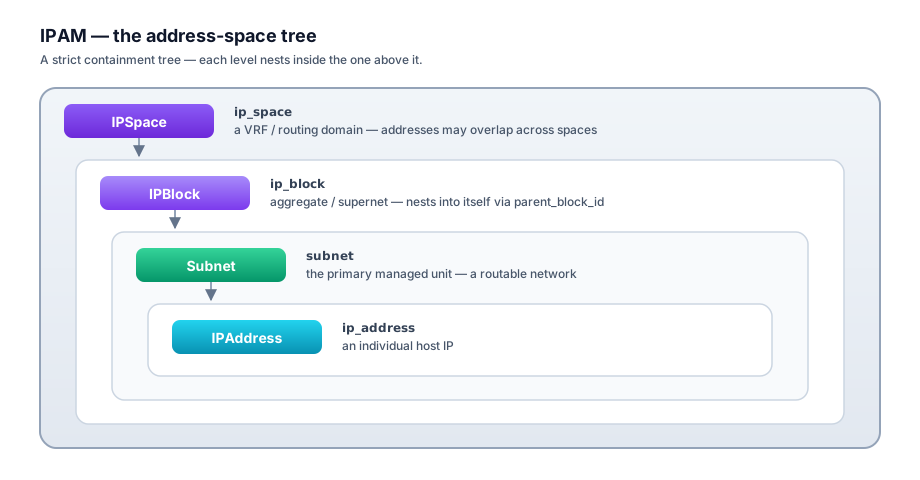
| Model | Table | Key FKs |
|---|---|---|
IPSpace |
ip_space |
optional vrf_id, asn_id, customer_id, dhcp_server_group_id (all SET NULL) |
IPBlock |
ip_block |
space_id (CASCADE), parent_block_id → self (CASCADE), optional vrf_id / asn_id / customer_id / site_id / ipam_template_id |
Subnet |
subnet |
space_id (RESTRICT), block_id (RESTRICT), router_zone_id / vlan_ref_id (SET NULL) |
IPAddress |
ip_address |
subnet_id (CASCADE); optional dns_zone_id / dns_record_id (SET NULL), nmap_scan_id |
Notes:
IPSpace.is_defaultflags a single “simplified deployment” space.- Block ↔ subnet overlap is enforced at the application layer using the
PostgreSQL
cidr &&operator (see IPAM.md);IPAddressis unique per(subnet_id, address). Subnet.kindis a discriminator:unicast(default) vsmulticast. IP-allocation endpoints refuse onmulticastsubnets — multicast stream identities are tracked byMulticastGroup, not per-endpointIPAddressrows.- The
RESTRICTonSubnet.space_id/block_idis intentional: you can’t delete a space or block out from under live subnets.
Supporting IPAM tables:
| Model | Table | Purpose |
|---|---|---|
RouterZone |
router_zone |
named L3 zone a subnet can sit in |
SubnetDomain |
subnet_domain |
many-to-many subnet ↔ DNS zone (subnet_id, dns_zone_id, both CASCADE) |
CustomFieldDefinition |
custom_field_definition |
per-resource-type custom field schema |
NATMapping |
nat_mapping |
inside ↔ outside IP/subnet mapping |
SubnetPlan |
subnet_plan |
saved multi-level CIDR design (planner workspace) |
IPAMTemplate |
ipam_template |
reusable stamp template with optional child layout |
SubnetUtilizationHistory |
subnet_utilization_history |
append-only per-subnet utilization samples |
IpMacHistory |
ip_mac_history |
observed IP ↔ MAC sightings (arpwatch-style) |
MACAllowlist |
mac_allowlist |
known-MAC allowlist for new-device detection |
VLAN / VXLAN
VLANs live under a Router (the L3 device that owns them), distinct
from the VLANMapping VLAN→VXLAN reference table:
| Model | Table | Key FKs / constraints |
|---|---|---|
Router |
router |
unique name; optional local_asn_id (SET NULL) |
VLAN |
vlan |
router_id (CASCADE); unique (router_id, vlan_id) and (router_id, name) |
VLANMapping |
vlan_mapping |
space_id (CASCADE); unique (space_id, vlan_id); optional vxlan_id |
Subnet.vlan_ref_id → VLAN ties a subnet to a defined VLAN.
Multicast
multicast.py adds MulticastDomain (PIM domain registry with
scope-boundary CIDRs + RP set), MulticastGroup (a group address /
stream identity), MulticastGroupPort, and MulticastMembership
(observed IGMP listeners).
3. DNS
File: dns.py. Feature spec:
DNS.md. Drivers:
DNS_DRIVERS.md.
The DNS hierarchy is group-centric — configuration lives on the group, servers are members, zones and records hang off the group:
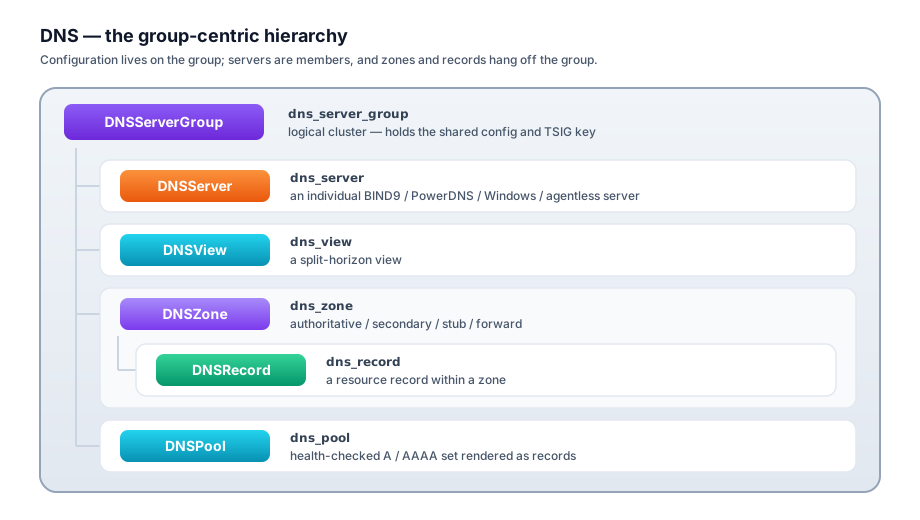
| Model | Table | Key FKs |
|---|---|---|
DNSServerGroup |
dns_server_group |
— (unique name); TSIG secret encrypted |
DNSServer |
dns_server |
group_id (CASCADE), optional appliance_id (CASCADE); api_key_encrypted, credentials_encrypted |
DNSView |
dns_view |
group_id (CASCADE); unique (group_id, name) |
DNSZone |
dns_zone |
group_id (CASCADE), optional view_id (SET NULL), subnet_id / domain_id / customer_id (SET NULL); unique (group_id, view_id, name) |
DNSRecord |
dns_record |
zone_id (CASCADE), optional view_id (SET NULL), ip_address_id (SET NULL), pool_member_id |
DNSPool |
dns_pool |
group_id + zone_id (CASCADE); unique (zone_id, record_name) |
DNSPoolMember |
dns_pool_member |
pool_id (CASCADE) |
DNSPool members render as ordinary DNSRecord rows with
pool_member_id set (one per healthy + enabled member), so the
underlying driver renders unchanged; a health-check task flips members in
and out of the rendered set.
Supporting / config tables:
| Model | Table | Notes |
|---|---|---|
DNSServerOptions |
dns_server_options |
group/server-level resolver + RRL tuning |
DNSServerZoneState |
dns_server_zone_state |
per-(server, zone) reported SOA serial → drift pill |
DNSServerRuntimeState |
dns_server_runtime_state |
latest agent-reported runtime status |
DNSRecordOp |
dns_record_op |
queued per-server record op (the propagation chokepoint) |
DNSAcl / DNSAclEntry |
dns_acl / dns_acl_entry |
named address-match lists |
DNSTSIGKey |
dns_tsig_key |
named operator-managed TSIG key (Fernet secret) |
DNSTrustAnchor |
dns_trust_anchor |
DNSSEC trust anchors |
DNSSECPolicy / DNSKey |
dnssec_policy / dnssec_key |
inline-signing policy + key material |
DNSBlockList |
dns_blocklist |
backend-neutral RPZ blocklist |
DNSBlockListEntry |
dns_blocklist_entry |
one blocked domain (blocklist_id CASCADE) |
DNSBlockListException |
dns_blocklist_exception |
passthru exception |
4. DHCP
File: dhcp.py. Feature spec:
DHCP.md. Drivers:
DHCP_DRIVERS.md.
Like DNS, DHCP is group-centric: scopes / pools / statics / classes live on the group, not on individual servers (a 2-member Kea group is an HA pair). Leases are per-server because each Kea instance owns its own memfile.
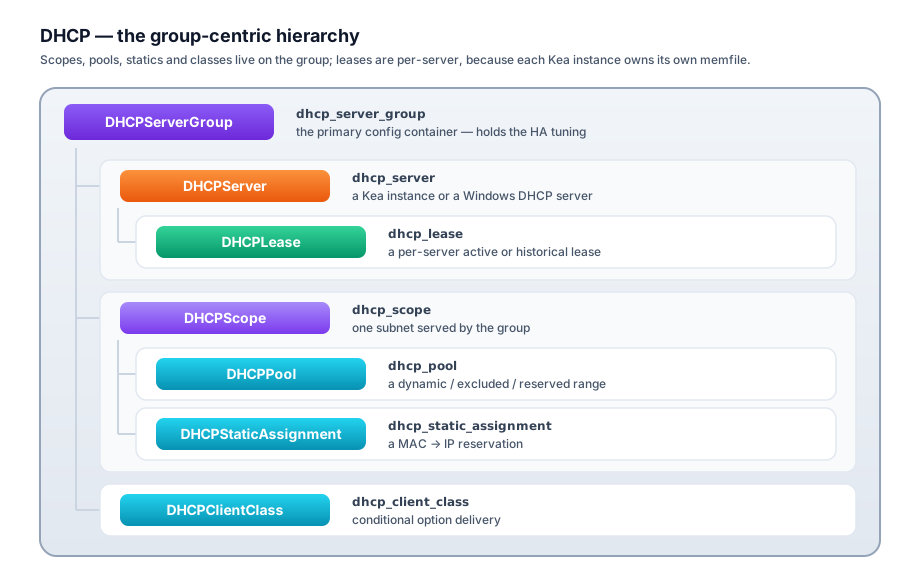
| Model | Table | Key FKs / constraints |
|---|---|---|
DHCPServerGroup |
dhcp_server_group |
unique name |
DHCPServer |
dhcp_server |
group_id (SET NULL), optional appliance_id (CASCADE); unique name; unique agent_id |
DHCPScope |
dhcp_scope |
group_id + subnet_id (CASCADE); unique (group_id, subnet_id); optional pxe_profile_id (SET NULL) |
DHCPPool |
dhcp_pool |
scope_id (CASCADE) |
DHCPStaticAssignment |
dhcp_static_assignment |
scope_id (CASCADE); unique (scope_id, mac_address) and (scope_id, ip_address) |
DHCPClientClass |
dhcp_client_class |
group_id (CASCADE); unique (group_id, name) |
DHCPLease |
dhcp_lease |
server_id (CASCADE), scope_id (SET NULL) |
Supporting tables:
| Model | Table | Purpose |
|---|---|---|
DHCPOptionTemplate |
dhcp_option_template |
named group-scoped reusable option set |
DHCPMACBlock |
dhcp_mac_block |
MAC blocklist |
DHCPLeaseHistory |
dhcp_lease_history |
append-only lease event history |
DHCPConfigOp (alias DHCPRecordOp) |
dhcp_config_op |
queued agent config / record ops (DHCPRecordOp is a Python alias of the same class) |
DHCPPXEProfile / DHCPPXEArchMatch |
dhcp_pxe_profile / dhcp_pxe_arch_match |
PXE / iPXE per-arch provisioning |
DHCPPhoneProfile / DHCPPhoneProfileScope |
dhcp_phone_profile / dhcp_phone_profile_scope |
VoIP phone option profiles |
DHCPObservedResponder / DHCPResponderAllowlist |
dhcp_observed_responder / dhcp_responder_allowlist |
rogue-DHCP detection |
DHCPFingerprint |
dhcp_fingerprint |
passive fingerprint records (dhcp_fingerprint.py) |
5. Network modeling
Logical ownership + WAN/service modeling overlaid on the IPAM/DNS/DHCP
core. Files:
asn.py,
vrf.py,
domain.py,
ownership.py,
circuit.py,
network_service.py,
overlay.py,
network.py,
bgp_looking_glass.py.
| Model | Table | Notes |
|---|---|---|
ASN |
asn |
BigInteger number (full 32-bit range); derived kind + registry |
ASNRpkiRoa |
asn_rpki_roa |
RPKI ROAs pulled per-ASN |
BGPPeering |
bgp_peering |
peer / customer / provider / sibling relationships |
BGPCommunity |
bgp_community |
well-known + per-AS community catalog |
LookingGlassCollector |
looking_glass_collector |
BGP Looking Glass — receive-only GoBGP collector daemon (#566); agent-registered like DNSServer; appliance_id (CASCADE) |
BGPLGPeer |
bgp_lg_peer |
configured receive-only BGP session; collector_id (CASCADE); Fernet TCP-MD5 (md5_password_encrypted); max_prefixes cap + collector-reported runtime state (session_state / down_since) |
BGPLGRoute |
bgp_lg_route |
learned Adj-RIB-In route; absence-reconcile sets withdrawn_at (never hard-delete); identity (peer, prefix, next_hop, route_distinguisher); matched_*_id IPAM/ASN/VRF links (SET NULL); rpki_status |
VRF |
vrf |
routing/forwarding domain; optional asn_id (SET NULL) |
Domain |
domain |
registered domain (registrar / expiry / NS / DNSSEC) — distinct from DNSZone |
Customer |
customer |
logical owner; soft-deletable |
Site |
site |
physical location; hierarchical via parent_site_id (SET NULL) |
Provider |
provider |
upstream/carrier org; optional default_asn_id (SET NULL) |
Circuit |
circuit |
carrier WAN circuit; soft-deletable (status='decom') |
NetworkService |
network_service |
per-customer deliverable; soft-deletable |
NetworkServiceResource |
network_service_resource |
polymorphic join service → (VRF/Subnet/IPBlock/DNSZone/DHCPScope/Circuit/Site/OverlayNetwork) |
OverlayNetwork |
overlay_network |
SD-WAN/IPsec/WireGuard/VXLAN overlay; soft-deletable |
OverlaySite |
overlay_site |
overlay ↔ site membership with role + preferred-circuit chain |
RoutingPolicy |
routing_policy |
overlay traffic policy |
ApplicationCategory |
application_category |
curated SaaS app catalog |
Cross-reference pattern: the ownership entities (Customer, Site,
Provider) and the modeling entities (VRF, ASN) are linked into the
IPAM/DNS/DHCP tables via nullable FKs with ON DELETE SET NULL (e.g.
IPSpace.customer_id, IPBlock.site_id, DNSZone.customer_id,
Subnet.site_id). Deleting an owner therefore detaches resources rather
than cascading their deletion.
NetworkServiceResource.resource_id is not a real FK — it’s a
polymorphic pointer (resource_kind + resource_id) validated at attach
time, with a service_resource_orphaned alert sweeping for stale rows
when a target is later deleted. The triple
(service_id, resource_kind, resource_id) is unique.
The network.py file holds discovery-side tables: NetworkDevice,
NetworkInterface, NetworkArpEntry, NetworkFdbEntry,
NetworkNeighbour (SNMP/ARP/FDB/LLDP poll results).
6. Auth + RBAC
File: auth.py,
auth_provider.py,
time_bound_grant.py.
Permission grammar: PERMISSIONS.md.
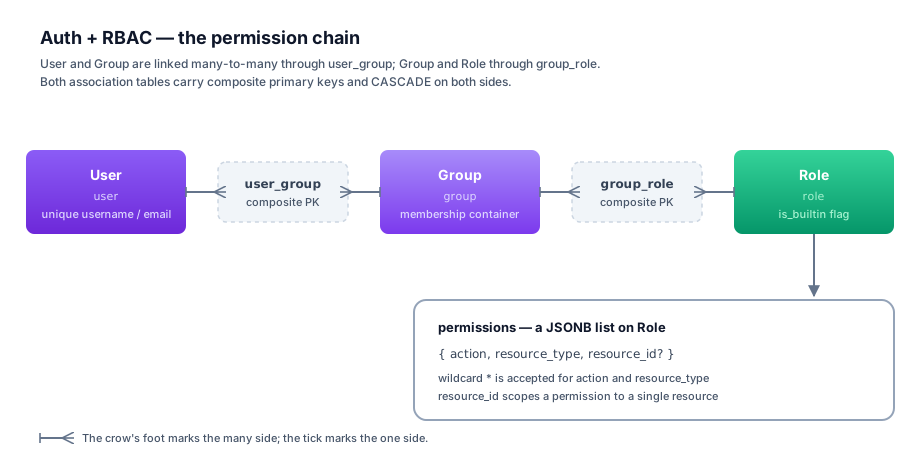
| Model | Table | Notes |
|---|---|---|
User |
user |
unique username / email; nullable hashed_password (external-auth users) |
Group |
group |
membership container |
Role |
role |
is_builtin flag; permissions JSONB ({action, resource_type, resource_id?}) |
APIToken |
api_token |
hashed token; scope, allowed_paths, coarse scopes; user_id (CASCADE), created_by_user_id (RESTRICT) |
UserSession |
user_session |
active session rows |
AuthProvider |
auth_provider |
LDAP / OIDC / SAML / RADIUS / TACACS+ config; secrets_encrypted |
AuthGroupMapping |
auth_group_mapping |
external-group → SpatiumDDI-group mapping |
TimeBoundGrant |
time_bound_grant |
temporary permission grant (issue #65) |
Association tables user_group and group_role are plain
Table(...) many-to-many links with composite PKs and CASCADE on both
sides. Permissions are stored as a JSONB list on Role rather than a
relational join — wildcard * for action and resource_type is
supported, and resource_id scopes a permission to one resource.
Role.is_builtin marks the seeded roles (Superadmin, Viewer, IPAM/DNS/
DHCP Editor, Auditor, Compliance Editor, Change Approver) that the
startup path keeps in sync.
7. Integration mirrors
Read-only pull reconcilers, each one a * endpoint/target row with
connection config + enabled + last_synced_at / last_sync_error,
and Fernet-encrypted credentials. The reconcilers stamp IPAddress (and
some IPBlock / Subnet) rows tagged with an integration-owned status
and an FK back to the source endpoint (ON DELETE CASCADE, so deleting
an endpoint cleans up its mirrored rows).
| Model | Table | Mirrors |
|---|---|---|
KubernetesCluster |
kubernetes_cluster |
nodes / services / LB IPs |
DockerHost |
docker_host |
container network IPs |
ProxmoxNode |
proxmox_node |
bridges / SDN VNets / guest IPs |
TailscaleTenant |
tailscale_tenant |
tailnet device IPs |
UnifiController |
unifi_controller |
UniFi networks + clients |
CloudEndpoint |
cloud_endpoint |
AWS / Azure / GCP instance / public / LB IPs |
OPNsenseRouter |
opnsense_router |
interface + DHCP + ARP-table state |
The reconciler FKs live on the IPAM rows: e.g.
IPAddress.kubernetes_cluster_id, docker_host_id, proxmox_node_id,
tailscale_tenant_id, unifi_controller_id, cloud_endpoint_id,
opnsense_router_id (all CASCADE), with parallel columns on IPBlock
and Subnet where the mirror creates structure.
The NetBox importer (models provenance columns, not a continuous
mirror) and the cloud DNS drivers are documented in
MIGRATION.md and
INTEGRATIONS.md.
8. Appliance + fleet
File: appliance.py. Deployment:
DNS_AGENT.md.
| Model | Table | Notes |
|---|---|---|
Appliance |
appliance |
one row per supervisor; public_key_fingerprint unique; pending_approval → approved / rejected; role_health JSONB; firewall_state JSONB ({} = healthy; set when the supervisor refuses a firewall drop-in that would partition a live etcd member — #593); cluster_join_state_at timestamp gating the clear-cluster-state escape hatch (#590) |
ApplianceCA |
appliance_ca |
internal CA (RSA root) for signing supervisor certs |
ApplianceCertificate |
appliance_certificate |
Web UI TLS cert storage + deploy state |
ApplianceUpgradeImage |
appliance_upgrade_image |
uploaded A/B slot image metadata |
PairingCode |
pairing_code |
single-use or persistent join code; stored sha256, cleartext shown once |
PairingClaim |
pairing_claim |
one row per (code, supervisor) successful claim |
DNSServer.appliance_id and DHCPServer.appliance_id (ON DELETE
CASCADE) tie managed service rows back to the supervisor that runs
them, so deleting an appliance cascades to the servers it hosted. The
pairing-code FK on Appliance is SET NULL so the code reaper can sweep
terminal codes without taking down the appliances they provisioned.
System-upgrade state lives in
system_upgrade.py
(SystemUpgradeRun, table system_upgrade_run).
9. Compliance + governance
Files: conformity.py,
alerts.py,
change_request.py.
| Model | Table | Notes |
|---|---|---|
ConformityPolicy |
conformity_policy |
declarative check + target_filter JSONB predicate |
ConformityResult |
conformity_result |
append-only; one row per (policy, resource) per pass; no modified_at |
AlertRule |
alert_rule |
operator-authored alert definition |
AlertEvent |
alert_event |
one firing per subject; open while condition matches, closed on a later clear |
ChangeRequest |
change_request |
risky operation queued for second-person approval (#62) and self-service provisioning requests (#696), discriminated by origin |
ApprovalPolicy |
approval_policy |
rule deciding whether an operation needs approval |
A ConformityPolicy pass→fail transition can emit an AlertEvent
against the policy’s wired AlertRule. The two-person-rule governance
flow (default-off governance.approvals module) gates the six delete
handlers through ChangeRequest + ApprovalPolicy.
change_request carries both governance flows, split by origin:
origin |
Surface | Direction | Approving… |
|---|---|---|---|
gate (default) |
/change-requests — #62 |
a permitted operator’s risky action is intercepted | unblocks the delete |
portal |
/requests — #696 |
a low-privilege user asks for something they cannot do | provisions the resource |
One table and one state machine on purpose: the lifecycle, the approver
checks (approver ≠ requester, approver holds the operation’s own
permission), the re-preview stale guard, the execution under the
approver’s identity, the audit rows and the expiry sweep are identical
for both. Only the direction of privilege differs. Every query on either
surface filters by origin, so neither queue ever renders the other’s
rows. justification is the requester’s free-text “why” and is NULL on
gate rows, which carry the policy-derived risk_reason instead.
10. Observability + audit
Files: audit.py,
logs.py,
metrics.py,
event_subscription.py,
audit_forward.py,
diagnostics.py. Spec:
OBSERVABILITY.md.
Audit log (append-only + hash chain)
AuditLog (table audit_log) is the append-only record of every
mutation. It is never deleted application-side, and a DB-level
trigger blocks DELETE as a second guard (issue #73).
Tamper-evidence is a hash chain: each row carries a monotonic
BigInteger seq (assigned from audit_log_seq_seq), a row_hash, and a
prev_hash pointing at the previous row’s hash. The hash is computed in
app.services.audit_chain via
a SQLAlchemy before_flush listener that takes a Postgres advisory lock
to serialize “look up previous row → hash → append”, so concurrent
inserts can’t interleave and break the chain. prev_hash is NULL only on
the first row. A nightly verify_chain task re-walks and validates it.
Each row records who (user_id, user_display_name, auth_source,
source_ip, user_agent), what (action, resource_type,
resource_id, resource_display), the state change
(old_value / new_value / changed_fields JSONB), correlation
(request_id), and the result (success / denied / error).
Log entries, metrics, events
| Model | Table | Notes |
|---|---|---|
DNSQueryLogEntry |
dns_query_log_entry |
parsed BIND9 query log lines (24h retention) |
DHCPLogEntry |
dhcp_log_entry |
parsed Kea kea-dhcp4.log lines |
DNSMetricSample |
dns_metric_sample |
composite PK (server_id, bucket_at); query/response counters |
DHCPMetricSample |
dhcp_metric_sample |
composite PK (server_id, bucket_at); DHCP message counters |
EventSubscription |
event_subscription |
one downstream webhook receiver (HMAC-signed) |
EventOutbox |
event_outbox |
one delivery attempt: pending / in-flight / delivered / failed / dead; subscription_id (CASCADE) |
AuditForwardTarget |
audit_forward_target |
SIEM / syslog forward destination |
InternalError |
internal_error |
captured unhandled exceptions for the diagnostics surface |
The log-entry and metric-sample tables are append-only operator-triage data (short retention) — longer history belongs in Loki / Prometheus per OBSERVABILITY.md, not these tables.
11. Platform + miscellaneous
| Model | Table | File | Purpose |
|---|---|---|---|
PlatformSettings |
platform_settings |
settings.py |
singleton global config (DNS auto-sync, SNMP, NTP, timezone, device profiling, …) |
FeatureModule |
feature_module |
feature_module.py |
togglable feature catalog; dotted-string PK |
BackupTarget |
backup_target |
backup.py |
remote backup destination config |
SavedView |
saved_view |
saved_view.py |
per-user saved list view |
AIProvider / AIChatSession / AIChatMessage |
ai.py |
Operator Copilot LLM provider + chat history | |
OUIVendor |
oui_vendor |
oui.py |
MAC OUI → vendor lookup table |
NmapScan / PacketCapture |
nmap.py / pcap.py |
on-demand scan / capture job rows | |
WolSchedule / WolRun / WolRunTarget |
wol_schedule / wol_run / wol_run_target |
wol_schedule.py |
Scheduled Wake-on-LAN (#586) — recurring cron/tag-targeted job + per-fire run history + per-host outcome. wol_schedule.verify_method picks the liveness source (ping / tcp / seen / auto, #596). wol_run.verify_params (JSONB, nullable) is the per-run verify+re-wake config snapshot for ad-hoc runs (schedule_id IS NULL, trigger='adhoc'), which have no parent schedule row to read it from; NULL on scheduled runs. wol_schedule.verify_alert_enabled mutes the wol_wake_failed alert per schedule; wol_run_target.verify_evidence (JSONB, nullable) is the ordered trail of every liveness source consulted on the final pass |
WolCalendar / WolCalendarEvent |
wol_calendar / wol_calendar_event |
wol_schedule.py |
subscribed iCal/CalDAV calendar (Fernet password) whose flattened all-day spans gate scheduled wakes |
TLSCertTarget / TLSCertProbe |
tls_cert.py |
cert-expiry monitoring targets + probe results | |
FirewallPolicy / FirewallRule / FirewallAlias / FirewallApplyState |
firewall.py |
per-appliance host firewall config | |
ACMEAccount |
acme.py |
ACME DNS-01 provider account | |
ACMEClientAccount / ACMEOrder / ACMEHTTPChallenge |
acme_client.py |
embedded ACME client (Let’s Encrypt Web UI cert) | |
AddressSet |
address_set.py |
named range within a subnet with its own RBAC scope (subnet_id CASCADE) |
A feature_module row defaults to enabled=true (server default) and is
seeded by Alembic alongside its feature’s model migration; the router
include and MCP tools gate on it.
See also
- IPAM.md — address-space management behaviour
- DNS.md — zones, records, views, pools, blocklists
- DHCP.md — scopes, pools, statics, leases, HA
- PERMISSIONS.md — the
{action, resource_type, resource_id?}grammar - OBSERVABILITY.md — audit chain, logging, metrics, alerting
backend/alembic/— the deployed schema, migration by migration